

372
Y. Kobayashi and H. Kobayashi
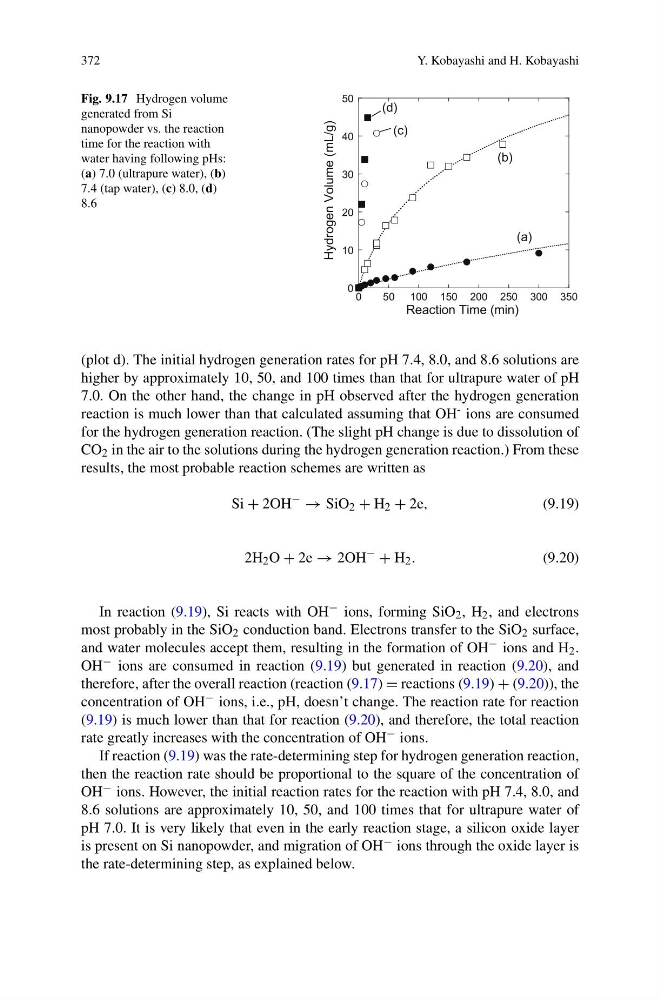
Fig. 9.17 Hydrogen volume
generated from Si
nanopowder vs. the reaction
time for the reaction with
water having following pHs:
(a) 7.0 (ultrapure water), (b)
7.4 (tap water), (c) 8.0, (d)
8.6
0
10
20
30
40
50
0
50 10 0 150 200 25 0 300 350
Hydrogen Volume (mL/g)
Reaction Time (min)
(a)
(b)
(d)
(c)
(plot d). The initial hydrogen generation rates for pH 7.4, 8.0, and 8.6 solutions are
higher by approximately 10, 50, and 100 times than that for ultrapure water of pH
7.0. On the other hand, the change in pH observed after the hydrogen generation
reaction is much lower than that calculated assuming that OH - ions are consumed
for the hydrogen generation reaction. (The slight pH change is due to dissolution of
CO 2 in the air to the solutions during the hydrogen generation reaction.) From these
results, the most probable reaction schemes are written as
Si + 2OH
−
→ SiO 2 + H 2 + 2e,
(9.19)
2H 2 O + 2e → 2OH
−
+ H 2 .
(9.20)
In reaction (9.19), Si reacts with OH − ions, forming SiO 2 , H 2 , and electrons
most probably in the SiO 2 conduction band. Electrons transfer to the SiO 2 surface,
and water molecules accept them, resulting in the formation of OH − ions and H 2 .
OH − ions are consumed in reaction (9.19) but generated in reaction (9.20), and
therefore, after the overall reaction (reaction (9.17) = reactions (9.19) + (9.20)), the
concentration of OH − ions, i.e., pH, doesn’t change. The reaction rate for reaction
(9.19) is much lower than that for reaction (9.20), and therefore, the total reaction
rate greatly increases with the concentration of OH − ions.
If reaction (9.19) was the rate-determining step for hydrogen generation reaction,
then the reaction rate should be proportional to the square of the concentration of
OH − ions. However, the initial reaction rates for the reaction with pH 7.4, 8.0, and
8.6 solutions are approximately 10, 50, and 100 times that for ultrapure water of
pH 7.0. It is very likely that even in the early reaction stage, a silicon oxide layer
is present on Si nanopowder, and migration of OH − ions through the oxide layer is
the rate-determining step, as explained below.
Y. Kobayashi and H. Kobayashi
Fig. 9.17 Hydrogen volume
generated from Si
nanopowder vs. the reaction
time for the reaction with
water having following pHs:
(a) 7.0 (ultrapure water), (b)
7.4 (tap water), (c) 8.0, (d)
8.6
0
10
20
30
40
50
0
50 10 0 150 200 25 0 300 350
Hydrogen Volume (mL/g)
Reaction Time (min)
(a)
(b)
(d)
(c)
(plot d). The initial hydrogen generation rates for pH 7.4, 8.0, and 8.6 solutions are
higher by approximately 10, 50, and 100 times than that for ultrapure water of pH
7.0. On the other hand, the change in pH observed after the hydrogen generation
reaction is much lower than that calculated assuming that OH - ions are consumed
for the hydrogen generation reaction. (The slight pH change is due to dissolution of
CO 2 in the air to the solutions during the hydrogen generation reaction.) From these
results, the most probable reaction schemes are written as
Si + 2OH
−
→ SiO 2 + H 2 + 2e,
(9.19)
2H 2 O + 2e → 2OH
−
+ H 2 .
(9.20)
In reaction (9.19), Si reacts with OH − ions, forming SiO 2 , H 2 , and electrons
most probably in the SiO 2 conduction band. Electrons transfer to the SiO 2 surface,
and water molecules accept them, resulting in the formation of OH − ions and H 2 .
OH − ions are consumed in reaction (9.19) but generated in reaction (9.20), and
therefore, after the overall reaction (reaction (9.17) = reactions (9.19) + (9.20)), the
concentration of OH − ions, i.e., pH, doesn’t change. The reaction rate for reaction
(9.19) is much lower than that for reaction (9.20), and therefore, the total reaction
rate greatly increases with the concentration of OH − ions.
If reaction (9.19) was the rate-determining step for hydrogen generation reaction,
then the reaction rate should be proportional to the square of the concentration of
OH − ions. However, the initial reaction rates for the reaction with pH 7.4, 8.0, and
8.6 solutions are approximately 10, 50, and 100 times that for ultrapure water of
pH 7.0. It is very likely that even in the early reaction stage, a silicon oxide layer
is present on Si nanopowder, and migration of OH − ions through the oxide layer is
the rate-determining step, as explained below.