

360
Y. Kobayashi and H. Kobayashi
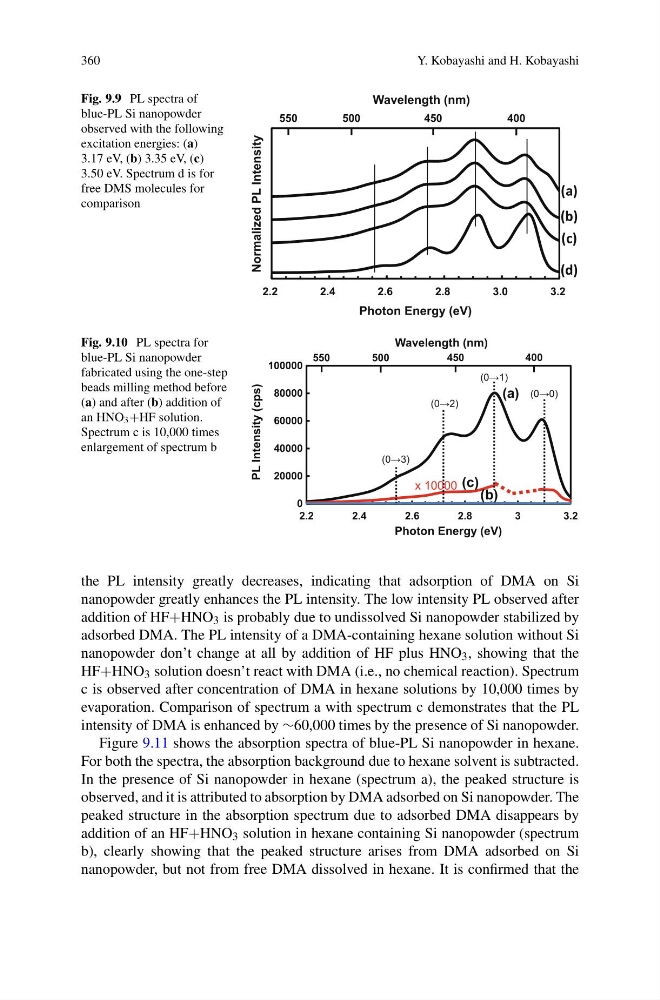
Fig. 9.9 PL spectra of
blue-PL Si nanopowder
observed with the following
excitation energies: (a)
3.17 eV, (b) 3.35 eV, (c)
3.50 eV. Spectrum d is for
free DMS molecules for
comparison
2.2
2.4
2.6
2.8
3.0
3.2
Normalized PL Intensity
Photon Energy (eV)
400
500
450
550
Wavelength (nm)
(c)
(b)
(a)
(d)
Fig. 9.10 PL spectra for
blue-PL Si nanopowder
fabricated using the one-step
beads milling method before
(a) and after (b) addition of
an HNO 3 +HF solution.
Spectrum c is 10,000 times
enlargement of spectrum b
0
20000
40000
60000
80000
100000
2.2
2.4
2.6
2.8
3
3.2
PL Intensity (cps)
Photon Energy (eV)
400
500
450
550
Wavelength (nm)
(a)
(0→1)
(0→0)
(0→2)
(0→3)
x 10000
(b)
(c)
the PL intensity greatly decreases, indicating that adsorption of DMA on Si
nanopowder greatly enhances the PL intensity. The low intensity PL observed after
addition of HF+HNO 3 is probably due to undissolved Si nanopowder stabilized by
adsorbed DMA. The PL intensity of a DMA-containing hexane solution without Si
nanopowder don’t change at all by addition of HF plus HNO 3 , showing that the
HF+HNO 3 solution doesn’t react with DMA (i.e., no chemical reaction). Spectrum
c is observed after concentration of DMA in hexane solutions by 10,000 times by
evaporation. Comparison of spectrum a with spectrum c demonstrates that the PL
intensity of DMA is enhanced by ∼60,000 times by the presence of Si nanopowder.
Figure 9.11 shows the absorption spectra of blue-PL Si nanopowder in hexane.
For both the spectra, the absorption background due to hexane solvent is subtracted.
In the presence of Si nanopowder in hexane (spectrum a), the peaked structure is
observed, and it is attributed to absorption by DMA adsorbed on Si nanopowder. The
peaked structure in the absorption spectrum due to adsorbed DMA disappears by
addition of an HF+HNO 3 solution in hexane containing Si nanopowder (spectrum
b), clearly showing that the peaked structure arises from DMA adsorbed on Si
nanopowder, but not from free DMA dissolved in hexane. It is confirmed that the
Y. Kobayashi and H. Kobayashi
Fig. 9.9 PL spectra of
blue-PL Si nanopowder
observed with the following
excitation energies: (a)
3.17 eV, (b) 3.35 eV, (c)
3.50 eV. Spectrum d is for
free DMS molecules for
comparison
2.2
2.4
2.6
2.8
3.0
3.2
Normalized PL Intensity
Photon Energy (eV)
400
500
450
550
Wavelength (nm)
(c)
(b)
(a)
(d)
Fig. 9.10 PL spectra for
blue-PL Si nanopowder
fabricated using the one-step
beads milling method before
(a) and after (b) addition of
an HNO 3 +HF solution.
Spectrum c is 10,000 times
enlargement of spectrum b
0
20000
40000
60000
80000
100000
2.2
2.4
2.6
2.8
3
3.2
PL Intensity (cps)
Photon Energy (eV)
400
500
450
550
Wavelength (nm)
(a)
(0→1)
(0→0)
(0→2)
(0→3)
x 10000
(b)
(c)
the PL intensity greatly decreases, indicating that adsorption of DMA on Si
nanopowder greatly enhances the PL intensity. The low intensity PL observed after
addition of HF+HNO 3 is probably due to undissolved Si nanopowder stabilized by
adsorbed DMA. The PL intensity of a DMA-containing hexane solution without Si
nanopowder don’t change at all by addition of HF plus HNO 3 , showing that the
HF+HNO 3 solution doesn’t react with DMA (i.e., no chemical reaction). Spectrum
c is observed after concentration of DMA in hexane solutions by 10,000 times by
evaporation. Comparison of spectrum a with spectrum c demonstrates that the PL
intensity of DMA is enhanced by ∼60,000 times by the presence of Si nanopowder.
Figure 9.11 shows the absorption spectra of blue-PL Si nanopowder in hexane.
For both the spectra, the absorption background due to hexane solvent is subtracted.
In the presence of Si nanopowder in hexane (spectrum a), the peaked structure is
observed, and it is attributed to absorption by DMA adsorbed on Si nanopowder. The
peaked structure in the absorption spectrum due to adsorbed DMA disappears by
addition of an HF+HNO 3 solution in hexane containing Si nanopowder (spectrum
b), clearly showing that the peaked structure arises from DMA adsorbed on Si
nanopowder, but not from free DMA dissolved in hexane. It is confirmed that the