

20
T. Onishi
Liquid Organic Electrolyte
Negative
Electrode
Liquid Organic Electrolyte
Negative
Electrode
Lithium Metal
Formation
(a)
(b)
Inserted Lithium Ion
Energy Barrier
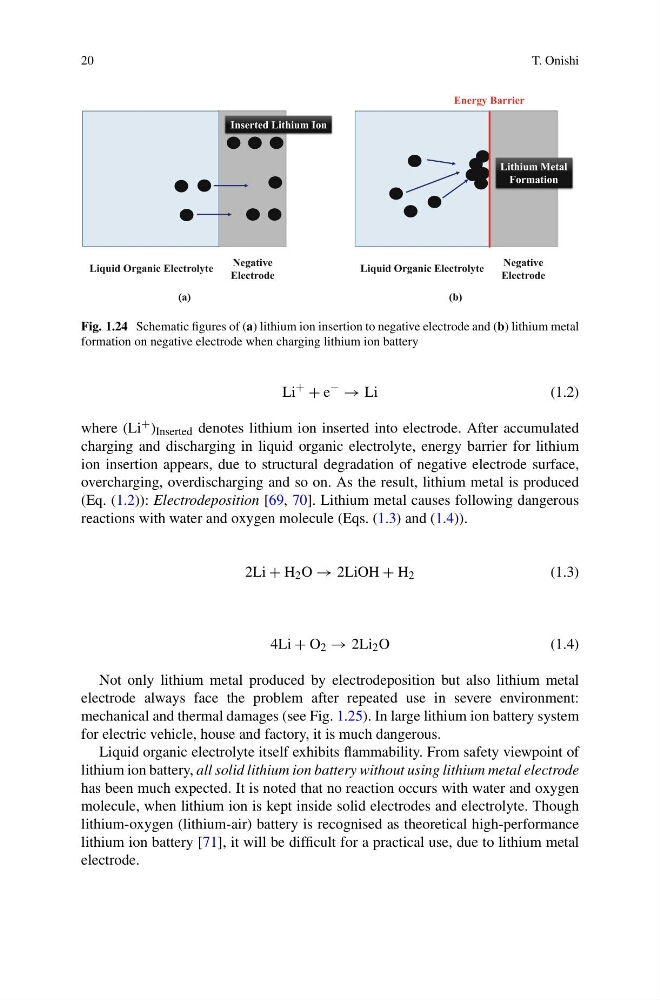
Fig. 1.24 Schematic figures of (a) lithium ion insertion to negative electrode and (b) lithium metal
formation on negative electrode when charging lithium ion battery
Li
+
+ e
−
→ Li
(1.2)
where (Li + ) Inserted denotes lithium ion inserted into electrode. After accumulated
charging and discharging in liquid organic electrolyte, energy barrier for lithium
ion insertion appears, due to structural degradation of negative electrode surface,
overcharging, overdischarging and so on. As the result, lithium metal is produced
(Eq. (1.2)): Electrodeposition [69, 70]. Lithium metal causes following dangerous
reactions with water and oxygen molecule (Eqs. (1.3) and (1.4)).
2Li + H 2 O → 2LiOH + H 2
(1.3)
4Li + O 2 → 2Li 2 O
(1.4)
Not only lithium metal produced by electrodeposition but also lithium metal
electrode always face the problem after repeated use in severe environment:
mechanical and thermal damages (see Fig. 1.25). In large lithium ion battery system
for electric vehicle, house and factory, it is much dangerous.
Liquid organic electrolyte itself exhibits flammability. From safety viewpoint of
lithium ion battery, all solid lithium ion battery without using lithium metal electrode
has been much expected. It is noted that no reaction occurs with water and oxygen
molecule, when lithium ion is kept inside solid electrodes and electrolyte. Though
lithium-oxygen (lithium-air) battery is recognised as theoretical high-performance
lithium ion battery [71], it will be difficult for a practical use, due to lithium metal
electrode.
T. Onishi
Liquid Organic Electrolyte
Negative
Electrode
Liquid Organic Electrolyte
Negative
Electrode
Lithium Metal
Formation
(a)
(b)
Inserted Lithium Ion
Energy Barrier
Fig. 1.24 Schematic figures of (a) lithium ion insertion to negative electrode and (b) lithium metal
formation on negative electrode when charging lithium ion battery
Li
+
+ e
−
→ Li
(1.2)
where (Li + ) Inserted denotes lithium ion inserted into electrode. After accumulated
charging and discharging in liquid organic electrolyte, energy barrier for lithium
ion insertion appears, due to structural degradation of negative electrode surface,
overcharging, overdischarging and so on. As the result, lithium metal is produced
(Eq. (1.2)): Electrodeposition [69, 70]. Lithium metal causes following dangerous
reactions with water and oxygen molecule (Eqs. (1.3) and (1.4)).
2Li + H 2 O → 2LiOH + H 2
(1.3)
4Li + O 2 → 2Li 2 O
(1.4)
Not only lithium metal produced by electrodeposition but also lithium metal
electrode always face the problem after repeated use in severe environment:
mechanical and thermal damages (see Fig. 1.25). In large lithium ion battery system
for electric vehicle, house and factory, it is much dangerous.
Liquid organic electrolyte itself exhibits flammability. From safety viewpoint of
lithium ion battery, all solid lithium ion battery without using lithium metal electrode
has been much expected. It is noted that no reaction occurs with water and oxygen
molecule, when lithium ion is kept inside solid electrodes and electrolyte. Though
lithium-oxygen (lithium-air) battery is recognised as theoretical high-performance
lithium ion battery [71], it will be difficult for a practical use, due to lithium metal
electrode.