

1 Theoretical Chemistry for Advanced Nanomaterials: Computational. . .
21
Repeated Use in
Severe Environment
(Vehicle, House, Factory)
Mechanical Damage
Thermal Damage
Reaction of Lithium Metal
with H 2 O and O 2
Lithium Metal
Lithium Ion Battery
Liquid
Organic
Electrolyte
Flammability of Liquid Organic Electrolyte
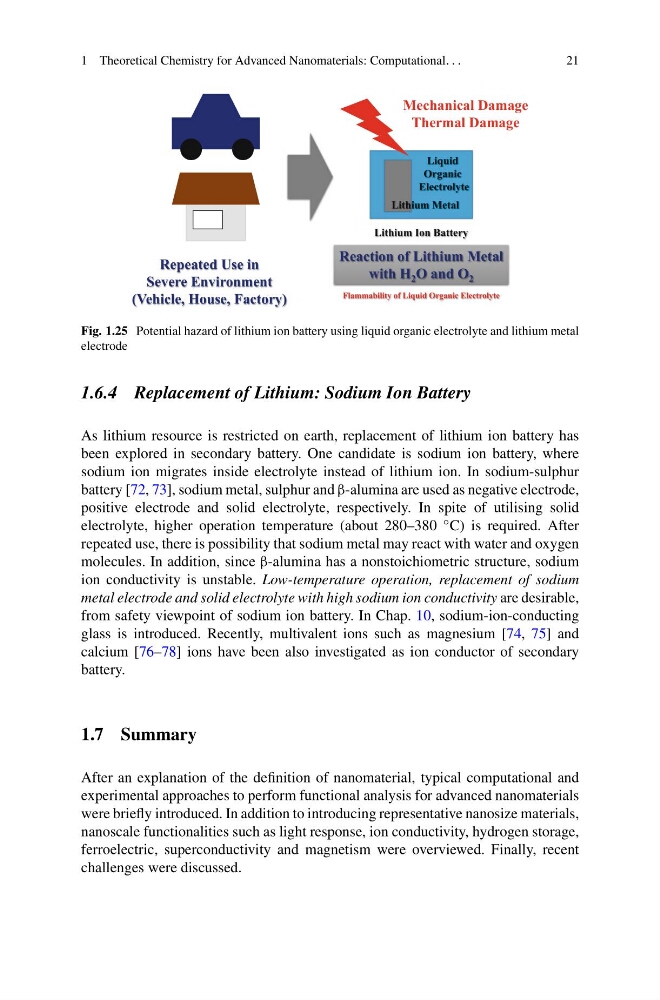
Fig. 1.25 Potential hazard of lithium ion battery using liquid organic electrolyte and lithium metal
electrode
1.6.4 Replacement of Lithium: Sodium Ion Battery
As lithium resource is restricted on earth, replacement of lithium ion battery has
been explored in secondary battery. One candidate is sodium ion battery, where
sodium ion migrates inside electrolyte instead of lithium ion. In sodium-sulphur
battery [72, 73], sodium metal, sulphur and β-alumina are used as negative electrode,
positive electrode and solid electrolyte, respectively. In spite of utilising solid
electrolyte, higher operation temperature (about 280–380 ◦ C) is required. After
repeated use, there is possibility that sodium metal may react with water and oxygen
molecules. In addition, since β-alumina has a nonstoichiometric structure, sodium
ion conductivity is unstable. Low-temperature operation, replacement of sodium
metal electrode and solid electrolyte with high sodium ion conductivity are desirable,
from safety viewpoint of sodium ion battery. In Chap. 10, sodium-ion-conducting
glass is introduced. Recently, multivalent ions such as magnesium [74, 75] and
calcium [76–78] ions have been also investigated as ion conductor of secondary
battery.
1.7 Summary
After an explanation of the definition of nanomaterial, typical computational and
experimental approaches to perform functional analysis for advanced nanomaterials
were briefly introduced. In addition to introducing representative nanosize materials,
nanoscale functionalities such as light response, ion conductivity, hydrogen storage,
ferroelectric, superconductivity and magnetism were overviewed. Finally, recent
challenges were discussed.
21
Repeated Use in
Severe Environment
(Vehicle, House, Factory)
Mechanical Damage
Thermal Damage
Reaction of Lithium Metal
with H 2 O and O 2
Lithium Metal
Lithium Ion Battery
Liquid
Organic
Electrolyte
Flammability of Liquid Organic Electrolyte
Fig. 1.25 Potential hazard of lithium ion battery using liquid organic electrolyte and lithium metal
electrode
1.6.4 Replacement of Lithium: Sodium Ion Battery
As lithium resource is restricted on earth, replacement of lithium ion battery has
been explored in secondary battery. One candidate is sodium ion battery, where
sodium ion migrates inside electrolyte instead of lithium ion. In sodium-sulphur
battery [72, 73], sodium metal, sulphur and β-alumina are used as negative electrode,
positive electrode and solid electrolyte, respectively. In spite of utilising solid
electrolyte, higher operation temperature (about 280–380 ◦ C) is required. After
repeated use, there is possibility that sodium metal may react with water and oxygen
molecules. In addition, since β-alumina has a nonstoichiometric structure, sodium
ion conductivity is unstable. Low-temperature operation, replacement of sodium
metal electrode and solid electrolyte with high sodium ion conductivity are desirable,
from safety viewpoint of sodium ion battery. In Chap. 10, sodium-ion-conducting
glass is introduced. Recently, multivalent ions such as magnesium [74, 75] and
calcium [76–78] ions have been also investigated as ion conductor of secondary
battery.
1.7 Summary
After an explanation of the definition of nanomaterial, typical computational and
experimental approaches to perform functional analysis for advanced nanomaterials
were briefly introduced. In addition to introducing representative nanosize materials,
nanoscale functionalities such as light response, ion conductivity, hydrogen storage,
ferroelectric, superconductivity and magnetism were overviewed. Finally, recent
challenges were discussed.