

8 Electronic Properties of Transition Metal-Benzene Sandwich Clusters
337
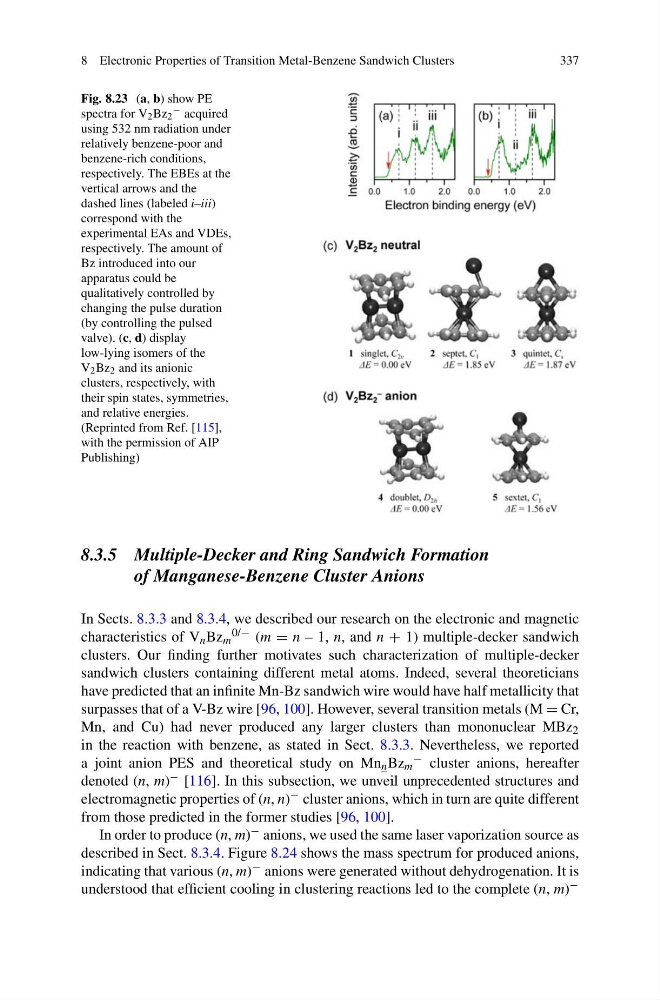
Fig. 8.23 (a, b) show PE
spectra for V 2 Bz 2
− acquired
using 532 nm radiation under
relatively benzene-poor and
benzene-rich conditions,
respectively. The EBEs at the
vertical arrows and the
dashed lines (labeled i–iii)
correspond with the
experimental EAs and VDEs,
respectively. The amount of
Bz introduced into our
apparatus could be
qualitatively controlled by
changing the pulse duration
(by controlling the pulsed
valve). (c, d) display
low-lying isomers of the
V 2 Bz 2 and its anionic
clusters, respectively, with
their spin states, symmetries,
and relative energies.
(Reprinted from Ref. [115],
with the permission of AIP
Publishing)
8.3.5 Multiple-Decker and Ring Sandwich Formation
of Manganese-Benzene Cluster Anions
In Sects. 8.3.3 and 8.3.4, we described our research on the electronic and magnetic
characteristics of V n Bz m
0/− (m = n – 1, n, and n + 1) multiple-decker sandwich
clusters. Our finding further motivates such characterization of multiple-decker
sandwich clusters containing different metal atoms. Indeed, several theoreticians
have predicted that an infinite Mn-Bz sandwich wire would have half metallicity that
surpasses that of a V-Bz wire [96, 100]. However, several transition metals (M = Cr,
Mn, and Cu) had never produced any larger clusters than mononuclear MBz 2
in the reaction with benzene, as stated in Sect. 8.3.3. Nevertheless, we reported
a joint anion PES and theoretical study on Mn n Bz m
− cluster anions, hereafter
denoted (n, m) − [116]. In this subsection, we unveil unprecedented structures and
electromagnetic properties of (n, n) − cluster anions, which in turn are quite different
from those predicted in the former studies [96, 100].
In order to produce (n, m) − anions, we used the same laser vaporization source as
described in Sect. 8.3.4. Figure 8.24 shows the mass spectrum for produced anions,
indicating that various (n, m) − anions were generated without dehydrogenation. It is
understood that efficient cooling in clustering reactions led to the complete (n, m) −
337
Fig. 8.23 (a, b) show PE
spectra for V 2 Bz 2
− acquired
using 532 nm radiation under
relatively benzene-poor and
benzene-rich conditions,
respectively. The EBEs at the
vertical arrows and the
dashed lines (labeled i–iii)
correspond with the
experimental EAs and VDEs,
respectively. The amount of
Bz introduced into our
apparatus could be
qualitatively controlled by
changing the pulse duration
(by controlling the pulsed
valve). (c, d) display
low-lying isomers of the
V 2 Bz 2 and its anionic
clusters, respectively, with
their spin states, symmetries,
and relative energies.
(Reprinted from Ref. [115],
with the permission of AIP
Publishing)
8.3.5 Multiple-Decker and Ring Sandwich Formation
of Manganese-Benzene Cluster Anions
In Sects. 8.3.3 and 8.3.4, we described our research on the electronic and magnetic
characteristics of V n Bz m
0/− (m = n – 1, n, and n + 1) multiple-decker sandwich
clusters. Our finding further motivates such characterization of multiple-decker
sandwich clusters containing different metal atoms. Indeed, several theoreticians
have predicted that an infinite Mn-Bz sandwich wire would have half metallicity that
surpasses that of a V-Bz wire [96, 100]. However, several transition metals (M = Cr,
Mn, and Cu) had never produced any larger clusters than mononuclear MBz 2
in the reaction with benzene, as stated in Sect. 8.3.3. Nevertheless, we reported
a joint anion PES and theoretical study on Mn n Bz m
− cluster anions, hereafter
denoted (n, m) − [116]. In this subsection, we unveil unprecedented structures and
electromagnetic properties of (n, n) − cluster anions, which in turn are quite different
from those predicted in the former studies [96, 100].
In order to produce (n, m) − anions, we used the same laser vaporization source as
described in Sect. 8.3.4. Figure 8.24 shows the mass spectrum for produced anions,
indicating that various (n, m) − anions were generated without dehydrogenation. It is
understood that efficient cooling in clustering reactions led to the complete (n, m) −