

336
T. Masubuchi and A. Nakajima
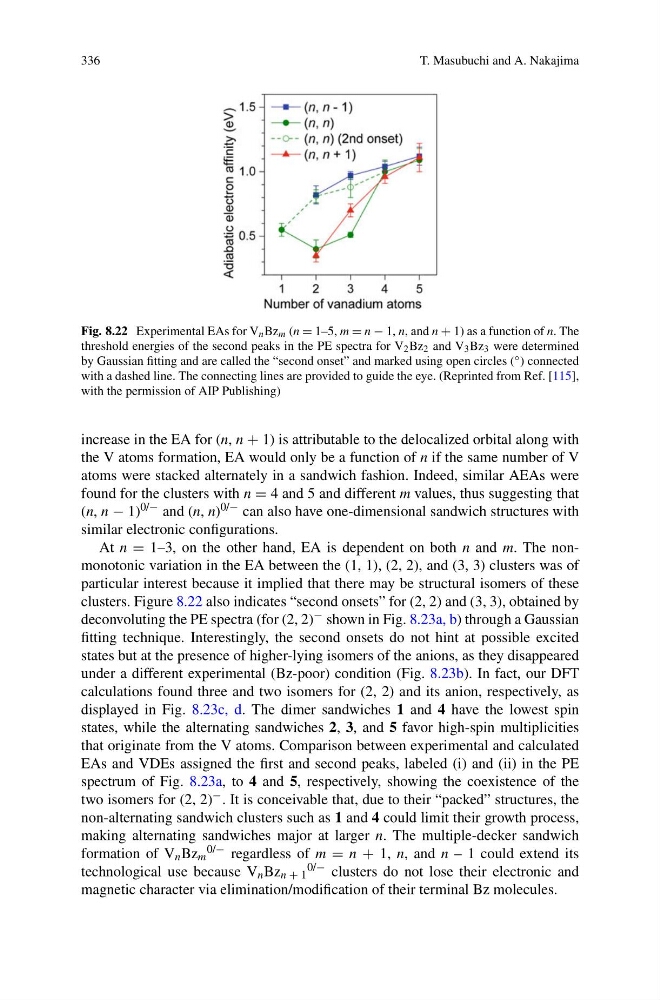
Fig. 8.22 Experimental EAs for V n Bz m (n = 1–5, m = n − 1, n, and n + 1) as a function of n. The
threshold energies of the second peaks in the PE spectra for V 2 Bz 2 and V 3 Bz 3 were determined
by Gaussian fitting and are called the “second onset” and marked using open circles ( ◦ ) connected
with a dashed line. The connecting lines are provided to guide the eye. (Reprinted from Ref. [115],
with the permission of AIP Publishing)
increase in the EA for (n, n + 1) is attributable to the delocalized orbital along with
the V atoms formation, EA would only be a function of n if the same number of V
atoms were stacked alternately in a sandwich fashion. Indeed, similar AEAs were
found for the clusters with n = 4 and 5 and different m values, thus suggesting that
(n, n − 1) 0/− and (n, n) 0/− can also have one-dimensional sandwich structures with
similar electronic configurations.
At n = 1–3, on the other hand, EA is dependent on both n and m. The nonmonotonic variation in the EA between the (1, 1), (2, 2), and (3, 3) clusters was of
particular interest because it implied that there may be structural isomers of these
clusters. Figure 8.22 also indicates “second onsets” for (2, 2) and (3, 3), obtained by
deconvoluting the PE spectra (for (2, 2) − shown in Fig. 8.23a, b) through a Gaussian
fitting technique. Interestingly, the second onsets do not hint at possible excited
states but at the presence of higher-lying isomers of the anions, as they disappeared
under a different experimental (Bz-poor) condition (Fig. 8.23b). In fact, our DFT
calculations found three and two isomers for (2, 2) and its anion, respectively, as
displayed in Fig. 8.23c, d. The dimer sandwiches 1 and 4 have the lowest spin
states, while the alternating sandwiches 2, 3, and 5 favor high-spin multiplicities
that originate from the V atoms. Comparison between experimental and calculated
EAs and VDEs assigned the first and second peaks, labeled (i) and (ii) in the PE
spectrum of Fig. 8.23a, to 4 and 5, respectively, showing the coexistence of the
two isomers for (2, 2) − . It is conceivable that, due to their “packed” structures, the
non-alternating sandwich clusters such as 1 and 4 could limit their growth process,
making alternating sandwiches major at larger n. The multiple-decker sandwich
formation of V n Bz m
0/− regardless of m = n + 1, n, and n – 1 could extend its
technological use because V n Bz n + 1
0/− clusters do not lose their electronic and
magnetic character via elimination/modification of their terminal Bz molecules.
T. Masubuchi and A. Nakajima
Fig. 8.22 Experimental EAs for V n Bz m (n = 1–5, m = n − 1, n, and n + 1) as a function of n. The
threshold energies of the second peaks in the PE spectra for V 2 Bz 2 and V 3 Bz 3 were determined
by Gaussian fitting and are called the “second onset” and marked using open circles ( ◦ ) connected
with a dashed line. The connecting lines are provided to guide the eye. (Reprinted from Ref. [115],
with the permission of AIP Publishing)
increase in the EA for (n, n + 1) is attributable to the delocalized orbital along with
the V atoms formation, EA would only be a function of n if the same number of V
atoms were stacked alternately in a sandwich fashion. Indeed, similar AEAs were
found for the clusters with n = 4 and 5 and different m values, thus suggesting that
(n, n − 1) 0/− and (n, n) 0/− can also have one-dimensional sandwich structures with
similar electronic configurations.
At n = 1–3, on the other hand, EA is dependent on both n and m. The nonmonotonic variation in the EA between the (1, 1), (2, 2), and (3, 3) clusters was of
particular interest because it implied that there may be structural isomers of these
clusters. Figure 8.22 also indicates “second onsets” for (2, 2) and (3, 3), obtained by
deconvoluting the PE spectra (for (2, 2) − shown in Fig. 8.23a, b) through a Gaussian
fitting technique. Interestingly, the second onsets do not hint at possible excited
states but at the presence of higher-lying isomers of the anions, as they disappeared
under a different experimental (Bz-poor) condition (Fig. 8.23b). In fact, our DFT
calculations found three and two isomers for (2, 2) and its anion, respectively, as
displayed in Fig. 8.23c, d. The dimer sandwiches 1 and 4 have the lowest spin
states, while the alternating sandwiches 2, 3, and 5 favor high-spin multiplicities
that originate from the V atoms. Comparison between experimental and calculated
EAs and VDEs assigned the first and second peaks, labeled (i) and (ii) in the PE
spectrum of Fig. 8.23a, to 4 and 5, respectively, showing the coexistence of the
two isomers for (2, 2) − . It is conceivable that, due to their “packed” structures, the
non-alternating sandwich clusters such as 1 and 4 could limit their growth process,
making alternating sandwiches major at larger n. The multiple-decker sandwich
formation of V n Bz m
0/− regardless of m = n + 1, n, and n – 1 could extend its
technological use because V n Bz n + 1
0/− clusters do not lose their electronic and
magnetic character via elimination/modification of their terminal Bz molecules.