

338
T. Masubuchi and A. Nakajima
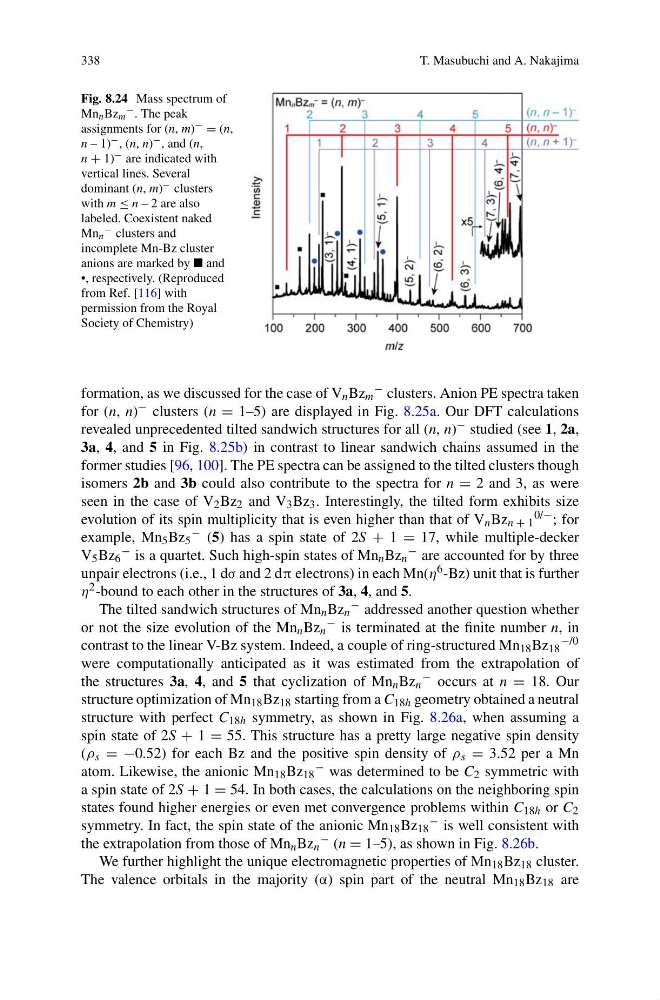
Fig. 8.24 Mass spectrum of
Mn n Bz m
− . The peak
assignments for (n, m) − = (n,
n – 1) − , (n, n) − , and (n,
n + 1) − are indicated with
vertical lines. Several
dominant (n, m) − clusters
with m ≤ n – 2 are also
labeled. Coexistent naked
Mn n
− clusters and
incomplete Mn-Bz cluster
anions are marked by and
•, respectively. (Reproduced
from Ref. [116] with
permission from the Royal
Society of Chemistry)
formation, as we discussed for the case of V n Bz m
− clusters. Anion PE spectra taken
for (n, n) − clusters (n = 1–5) are displayed in Fig. 8.25a. Our DFT calculations
revealed unprecedented tilted sandwich structures for all (n, n) − studied (see 1, 2a,
3a, 4, and 5 in Fig. 8.25b) in contrast to linear sandwich chains assumed in the
former studies [96, 100]. The PE spectra can be assigned to the tilted clusters though
isomers 2b and 3b could also contribute to the spectra for n = 2 and 3, as were
seen in the case of V 2 Bz 2 and V 3 Bz 3 . Interestingly, the tilted form exhibits size
evolution of its spin multiplicity that is even higher than that of V n Bz n + 1
0/− ; for
example, Mn 5 Bz 5
− (5) has a spin state of 2S + 1 = 17, while multiple-decker
V 5 Bz 6
− is a quartet. Such high-spin states of Mn n Bz n
− are accounted for by three
unpair electrons (i.e., 1 dσ and 2 dπ electrons) in each Mn(η 6 -Bz) unit that is further
η 2 -bound to each other in the structures of 3a, 4, and 5.
The tilted sandwich structures of Mn n Bz n
− addressed another question whether
or not the size evolution of the Mn n Bz n
− is terminated at the finite number n, in
contrast to the linear V-Bz system. Indeed, a couple of ring-structured Mn 18 Bz 18
−/0
were computationally anticipated as it was estimated from the extrapolation of
the structures 3a, 4, and 5 that cyclization of Mn n Bz n
− occurs at n = 18. Our
structure optimization of Mn 18 Bz 18 starting from a C 18h geometry obtained a neutral
structure with perfect C 18h symmetry, as shown in Fig. 8.26a, when assuming a
spin state of 2S + 1 = 55. This structure has a pretty large negative spin density
(ρ s = −0.52) for each Bz and the positive spin density of ρ s = 3.52 per a Mn
atom. Likewise, the anionic Mn 18 Bz 18
− was determined to be C 2 symmetric with
a spin state of 2S + 1 = 54. In both cases, the calculations on the neighboring spin
states found higher energies or even met convergence problems within C 18h or C 2
symmetry. In fact, the spin state of the anionic Mn 18 Bz 18
− is well consistent with
the extrapolation from those of Mn n Bz n
− (n = 1–5), as shown in Fig. 8.26b.
We further highlight the unique electromagnetic properties of Mn 18 Bz 18 cluster.
The valence orbitals in the majority (α) spin part of the neutral Mn 18 Bz 18 are
T. Masubuchi and A. Nakajima
Fig. 8.24 Mass spectrum of
Mn n Bz m
− . The peak
assignments for (n, m) − = (n,
n – 1) − , (n, n) − , and (n,
n + 1) − are indicated with
vertical lines. Several
dominant (n, m) − clusters
with m ≤ n – 2 are also
labeled. Coexistent naked
Mn n
− clusters and
incomplete Mn-Bz cluster
anions are marked by and
•, respectively. (Reproduced
from Ref. [116] with
permission from the Royal
Society of Chemistry)
formation, as we discussed for the case of V n Bz m
− clusters. Anion PE spectra taken
for (n, n) − clusters (n = 1–5) are displayed in Fig. 8.25a. Our DFT calculations
revealed unprecedented tilted sandwich structures for all (n, n) − studied (see 1, 2a,
3a, 4, and 5 in Fig. 8.25b) in contrast to linear sandwich chains assumed in the
former studies [96, 100]. The PE spectra can be assigned to the tilted clusters though
isomers 2b and 3b could also contribute to the spectra for n = 2 and 3, as were
seen in the case of V 2 Bz 2 and V 3 Bz 3 . Interestingly, the tilted form exhibits size
evolution of its spin multiplicity that is even higher than that of V n Bz n + 1
0/− ; for
example, Mn 5 Bz 5
− (5) has a spin state of 2S + 1 = 17, while multiple-decker
V 5 Bz 6
− is a quartet. Such high-spin states of Mn n Bz n
− are accounted for by three
unpair electrons (i.e., 1 dσ and 2 dπ electrons) in each Mn(η 6 -Bz) unit that is further
η 2 -bound to each other in the structures of 3a, 4, and 5.
The tilted sandwich structures of Mn n Bz n
− addressed another question whether
or not the size evolution of the Mn n Bz n
− is terminated at the finite number n, in
contrast to the linear V-Bz system. Indeed, a couple of ring-structured Mn 18 Bz 18
−/0
were computationally anticipated as it was estimated from the extrapolation of
the structures 3a, 4, and 5 that cyclization of Mn n Bz n
− occurs at n = 18. Our
structure optimization of Mn 18 Bz 18 starting from a C 18h geometry obtained a neutral
structure with perfect C 18h symmetry, as shown in Fig. 8.26a, when assuming a
spin state of 2S + 1 = 55. This structure has a pretty large negative spin density
(ρ s = −0.52) for each Bz and the positive spin density of ρ s = 3.52 per a Mn
atom. Likewise, the anionic Mn 18 Bz 18
− was determined to be C 2 symmetric with
a spin state of 2S + 1 = 54. In both cases, the calculations on the neighboring spin
states found higher energies or even met convergence problems within C 18h or C 2
symmetry. In fact, the spin state of the anionic Mn 18 Bz 18
− is well consistent with
the extrapolation from those of Mn n Bz n
− (n = 1–5), as shown in Fig. 8.26b.
We further highlight the unique electromagnetic properties of Mn 18 Bz 18 cluster.
The valence orbitals in the majority (α) spin part of the neutral Mn 18 Bz 18 are