

328
T. Masubuchi and A. Nakajima
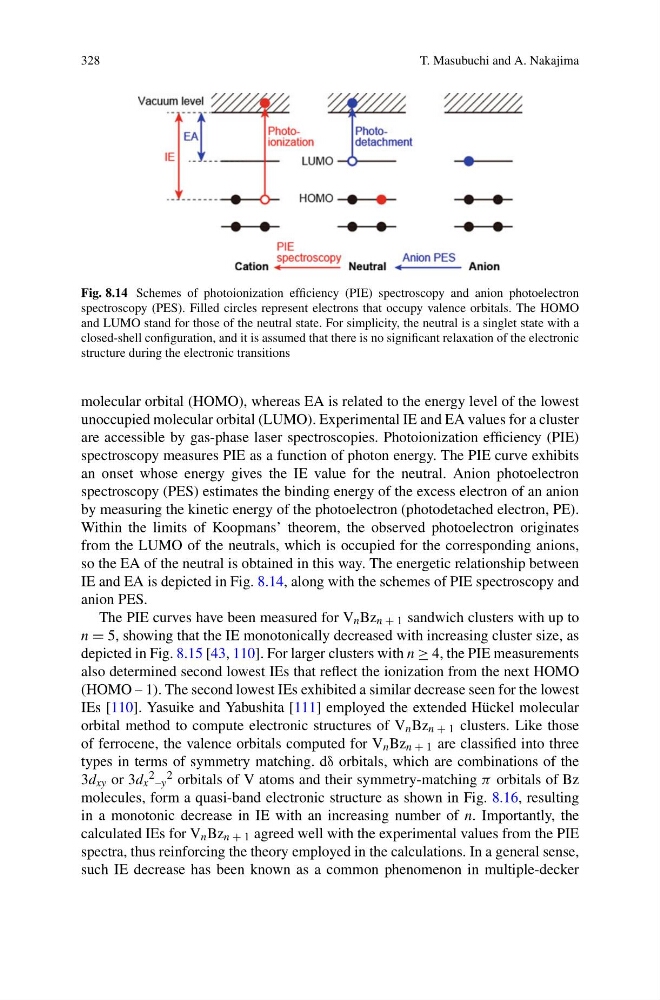
Fig. 8.14 Schemes of photoionization efficiency (PIE) spectroscopy and anion photoelectron
spectroscopy (PES). Filled circles represent electrons that occupy valence orbitals. The HOMO
and LUMO stand for those of the neutral state. For simplicity, the neutral is a singlet state with a
closed-shell configuration, and it is assumed that there is no significant relaxation of the electronic
structure during the electronic transitions
molecular orbital (HOMO), whereas EA is related to the energy level of the lowest
unoccupied molecular orbital (LUMO). Experimental IE and EA values for a cluster
are accessible by gas-phase laser spectroscopies. Photoionization efficiency (PIE)
spectroscopy measures PIE as a function of photon energy. The PIE curve exhibits
an onset whose energy gives the IE value for the neutral. Anion photoelectron
spectroscopy (PES) estimates the binding energy of the excess electron of an anion
by measuring the kinetic energy of the photoelectron (photodetached electron, PE).
Within the limits of Koopmans’ theorem, the observed photoelectron originates
from the LUMO of the neutrals, which is occupied for the corresponding anions,
so the EA of the neutral is obtained in this way. The energetic relationship between
IE and EA is depicted in Fig. 8.14, along with the schemes of PIE spectroscopy and
anion PES.
The PIE curves have been measured for V n Bz n + 1 sandwich clusters with up to
n = 5, showing that the IE monotonically decreased with increasing cluster size, as
depicted in Fig. 8.15 [43, 110]. For larger clusters with n ≥ 4, the PIE measurements
also determined second lowest IEs that reflect the ionization from the next HOMO
(HOMO – 1). The second lowest IEs exhibited a similar decrease seen for the lowest
IEs [110]. Yasuike and Yabushita [111] employed the extended Hückel molecular
orbital method to compute electronic structures of V n Bz n + 1 clusters. Like those
of ferrocene, the valence orbitals computed for V n Bz n + 1 are classified into three
types in terms of symmetry matching. dδ orbitals, which are combinations of the
3d xy or 3d x
2 –y
2 orbitals of V atoms and their symmetry-matching π orbitals of Bz
molecules, form a quasi-band electronic structure as shown in Fig. 8.16, resulting
in a monotonic decrease in IE with an increasing number of n. Importantly, the
calculated IEs for V n Bz n + 1 agreed well with the experimental values from the PIE
spectra, thus reinforcing the theory employed in the calculations. In a general sense,
such IE decrease has been known as a common phenomenon in multiple-decker
T. Masubuchi and A. Nakajima
Fig. 8.14 Schemes of photoionization efficiency (PIE) spectroscopy and anion photoelectron
spectroscopy (PES). Filled circles represent electrons that occupy valence orbitals. The HOMO
and LUMO stand for those of the neutral state. For simplicity, the neutral is a singlet state with a
closed-shell configuration, and it is assumed that there is no significant relaxation of the electronic
structure during the electronic transitions
molecular orbital (HOMO), whereas EA is related to the energy level of the lowest
unoccupied molecular orbital (LUMO). Experimental IE and EA values for a cluster
are accessible by gas-phase laser spectroscopies. Photoionization efficiency (PIE)
spectroscopy measures PIE as a function of photon energy. The PIE curve exhibits
an onset whose energy gives the IE value for the neutral. Anion photoelectron
spectroscopy (PES) estimates the binding energy of the excess electron of an anion
by measuring the kinetic energy of the photoelectron (photodetached electron, PE).
Within the limits of Koopmans’ theorem, the observed photoelectron originates
from the LUMO of the neutrals, which is occupied for the corresponding anions,
so the EA of the neutral is obtained in this way. The energetic relationship between
IE and EA is depicted in Fig. 8.14, along with the schemes of PIE spectroscopy and
anion PES.
The PIE curves have been measured for V n Bz n + 1 sandwich clusters with up to
n = 5, showing that the IE monotonically decreased with increasing cluster size, as
depicted in Fig. 8.15 [43, 110]. For larger clusters with n ≥ 4, the PIE measurements
also determined second lowest IEs that reflect the ionization from the next HOMO
(HOMO – 1). The second lowest IEs exhibited a similar decrease seen for the lowest
IEs [110]. Yasuike and Yabushita [111] employed the extended Hückel molecular
orbital method to compute electronic structures of V n Bz n + 1 clusters. Like those
of ferrocene, the valence orbitals computed for V n Bz n + 1 are classified into three
types in terms of symmetry matching. dδ orbitals, which are combinations of the
3d xy or 3d x
2 –y
2 orbitals of V atoms and their symmetry-matching π orbitals of Bz
molecules, form a quasi-band electronic structure as shown in Fig. 8.16, resulting
in a monotonic decrease in IE with an increasing number of n. Importantly, the
calculated IEs for V n Bz n + 1 agreed well with the experimental values from the PIE
spectra, thus reinforcing the theory employed in the calculations. In a general sense,
such IE decrease has been known as a common phenomenon in multiple-decker