

8 Electronic Properties of Transition Metal-Benzene Sandwich Clusters
327
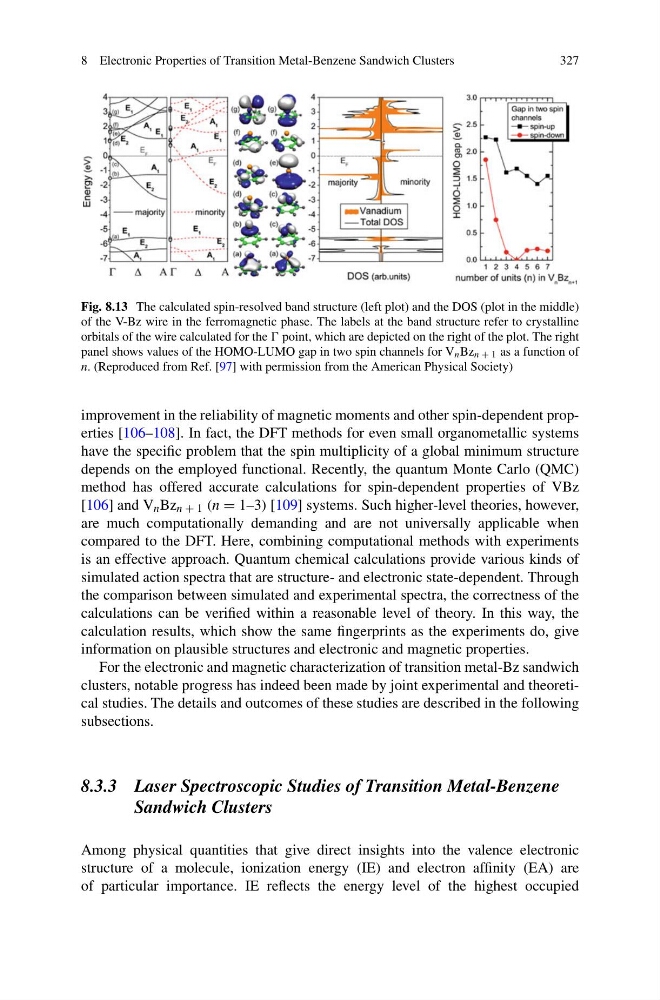
Fig. 8.13 The calculated spin-resolved band structure (left plot) and the DOS (plot in the middle)
of the V-Bz wire in the ferromagnetic phase. The labels at the band structure refer to crystalline
orbitals of the wire calculated for the point, which are depicted on the right of the plot. The right
panel shows values of the HOMO-LUMO gap in two spin channels for V n Bz n + 1 as a function of
n. (Reproduced from Ref. [97] with permission from the American Physical Society)
improvement in the reliability of magnetic moments and other spin-dependent properties [106–108]. In fact, the DFT methods for even small organometallic systems
have the specific problem that the spin multiplicity of a global minimum structure
depends on the employed functional. Recently, the quantum Monte Carlo (QMC)
method has offered accurate calculations for spin-dependent properties of VBz
[106] and V n Bz n + 1 (n = 1–3) [109] systems. Such higher-level theories, however,
are much computationally demanding and are not universally applicable when
compared to the DFT. Here, combining computational methods with experiments
is an effective approach. Quantum chemical calculations provide various kinds of
simulated action spectra that are structure- and electronic state-dependent. Through
the comparison between simulated and experimental spectra, the correctness of the
calculations can be verified within a reasonable level of theory. In this way, the
calculation results, which show the same fingerprints as the experiments do, give
information on plausible structures and electronic and magnetic properties.
For the electronic and magnetic characterization of transition metal-Bz sandwich
clusters, notable progress has indeed been made by joint experimental and theoretical studies. The details and outcomes of these studies are described in the following
subsections.
8.3.3 Laser Spectroscopic Studies of Transition Metal-Benzene
Sandwich Clusters
Among physical quantities that give direct insights into the valence electronic
structure of a molecule, ionization energy (IE) and electron affinity (EA) are
of particular importance. IE reflects the energy level of the highest occupied
327
Fig. 8.13 The calculated spin-resolved band structure (left plot) and the DOS (plot in the middle)
of the V-Bz wire in the ferromagnetic phase. The labels at the band structure refer to crystalline
orbitals of the wire calculated for the point, which are depicted on the right of the plot. The right
panel shows values of the HOMO-LUMO gap in two spin channels for V n Bz n + 1 as a function of
n. (Reproduced from Ref. [97] with permission from the American Physical Society)
improvement in the reliability of magnetic moments and other spin-dependent properties [106–108]. In fact, the DFT methods for even small organometallic systems
have the specific problem that the spin multiplicity of a global minimum structure
depends on the employed functional. Recently, the quantum Monte Carlo (QMC)
method has offered accurate calculations for spin-dependent properties of VBz
[106] and V n Bz n + 1 (n = 1–3) [109] systems. Such higher-level theories, however,
are much computationally demanding and are not universally applicable when
compared to the DFT. Here, combining computational methods with experiments
is an effective approach. Quantum chemical calculations provide various kinds of
simulated action spectra that are structure- and electronic state-dependent. Through
the comparison between simulated and experimental spectra, the correctness of the
calculations can be verified within a reasonable level of theory. In this way, the
calculation results, which show the same fingerprints as the experiments do, give
information on plausible structures and electronic and magnetic properties.
For the electronic and magnetic characterization of transition metal-Bz sandwich
clusters, notable progress has indeed been made by joint experimental and theoretical studies. The details and outcomes of these studies are described in the following
subsections.
8.3.3 Laser Spectroscopic Studies of Transition Metal-Benzene
Sandwich Clusters
Among physical quantities that give direct insights into the valence electronic
structure of a molecule, ionization energy (IE) and electron affinity (EA) are
of particular importance. IE reflects the energy level of the highest occupied