

326
T. Masubuchi and A. Nakajima
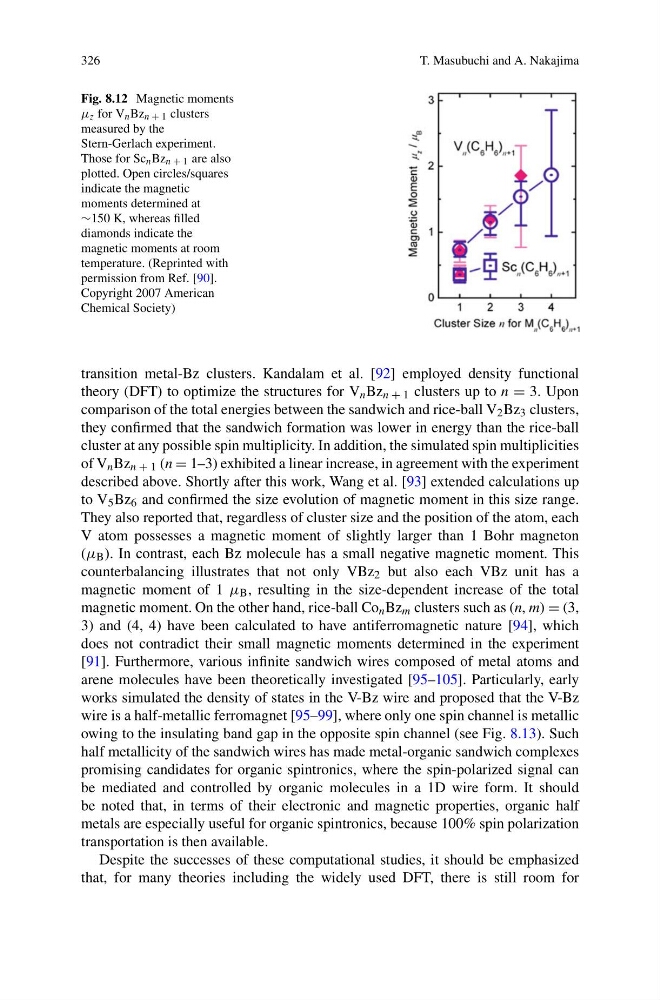
Fig. 8.12 Magnetic moments
μ z for V n Bz n + 1 clusters
measured by the
Stern-Gerlach experiment.
Those for Sc n Bz n + 1 are also
plotted. Open circles/squares
indicate the magnetic
moments determined at
∼150 K, whereas filled
diamonds indicate the
magnetic moments at room
temperature. (Reprinted with
permission from Ref. [90].
Copyright 2007 American
Chemical Society)
transition metal-Bz clusters. Kandalam et al. [92] employed density functional
theory (DFT) to optimize the structures for V n Bz n + 1 clusters up to n = 3. Upon
comparison of the total energies between the sandwich and rice-ball V 2 Bz 3 clusters,
they confirmed that the sandwich formation was lower in energy than the rice-ball
cluster at any possible spin multiplicity. In addition, the simulated spin multiplicities
of V n Bz n + 1 (n = 1–3) exhibited a linear increase, in agreement with the experiment
described above. Shortly after this work, Wang et al. [93] extended calculations up
to V 5 Bz 6 and confirmed the size evolution of magnetic moment in this size range.
They also reported that, regardless of cluster size and the position of the atom, each
V atom possesses a magnetic moment of slightly larger than 1 Bohr magneton
(μ B ). In contrast, each Bz molecule has a small negative magnetic moment. This
counterbalancing illustrates that not only VBz 2 but also each VBz unit has a
magnetic moment of 1 μ B , resulting in the size-dependent increase of the total
magnetic moment. On the other hand, rice-ball Co n Bz m clusters such as (n, m) = (3,
3) and (4, 4) have been calculated to have antiferromagnetic nature [94], which
does not contradict their small magnetic moments determined in the experiment
[91]. Furthermore, various infinite sandwich wires composed of metal atoms and
arene molecules have been theoretically investigated [95–105]. Particularly, early
works simulated the density of states in the V-Bz wire and proposed that the V-Bz
wire is a half-metallic ferromagnet [95–99], where only one spin channel is metallic
owing to the insulating band gap in the opposite spin channel (see Fig. 8.13). Such
half metallicity of the sandwich wires has made metal-organic sandwich complexes
promising candidates for organic spintronics, where the spin-polarized signal can
be mediated and controlled by organic molecules in a 1D wire form. It should
be noted that, in terms of their electronic and magnetic properties, organic half
metals are especially useful for organic spintronics, because 100% spin polarization
transportation is then available.
Despite the successes of these computational studies, it should be emphasized
that, for many theories including the widely used DFT, there is still room for
T. Masubuchi and A. Nakajima
Fig. 8.12 Magnetic moments
μ z for V n Bz n + 1 clusters
measured by the
Stern-Gerlach experiment.
Those for Sc n Bz n + 1 are also
plotted. Open circles/squares
indicate the magnetic
moments determined at
∼150 K, whereas filled
diamonds indicate the
magnetic moments at room
temperature. (Reprinted with
permission from Ref. [90].
Copyright 2007 American
Chemical Society)
transition metal-Bz clusters. Kandalam et al. [92] employed density functional
theory (DFT) to optimize the structures for V n Bz n + 1 clusters up to n = 3. Upon
comparison of the total energies between the sandwich and rice-ball V 2 Bz 3 clusters,
they confirmed that the sandwich formation was lower in energy than the rice-ball
cluster at any possible spin multiplicity. In addition, the simulated spin multiplicities
of V n Bz n + 1 (n = 1–3) exhibited a linear increase, in agreement with the experiment
described above. Shortly after this work, Wang et al. [93] extended calculations up
to V 5 Bz 6 and confirmed the size evolution of magnetic moment in this size range.
They also reported that, regardless of cluster size and the position of the atom, each
V atom possesses a magnetic moment of slightly larger than 1 Bohr magneton
(μ B ). In contrast, each Bz molecule has a small negative magnetic moment. This
counterbalancing illustrates that not only VBz 2 but also each VBz unit has a
magnetic moment of 1 μ B , resulting in the size-dependent increase of the total
magnetic moment. On the other hand, rice-ball Co n Bz m clusters such as (n, m) = (3,
3) and (4, 4) have been calculated to have antiferromagnetic nature [94], which
does not contradict their small magnetic moments determined in the experiment
[91]. Furthermore, various infinite sandwich wires composed of metal atoms and
arene molecules have been theoretically investigated [95–105]. Particularly, early
works simulated the density of states in the V-Bz wire and proposed that the V-Bz
wire is a half-metallic ferromagnet [95–99], where only one spin channel is metallic
owing to the insulating band gap in the opposite spin channel (see Fig. 8.13). Such
half metallicity of the sandwich wires has made metal-organic sandwich complexes
promising candidates for organic spintronics, where the spin-polarized signal can
be mediated and controlled by organic molecules in a 1D wire form. It should
be noted that, in terms of their electronic and magnetic properties, organic half
metals are especially useful for organic spintronics, because 100% spin polarization
transportation is then available.
Despite the successes of these computational studies, it should be emphasized
that, for many theories including the widely used DFT, there is still room for