

8 Electronic Properties of Transition Metal-Benzene Sandwich Clusters
325
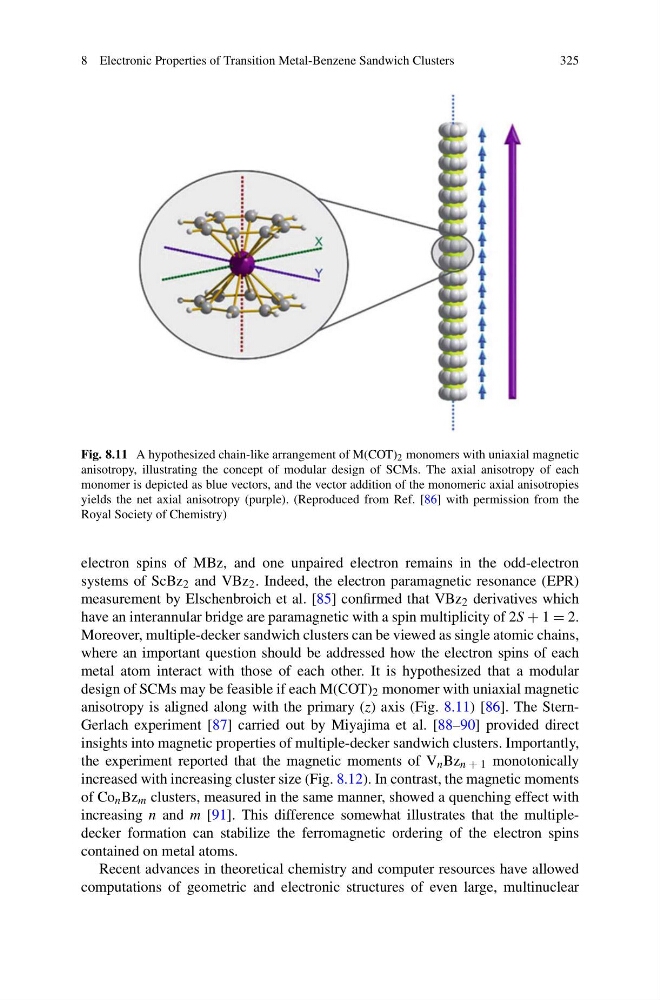
Fig. 8.11 A hypothesized chain-like arrangement of M(COT) 2 monomers with uniaxial magnetic
anisotropy, illustrating the concept of modular design of SCMs. The axial anisotropy of each
monomer is depicted as blue vectors, and the vector addition of the monomeric axial anisotropies
yields the net axial anisotropy (purple). (Reproduced from Ref. [86] with permission from the
Royal Society of Chemistry)
electron spins of MBz, and one unpaired electron remains in the odd-electron
systems of ScBz 2 and VBz 2 . Indeed, the electron paramagnetic resonance (EPR)
measurement by Elschenbroich et al. [85] confirmed that VBz 2 derivatives which
have an interannular bridge are paramagnetic with a spin multiplicity of 2S + 1 = 2.
Moreover, multiple-decker sandwich clusters can be viewed as single atomic chains,
where an important question should be addressed how the electron spins of each
metal atom interact with those of each other. It is hypothesized that a modular
design of SCMs may be feasible if each M(COT) 2 monomer with uniaxial magnetic
anisotropy is aligned along with the primary (z) axis (Fig. 8.11) [86]. The SternGerlach experiment [87] carried out by Miyajima et al. [88–90] provided direct
insights into magnetic properties of multiple-decker sandwich clusters. Importantly,
the experiment reported that the magnetic moments of V n Bz n + 1 monotonically
increased with increasing cluster size (Fig. 8.12). In contrast, the magnetic moments
of Co n Bz m clusters, measured in the same manner, showed a quenching effect with
increasing n and m [91]. This difference somewhat illustrates that the multipledecker formation can stabilize the ferromagnetic ordering of the electron spins
contained on metal atoms.
Recent advances in theoretical chemistry and computer resources have allowed
computations of geometric and electronic structures of even large, multinuclear
325
Fig. 8.11 A hypothesized chain-like arrangement of M(COT) 2 monomers with uniaxial magnetic
anisotropy, illustrating the concept of modular design of SCMs. The axial anisotropy of each
monomer is depicted as blue vectors, and the vector addition of the monomeric axial anisotropies
yields the net axial anisotropy (purple). (Reproduced from Ref. [86] with permission from the
Royal Society of Chemistry)
electron spins of MBz, and one unpaired electron remains in the odd-electron
systems of ScBz 2 and VBz 2 . Indeed, the electron paramagnetic resonance (EPR)
measurement by Elschenbroich et al. [85] confirmed that VBz 2 derivatives which
have an interannular bridge are paramagnetic with a spin multiplicity of 2S + 1 = 2.
Moreover, multiple-decker sandwich clusters can be viewed as single atomic chains,
where an important question should be addressed how the electron spins of each
metal atom interact with those of each other. It is hypothesized that a modular
design of SCMs may be feasible if each M(COT) 2 monomer with uniaxial magnetic
anisotropy is aligned along with the primary (z) axis (Fig. 8.11) [86]. The SternGerlach experiment [87] carried out by Miyajima et al. [88–90] provided direct
insights into magnetic properties of multiple-decker sandwich clusters. Importantly,
the experiment reported that the magnetic moments of V n Bz n + 1 monotonically
increased with increasing cluster size (Fig. 8.12). In contrast, the magnetic moments
of Co n Bz m clusters, measured in the same manner, showed a quenching effect with
increasing n and m [91]. This difference somewhat illustrates that the multipledecker formation can stabilize the ferromagnetic ordering of the electron spins
contained on metal atoms.
Recent advances in theoretical chemistry and computer resources have allowed
computations of geometric and electronic structures of even large, multinuclear