

324
T. Masubuchi and A. Nakajima
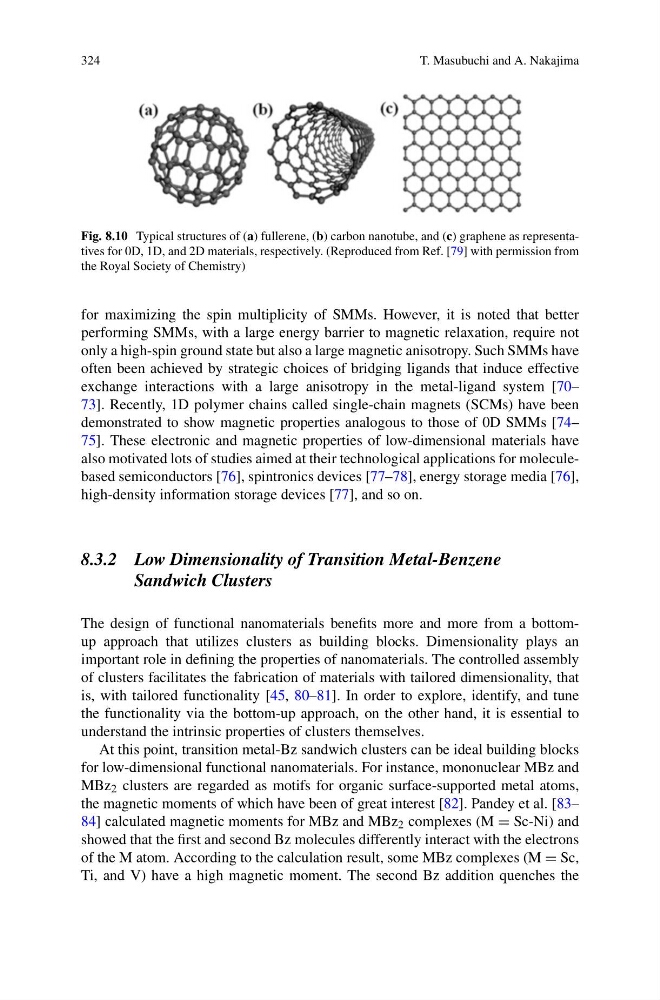
Fig. 8.10 Typical structures of (a) fullerene, (b) carbon nanotube, and (c) graphene as representatives for 0D, 1D, and 2D materials, respectively. (Reproduced from Ref. [79] with permission from
the Royal Society of Chemistry)
for maximizing the spin multiplicity of SMMs. However, it is noted that better
performing SMMs, with a large energy barrier to magnetic relaxation, require not
only a high-spin ground state but also a large magnetic anisotropy. Such SMMs have
often been achieved by strategic choices of bridging ligands that induce effective
exchange interactions with a large anisotropy in the metal-ligand system [70–
73]. Recently, 1D polymer chains called single-chain magnets (SCMs) have been
demonstrated to show magnetic properties analogous to those of 0D SMMs [74–
75]. These electronic and magnetic properties of low-dimensional materials have
also motivated lots of studies aimed at their technological applications for moleculebased semiconductors [76], spintronics devices [77–78], energy storage media [76],
high-density information storage devices [77], and so on.
8.3.2 Low Dimensionality of Transition Metal-Benzene
Sandwich Clusters
The design of functional nanomaterials benefits more and more from a bottomup approach that utilizes clusters as building blocks. Dimensionality plays an
important role in defining the properties of nanomaterials. The controlled assembly
of clusters facilitates the fabrication of materials with tailored dimensionality, that
is, with tailored functionality [45, 80–81]. In order to explore, identify, and tune
the functionality via the bottom-up approach, on the other hand, it is essential to
understand the intrinsic properties of clusters themselves.
At this point, transition metal-Bz sandwich clusters can be ideal building blocks
for low-dimensional functional nanomaterials. For instance, mononuclear MBz and
MBz 2 clusters are regarded as motifs for organic surface-supported metal atoms,
the magnetic moments of which have been of great interest [82]. Pandey et al. [83–
84] calculated magnetic moments for MBz and MBz 2 complexes (M = Sc-Ni) and
showed that the first and second Bz molecules differently interact with the electrons
of the M atom. According to the calculation result, some MBz complexes (M = Sc,
Ti, and V) have a high magnetic moment. The second Bz addition quenches the
T. Masubuchi and A. Nakajima
Fig. 8.10 Typical structures of (a) fullerene, (b) carbon nanotube, and (c) graphene as representatives for 0D, 1D, and 2D materials, respectively. (Reproduced from Ref. [79] with permission from
the Royal Society of Chemistry)
for maximizing the spin multiplicity of SMMs. However, it is noted that better
performing SMMs, with a large energy barrier to magnetic relaxation, require not
only a high-spin ground state but also a large magnetic anisotropy. Such SMMs have
often been achieved by strategic choices of bridging ligands that induce effective
exchange interactions with a large anisotropy in the metal-ligand system [70–
73]. Recently, 1D polymer chains called single-chain magnets (SCMs) have been
demonstrated to show magnetic properties analogous to those of 0D SMMs [74–
75]. These electronic and magnetic properties of low-dimensional materials have
also motivated lots of studies aimed at their technological applications for moleculebased semiconductors [76], spintronics devices [77–78], energy storage media [76],
high-density information storage devices [77], and so on.
8.3.2 Low Dimensionality of Transition Metal-Benzene
Sandwich Clusters
The design of functional nanomaterials benefits more and more from a bottomup approach that utilizes clusters as building blocks. Dimensionality plays an
important role in defining the properties of nanomaterials. The controlled assembly
of clusters facilitates the fabrication of materials with tailored dimensionality, that
is, with tailored functionality [45, 80–81]. In order to explore, identify, and tune
the functionality via the bottom-up approach, on the other hand, it is essential to
understand the intrinsic properties of clusters themselves.
At this point, transition metal-Bz sandwich clusters can be ideal building blocks
for low-dimensional functional nanomaterials. For instance, mononuclear MBz and
MBz 2 clusters are regarded as motifs for organic surface-supported metal atoms,
the magnetic moments of which have been of great interest [82]. Pandey et al. [83–
84] calculated magnetic moments for MBz and MBz 2 complexes (M = Sc-Ni) and
showed that the first and second Bz molecules differently interact with the electrons
of the M atom. According to the calculation result, some MBz complexes (M = Sc,
Ti, and V) have a high magnetic moment. The second Bz addition quenches the