

18
T. Onishi
1.6 Challenges
1.6.1 Nanospace Chemistry Towards Nanomachine
Nanospace is defined as nanosize-space, where molecule, atom and ion can be
inserted. Though it looks easier to understand insertion process based on classical
host-guest chemistry [59], it must be noted that insert-framework interaction is
dominated by quantum mechanics. When insert has orbital overlap with framework,
covalent bonding is formed. Even if there is no orbital overlap between insert
and framework, quantum charge interaction exists. For example, metal organic
framework (MOF) [60–63], nanoporous material and inclusion compound have
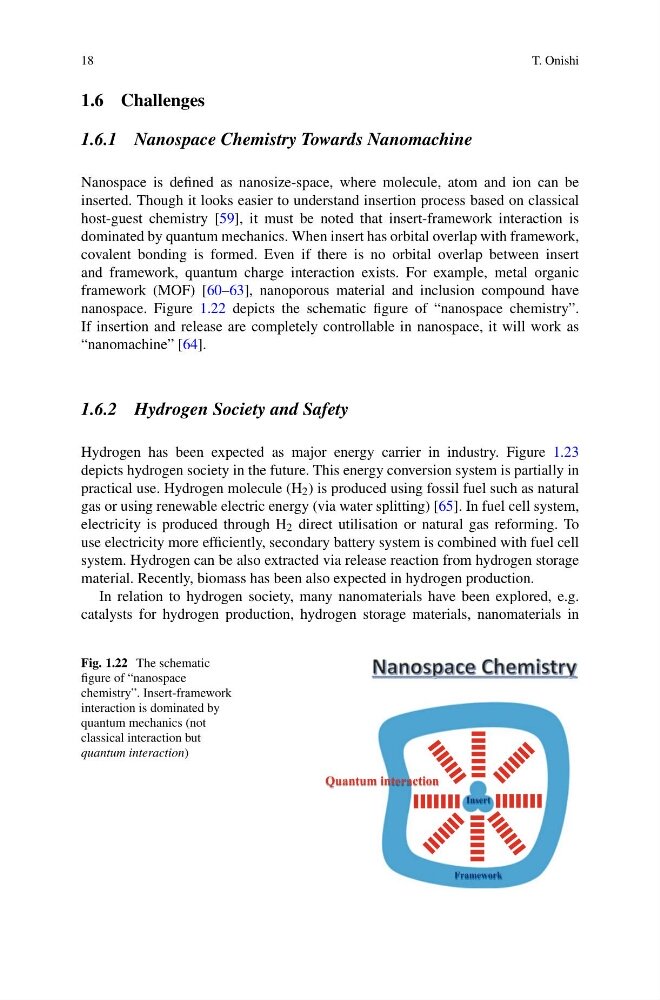
nanospace. Figure 1.22 depicts the schematic figure of “nanospace chemistry”.
If insertion and release are completely controllable in nanospace, it will work as
“nanomachine” [64].
1.6.2 Hydrogen Society and Safety
Hydrogen has been expected as major energy carrier in industry. Figure 1.23
depicts hydrogen society in the future. This energy conversion system is partially in
practical use. Hydrogen molecule (H 2 ) is produced using fossil fuel such as natural
gas or using renewable electric energy (via water splitting) [65]. In fuel cell system,
electricity is produced through H 2 direct utilisation or natural gas reforming. To
use electricity more efficiently, secondary battery system is combined with fuel cell
system. Hydrogen can be also extracted via release reaction from hydrogen storage
material. Recently, biomass has been also expected in hydrogen production.
In relation to hydrogen society, many nanomaterials have been explored, e.g.
catalysts for hydrogen production, hydrogen storage materials, nanomaterials in
Fig. 1.22 The schematic
figure of “nanospace
chemistry”. Insert-framework
interaction is dominated by
quantum mechanics (not
classical interaction but
quantum interaction)
Insert
Framework
Quantum interaction
T. Onishi
1.6 Challenges
1.6.1 Nanospace Chemistry Towards Nanomachine
Nanospace is defined as nanosize-space, where molecule, atom and ion can be
inserted. Though it looks easier to understand insertion process based on classical
host-guest chemistry [59], it must be noted that insert-framework interaction is
dominated by quantum mechanics. When insert has orbital overlap with framework,
covalent bonding is formed. Even if there is no orbital overlap between insert
and framework, quantum charge interaction exists. For example, metal organic
framework (MOF) [60–63], nanoporous material and inclusion compound have
nanospace. Figure 1.22 depicts the schematic figure of “nanospace chemistry”.
If insertion and release are completely controllable in nanospace, it will work as
“nanomachine” [64].
1.6.2 Hydrogen Society and Safety
Hydrogen has been expected as major energy carrier in industry. Figure 1.23
depicts hydrogen society in the future. This energy conversion system is partially in
practical use. Hydrogen molecule (H 2 ) is produced using fossil fuel such as natural
gas or using renewable electric energy (via water splitting) [65]. In fuel cell system,
electricity is produced through H 2 direct utilisation or natural gas reforming. To
use electricity more efficiently, secondary battery system is combined with fuel cell
system. Hydrogen can be also extracted via release reaction from hydrogen storage
material. Recently, biomass has been also expected in hydrogen production.
In relation to hydrogen society, many nanomaterials have been explored, e.g.
catalysts for hydrogen production, hydrogen storage materials, nanomaterials in
Fig. 1.22 The schematic
figure of “nanospace
chemistry”. Insert-framework
interaction is dominated by
quantum mechanics (not
classical interaction but
quantum interaction)
Insert
Framework
Quantum interaction