

1 Theoretical Chemistry for Advanced Nanomaterials: Computational. . .
17
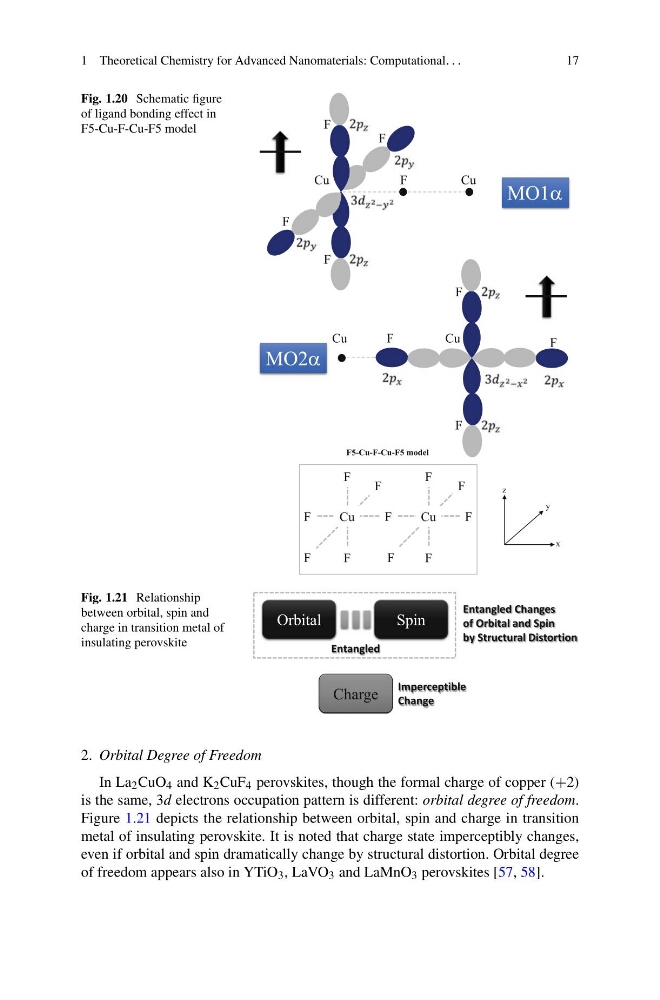
Fig. 1.20 Schematic figure
of ligand bonding effect in
F5-Cu-F-Cu-F5 model
MO1
Cu
F
F
F
F
Cu
F
MO2
Cu
F
F
F
F
Cu
x
y
z
F
F
F
F
F
F
F
F
Cu
F
F
Cu
F
F5-Cu-F-Cu-F5 model
Fig. 1.21 Relationship
between orbital, spin and
charge in transition metal of
insulating perovskite
Charge
Orbital
Spin
Entangled
Imperceptible
Change
Entangled Changes
of Orbital and Spin
by Structural Distortion
2. Orbital Degree of Freedom
In La 2 CuO 4 and K 2 CuF 4 perovskites, though the formal charge of copper (+2)
is the same, 3d electrons occupation pattern is different: orbital degree of freedom.
Figure 1.21 depicts the relationship between orbital, spin and charge in transition
metal of insulating perovskite. It is noted that charge state imperceptibly changes,
even if orbital and spin dramatically change by structural distortion. Orbital degree
of freedom appears also in YTiO 3 , LaVO 3 and LaMnO 3 perovskites [57, 58].
17
Fig. 1.20 Schematic figure
of ligand bonding effect in
F5-Cu-F-Cu-F5 model
MO1
Cu
F
F
F
F
Cu
F
MO2
Cu
F
F
F
F
Cu
x
y
z
F
F
F
F
F
F
F
F
Cu
F
F
Cu
F
F5-Cu-F-Cu-F5 model
Fig. 1.21 Relationship
between orbital, spin and
charge in transition metal of
insulating perovskite
Charge
Orbital
Spin
Entangled
Imperceptible
Change
Entangled Changes
of Orbital and Spin
by Structural Distortion
2. Orbital Degree of Freedom
In La 2 CuO 4 and K 2 CuF 4 perovskites, though the formal charge of copper (+2)
is the same, 3d electrons occupation pattern is different: orbital degree of freedom.
Figure 1.21 depicts the relationship between orbital, spin and charge in transition
metal of insulating perovskite. It is noted that charge state imperceptibly changes,
even if orbital and spin dramatically change by structural distortion. Orbital degree
of freedom appears also in YTiO 3 , LaVO 3 and LaMnO 3 perovskites [57, 58].