

8 Electronic Properties of Transition Metal-Benzene Sandwich Clusters
321
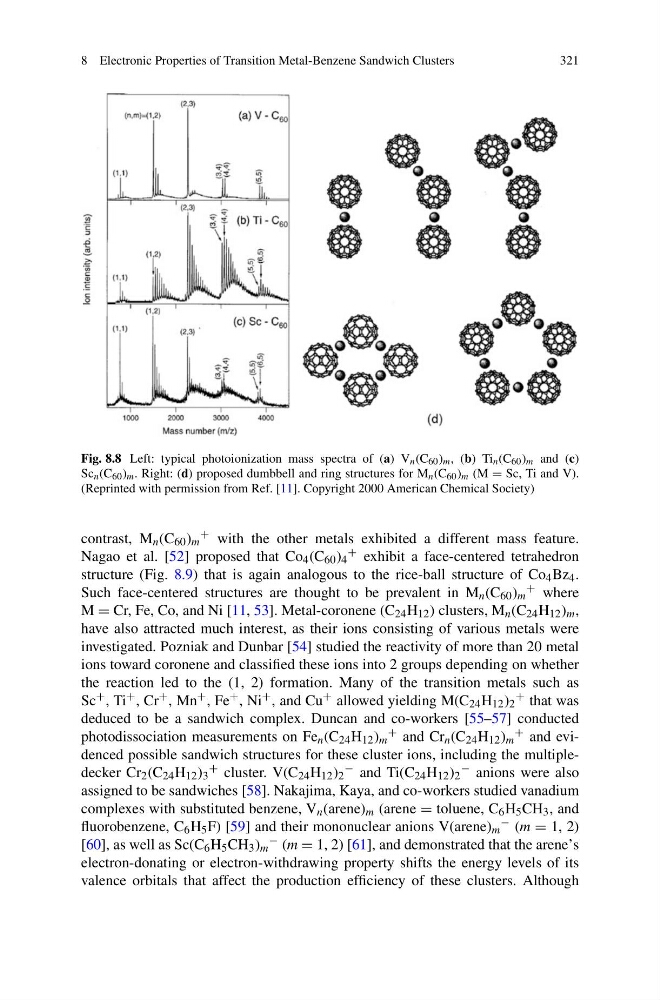
Fig. 8.8 Left: typical photoionization mass spectra of (a) V n (C 60 ) m , (b) Ti n (C 60 ) m and (c)
Sc n (C 60 ) m . Right: (d) proposed dumbbell and ring structures for M n (C 60 ) m (M = Sc, Ti and V).
(Reprinted with permission from Ref. [11]. Copyright 2000 American Chemical Society)
contrast, M n (C 60 ) m
+ with the other metals exhibited a different mass feature.
Nagao et al. [52] proposed that Co 4 (C 60 ) 4
+ exhibit a face-centered tetrahedron
structure (Fig. 8.9) that is again analogous to the rice-ball structure of Co 4 Bz 4 .
Such face-centered structures are thought to be prevalent in M n (C 60 ) m
+ where
M = Cr, Fe, Co, and Ni [11, 53]. Metal-coronene (C 24 H 12 ) clusters, M n (C 24 H 12 ) m ,
have also attracted much interest, as their ions consisting of various metals were
investigated. Pozniak and Dunbar [54] studied the reactivity of more than 20 metal
ions toward coronene and classified these ions into 2 groups depending on whether
the reaction led to the (1, 2) formation. Many of the transition metals such as
Sc + , Ti + , Cr + , Mn + , Fe + , Ni + , and Cu + allowed yielding M(C 24 H 12 ) 2
+ that was
deduced to be a sandwich complex. Duncan and co-workers [55–57] conducted
photodissociation measurements on Fe n (C 24 H 12 ) m
+ and Cr n (C 24 H 12 ) m
+ and evidenced possible sandwich structures for these cluster ions, including the multipledecker Cr 2 (C 24 H 12 ) 3
+ cluster. V(C 24 H 12 ) 2
− and Ti(C 24 H 12 ) 2
− anions were also
assigned to be sandwiches [58]. Nakajima, Kaya, and co-workers studied vanadium
complexes with substituted benzene, V n (arene) m (arene = toluene, C 6 H 5 CH 3 , and
fluorobenzene, C 6 H 5 F) [59] and their mononuclear anions V(arene) m
− (m = 1, 2)
[60], as well as Sc(C 6 H 5 CH 3 ) m
− (m = 1, 2) [61], and demonstrated that the arene’s
electron-donating or electron-withdrawing property shifts the energy levels of its
valence orbitals that affect the production efficiency of these clusters. Although
321
Fig. 8.8 Left: typical photoionization mass spectra of (a) V n (C 60 ) m , (b) Ti n (C 60 ) m and (c)
Sc n (C 60 ) m . Right: (d) proposed dumbbell and ring structures for M n (C 60 ) m (M = Sc, Ti and V).
(Reprinted with permission from Ref. [11]. Copyright 2000 American Chemical Society)
contrast, M n (C 60 ) m
+ with the other metals exhibited a different mass feature.
Nagao et al. [52] proposed that Co 4 (C 60 ) 4
+ exhibit a face-centered tetrahedron
structure (Fig. 8.9) that is again analogous to the rice-ball structure of Co 4 Bz 4 .
Such face-centered structures are thought to be prevalent in M n (C 60 ) m
+ where
M = Cr, Fe, Co, and Ni [11, 53]. Metal-coronene (C 24 H 12 ) clusters, M n (C 24 H 12 ) m ,
have also attracted much interest, as their ions consisting of various metals were
investigated. Pozniak and Dunbar [54] studied the reactivity of more than 20 metal
ions toward coronene and classified these ions into 2 groups depending on whether
the reaction led to the (1, 2) formation. Many of the transition metals such as
Sc + , Ti + , Cr + , Mn + , Fe + , Ni + , and Cu + allowed yielding M(C 24 H 12 ) 2
+ that was
deduced to be a sandwich complex. Duncan and co-workers [55–57] conducted
photodissociation measurements on Fe n (C 24 H 12 ) m
+ and Cr n (C 24 H 12 ) m
+ and evidenced possible sandwich structures for these cluster ions, including the multipledecker Cr 2 (C 24 H 12 ) 3
+ cluster. V(C 24 H 12 ) 2
− and Ti(C 24 H 12 ) 2
− anions were also
assigned to be sandwiches [58]. Nakajima, Kaya, and co-workers studied vanadium
complexes with substituted benzene, V n (arene) m (arene = toluene, C 6 H 5 CH 3 , and
fluorobenzene, C 6 H 5 F) [59] and their mononuclear anions V(arene) m
− (m = 1, 2)
[60], as well as Sc(C 6 H 5 CH 3 ) m
− (m = 1, 2) [61], and demonstrated that the arene’s
electron-donating or electron-withdrawing property shifts the energy levels of its
valence orbitals that affect the production efficiency of these clusters. Although