

322
T. Masubuchi and A. Nakajima
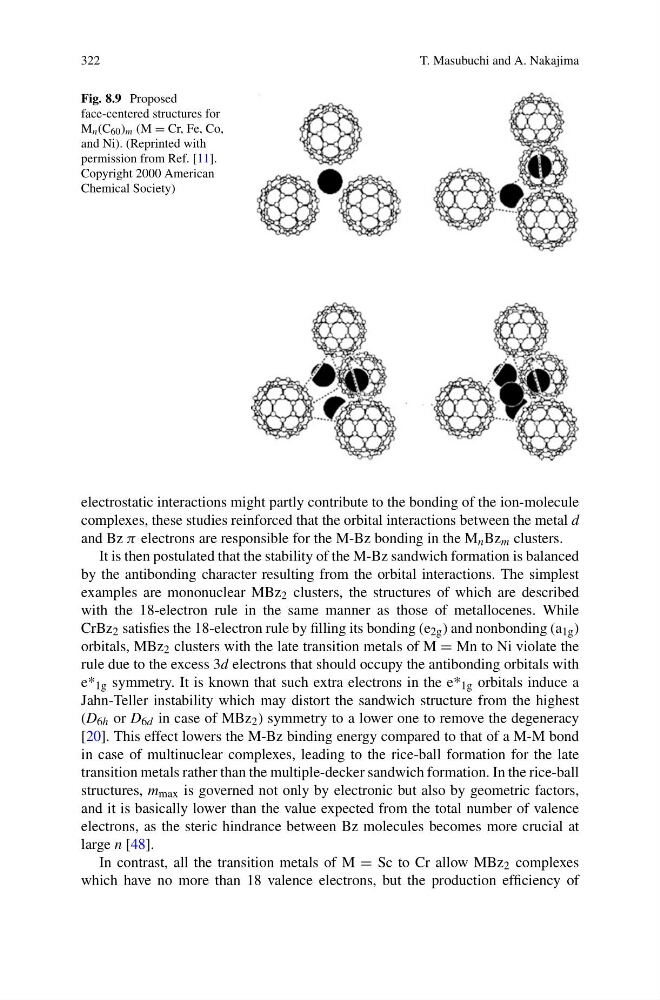
Fig. 8.9 Proposed
face-centered structures for
M n (C 60 ) m (M = Cr, Fe, Co,
and Ni). (Reprinted with
permission from Ref. [11].
Copyright 2000 American
Chemical Society)
electrostatic interactions might partly contribute to the bonding of the ion-molecule
complexes, these studies reinforced that the orbital interactions between the metal d
and Bz π electrons are responsible for the M-Bz bonding in the M n Bz m clusters.
It is then postulated that the stability of the M-Bz sandwich formation is balanced
by the antibonding character resulting from the orbital interactions. The simplest
examples are mononuclear MBz 2 clusters, the structures of which are described
with the 18-electron rule in the same manner as those of metallocenes. While
CrBz 2 satisfies the 18-electron rule by filling its bonding (e 2g ) and nonbonding (a 1g )
orbitals, MBz 2 clusters with the late transition metals of M = Mn to Ni violate the
rule due to the excess 3d electrons that should occupy the antibonding orbitals with
e* 1g symmetry. It is known that such extra electrons in the e* 1g orbitals induce a
Jahn-Teller instability which may distort the sandwich structure from the highest
(D 6h or D 6d in case of MBz 2 ) symmetry to a lower one to remove the degeneracy
[20]. This effect lowers the M-Bz binding energy compared to that of a M-M bond
in case of multinuclear complexes, leading to the rice-ball formation for the late
transition metals rather than the multiple-decker sandwich formation. In the rice-ball
structures, m max is governed not only by electronic but also by geometric factors,
and it is basically lower than the value expected from the total number of valence
electrons, as the steric hindrance between Bz molecules becomes more crucial at
large n [48].
In contrast, all the transition metals of M = Sc to Cr allow MBz 2 complexes
which have no more than 18 valence electrons, but the production efficiency of
T. Masubuchi and A. Nakajima
Fig. 8.9 Proposed
face-centered structures for
M n (C 60 ) m (M = Cr, Fe, Co,
and Ni). (Reprinted with
permission from Ref. [11].
Copyright 2000 American
Chemical Society)
electrostatic interactions might partly contribute to the bonding of the ion-molecule
complexes, these studies reinforced that the orbital interactions between the metal d
and Bz π electrons are responsible for the M-Bz bonding in the M n Bz m clusters.
It is then postulated that the stability of the M-Bz sandwich formation is balanced
by the antibonding character resulting from the orbital interactions. The simplest
examples are mononuclear MBz 2 clusters, the structures of which are described
with the 18-electron rule in the same manner as those of metallocenes. While
CrBz 2 satisfies the 18-electron rule by filling its bonding (e 2g ) and nonbonding (a 1g )
orbitals, MBz 2 clusters with the late transition metals of M = Mn to Ni violate the
rule due to the excess 3d electrons that should occupy the antibonding orbitals with
e* 1g symmetry. It is known that such extra electrons in the e* 1g orbitals induce a
Jahn-Teller instability which may distort the sandwich structure from the highest
(D 6h or D 6d in case of MBz 2 ) symmetry to a lower one to remove the degeneracy
[20]. This effect lowers the M-Bz binding energy compared to that of a M-M bond
in case of multinuclear complexes, leading to the rice-ball formation for the late
transition metals rather than the multiple-decker sandwich formation. In the rice-ball
structures, m max is governed not only by electronic but also by geometric factors,
and it is basically lower than the value expected from the total number of valence
electrons, as the steric hindrance between Bz molecules becomes more crucial at
large n [48].
In contrast, all the transition metals of M = Sc to Cr allow MBz 2 complexes
which have no more than 18 valence electrons, but the production efficiency of