

320
T. Masubuchi and A. Nakajima
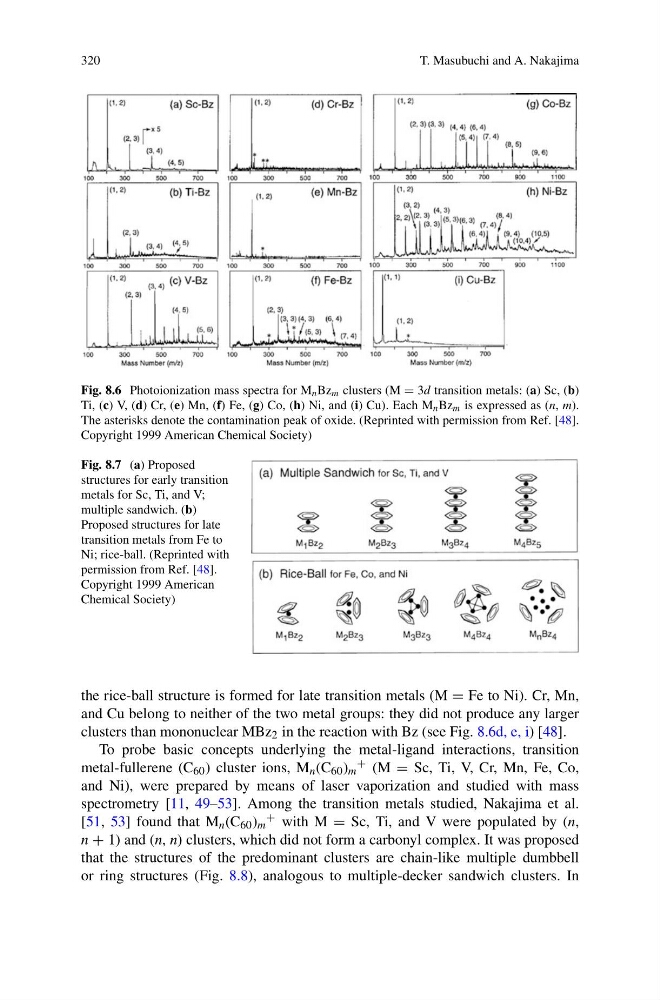
Fig. 8.6 Photoionization mass spectra for M n Bz m clusters (M = 3d transition metals: (a) Sc, (b)
Ti, (c) V, (d) Cr, (e) Mn, (f) Fe, (g) Co, (h) Ni, and (i) Cu). Each M n Bz m is expressed as (n, m).
The asterisks denote the contamination peak of oxide. (Reprinted with permission from Ref. [48].
Copyright 1999 American Chemical Society)
Fig. 8.7 (a) Proposed
structures for early transition
metals for Sc, Ti, and V;
multiple sandwich. (b)
Proposed structures for late
transition metals from Fe to
Ni; rice-ball. (Reprinted with
permission from Ref. [48].
Copyright 1999 American
Chemical Society)
the rice-ball structure is formed for late transition metals (M = Fe to Ni). Cr, Mn,
and Cu belong to neither of the two metal groups: they did not produce any larger
clusters than mononuclear MBz 2 in the reaction with Bz (see Fig. 8.6d, e, i) [48].
To probe basic concepts underlying the metal-ligand interactions, transition
metal-fullerene (C 60 ) cluster ions, M n (C 60 ) m
+ (M = Sc, Ti, V, Cr, Mn, Fe, Co,
and Ni), were prepared by means of laser vaporization and studied with mass
spectrometry [11, 49–53]. Among the transition metals studied, Nakajima et al.
[51, 53] found that M n (C 60 ) m
+ with M = Sc, Ti, and V were populated by (n,
n + 1) and (n, n) clusters, which did not form a carbonyl complex. It was proposed
that the structures of the predominant clusters are chain-like multiple dumbbell
or ring structures (Fig. 8.8), analogous to multiple-decker sandwich clusters. In
T. Masubuchi and A. Nakajima
Fig. 8.6 Photoionization mass spectra for M n Bz m clusters (M = 3d transition metals: (a) Sc, (b)
Ti, (c) V, (d) Cr, (e) Mn, (f) Fe, (g) Co, (h) Ni, and (i) Cu). Each M n Bz m is expressed as (n, m).
The asterisks denote the contamination peak of oxide. (Reprinted with permission from Ref. [48].
Copyright 1999 American Chemical Society)
Fig. 8.7 (a) Proposed
structures for early transition
metals for Sc, Ti, and V;
multiple sandwich. (b)
Proposed structures for late
transition metals from Fe to
Ni; rice-ball. (Reprinted with
permission from Ref. [48].
Copyright 1999 American
Chemical Society)
the rice-ball structure is formed for late transition metals (M = Fe to Ni). Cr, Mn,
and Cu belong to neither of the two metal groups: they did not produce any larger
clusters than mononuclear MBz 2 in the reaction with Bz (see Fig. 8.6d, e, i) [48].
To probe basic concepts underlying the metal-ligand interactions, transition
metal-fullerene (C 60 ) cluster ions, M n (C 60 ) m
+ (M = Sc, Ti, V, Cr, Mn, Fe, Co,
and Ni), were prepared by means of laser vaporization and studied with mass
spectrometry [11, 49–53]. Among the transition metals studied, Nakajima et al.
[51, 53] found that M n (C 60 ) m
+ with M = Sc, Ti, and V were populated by (n,
n + 1) and (n, n) clusters, which did not form a carbonyl complex. It was proposed
that the structures of the predominant clusters are chain-like multiple dumbbell
or ring structures (Fig. 8.8), analogous to multiple-decker sandwich clusters. In