

8 Electronic Properties of Transition Metal-Benzene Sandwich Clusters
319
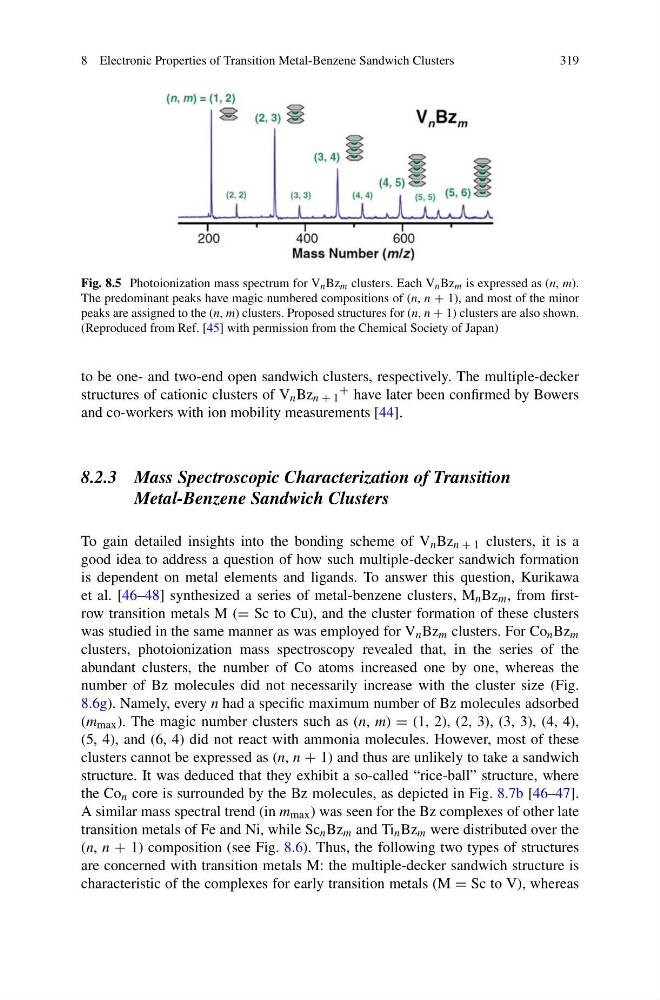
Fig. 8.5 Photoionization mass spectrum for V n Bz m clusters. Each V n Bz m is expressed as (n, m).
The predominant peaks have magic numbered compositions of (n, n + 1), and most of the minor
peaks are assigned to the (n, m) clusters. Proposed structures for (n, n + 1) clusters are also shown.
(Reproduced from Ref. [45] with permission from the Chemical Society of Japan)
to be one- and two-end open sandwich clusters, respectively. The multiple-decker
structures of cationic clusters of V n Bz n + 1
+ have later been confirmed by Bowers
and co-workers with ion mobility measurements [44].
8.2.3 Mass Spectroscopic Characterization of Transition
Metal-Benzene Sandwich Clusters
To gain detailed insights into the bonding scheme of V n Bz n + 1 clusters, it is a
good idea to address a question of how such multiple-decker sandwich formation
is dependent on metal elements and ligands. To answer this question, Kurikawa
et al. [46–48] synthesized a series of metal-benzene clusters, M n Bz m , from firstrow transition metals M (= Sc to Cu), and the cluster formation of these clusters
was studied in the same manner as was employed for V n Bz m clusters. For Co n Bz m
clusters, photoionization mass spectroscopy revealed that, in the series of the
abundant clusters, the number of Co atoms increased one by one, whereas the
number of Bz molecules did not necessarily increase with the cluster size (Fig.
8.6g). Namely, every n had a specific maximum number of Bz molecules adsorbed
(m max ). The magic number clusters such as (n, m) = (1, 2), (2, 3), (3, 3), (4, 4),
(5, 4), and (6, 4) did not react with ammonia molecules. However, most of these
clusters cannot be expressed as (n, n + 1) and thus are unlikely to take a sandwich
structure. It was deduced that they exhibit a so-called “rice-ball” structure, where
the Co n core is surrounded by the Bz molecules, as depicted in Fig. 8.7b [46–47].
A similar mass spectral trend (in m max ) was seen for the Bz complexes of other late
transition metals of Fe and Ni, while Sc n Bz m and Ti n Bz m were distributed over the
(n, n + 1) composition (see Fig. 8.6). Thus, the following two types of structures
are concerned with transition metals M: the multiple-decker sandwich structure is
characteristic of the complexes for early transition metals (M = Sc to V), whereas
319
Fig. 8.5 Photoionization mass spectrum for V n Bz m clusters. Each V n Bz m is expressed as (n, m).
The predominant peaks have magic numbered compositions of (n, n + 1), and most of the minor
peaks are assigned to the (n, m) clusters. Proposed structures for (n, n + 1) clusters are also shown.
(Reproduced from Ref. [45] with permission from the Chemical Society of Japan)
to be one- and two-end open sandwich clusters, respectively. The multiple-decker
structures of cationic clusters of V n Bz n + 1
+ have later been confirmed by Bowers
and co-workers with ion mobility measurements [44].
8.2.3 Mass Spectroscopic Characterization of Transition
Metal-Benzene Sandwich Clusters
To gain detailed insights into the bonding scheme of V n Bz n + 1 clusters, it is a
good idea to address a question of how such multiple-decker sandwich formation
is dependent on metal elements and ligands. To answer this question, Kurikawa
et al. [46–48] synthesized a series of metal-benzene clusters, M n Bz m , from firstrow transition metals M (= Sc to Cu), and the cluster formation of these clusters
was studied in the same manner as was employed for V n Bz m clusters. For Co n Bz m
clusters, photoionization mass spectroscopy revealed that, in the series of the
abundant clusters, the number of Co atoms increased one by one, whereas the
number of Bz molecules did not necessarily increase with the cluster size (Fig.
8.6g). Namely, every n had a specific maximum number of Bz molecules adsorbed
(m max ). The magic number clusters such as (n, m) = (1, 2), (2, 3), (3, 3), (4, 4),
(5, 4), and (6, 4) did not react with ammonia molecules. However, most of these
clusters cannot be expressed as (n, n + 1) and thus are unlikely to take a sandwich
structure. It was deduced that they exhibit a so-called “rice-ball” structure, where
the Co n core is surrounded by the Bz molecules, as depicted in Fig. 8.7b [46–47].
A similar mass spectral trend (in m max ) was seen for the Bz complexes of other late
transition metals of Fe and Ni, while Sc n Bz m and Ti n Bz m were distributed over the
(n, n + 1) composition (see Fig. 8.6). Thus, the following two types of structures
are concerned with transition metals M: the multiple-decker sandwich structure is
characteristic of the complexes for early transition metals (M = Sc to V), whereas