

318
T. Masubuchi and A. Nakajima
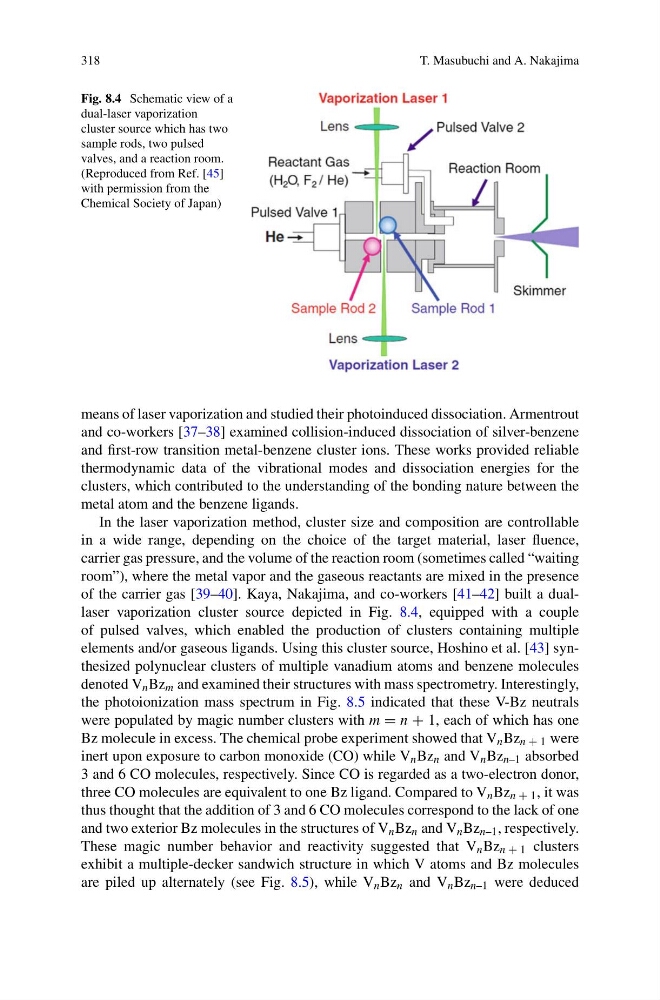
Fig. 8.4 Schematic view of a
dual-laser vaporization
cluster source which has two
sample rods, two pulsed
valves, and a reaction room.
(Reproduced from Ref. [45]
with permission from the
Chemical Society of Japan)
means of laser vaporization and studied their photoinduced dissociation. Armentrout
and co-workers [37–38] examined collision-induced dissociation of silver-benzene
and first-row transition metal-benzene cluster ions. These works provided reliable
thermodynamic data of the vibrational modes and dissociation energies for the
clusters, which contributed to the understanding of the bonding nature between the
metal atom and the benzene ligands.
In the laser vaporization method, cluster size and composition are controllable
in a wide range, depending on the choice of the target material, laser fluence,
carrier gas pressure, and the volume of the reaction room (sometimes called “waiting
room”), where the metal vapor and the gaseous reactants are mixed in the presence
of the carrier gas [39–40]. Kaya, Nakajima, and co-workers [41–42] built a duallaser vaporization cluster source depicted in Fig. 8.4, equipped with a couple
of pulsed valves, which enabled the production of clusters containing multiple
elements and/or gaseous ligands. Using this cluster source, Hoshino et al. [43] synthesized polynuclear clusters of multiple vanadium atoms and benzene molecules
denoted V n Bz m and examined their structures with mass spectrometry. Interestingly,
the photoionization mass spectrum in Fig. 8.5 indicated that these V-Bz neutrals
were populated by magic number clusters with m = n + 1, each of which has one
Bz molecule in excess. The chemical probe experiment showed that V n Bz n + 1 were
inert upon exposure to carbon monoxide (CO) while V n Bz n and V n Bz n–1 absorbed
3 and 6 CO molecules, respectively. Since CO is regarded as a two-electron donor,
three CO molecules are equivalent to one Bz ligand. Compared to V n Bz n + 1 , it was
thus thought that the addition of 3 and 6 CO molecules correspond to the lack of one
and two exterior Bz molecules in the structures of V n Bz n and V n Bz n–1 , respectively.
These magic number behavior and reactivity suggested that V n Bz n + 1 clusters
exhibit a multiple-decker sandwich structure in which V atoms and Bz molecules
are piled up alternately (see Fig. 8.5), while V n Bz n and V n Bz n–1 were deduced
T. Masubuchi and A. Nakajima
Fig. 8.4 Schematic view of a
dual-laser vaporization
cluster source which has two
sample rods, two pulsed
valves, and a reaction room.
(Reproduced from Ref. [45]
with permission from the
Chemical Society of Japan)
means of laser vaporization and studied their photoinduced dissociation. Armentrout
and co-workers [37–38] examined collision-induced dissociation of silver-benzene
and first-row transition metal-benzene cluster ions. These works provided reliable
thermodynamic data of the vibrational modes and dissociation energies for the
clusters, which contributed to the understanding of the bonding nature between the
metal atom and the benzene ligands.
In the laser vaporization method, cluster size and composition are controllable
in a wide range, depending on the choice of the target material, laser fluence,
carrier gas pressure, and the volume of the reaction room (sometimes called “waiting
room”), where the metal vapor and the gaseous reactants are mixed in the presence
of the carrier gas [39–40]. Kaya, Nakajima, and co-workers [41–42] built a duallaser vaporization cluster source depicted in Fig. 8.4, equipped with a couple
of pulsed valves, which enabled the production of clusters containing multiple
elements and/or gaseous ligands. Using this cluster source, Hoshino et al. [43] synthesized polynuclear clusters of multiple vanadium atoms and benzene molecules
denoted V n Bz m and examined their structures with mass spectrometry. Interestingly,
the photoionization mass spectrum in Fig. 8.5 indicated that these V-Bz neutrals
were populated by magic number clusters with m = n + 1, each of which has one
Bz molecule in excess. The chemical probe experiment showed that V n Bz n + 1 were
inert upon exposure to carbon monoxide (CO) while V n Bz n and V n Bz n–1 absorbed
3 and 6 CO molecules, respectively. Since CO is regarded as a two-electron donor,
three CO molecules are equivalent to one Bz ligand. Compared to V n Bz n + 1 , it was
thus thought that the addition of 3 and 6 CO molecules correspond to the lack of one
and two exterior Bz molecules in the structures of V n Bz n and V n Bz n–1 , respectively.
These magic number behavior and reactivity suggested that V n Bz n + 1 clusters
exhibit a multiple-decker sandwich structure in which V atoms and Bz molecules
are piled up alternately (see Fig. 8.5), while V n Bz n and V n Bz n–1 were deduced