

8 Electronic Properties of Transition Metal-Benzene Sandwich Clusters
317
8.2.2 Gas-Phase Synthesis of Organometallic Complexes
The development of vacuum techniques has enabled the direct synthesis of difficultto-form complexes from vaporized materials. Followed by the synthesis of C 3
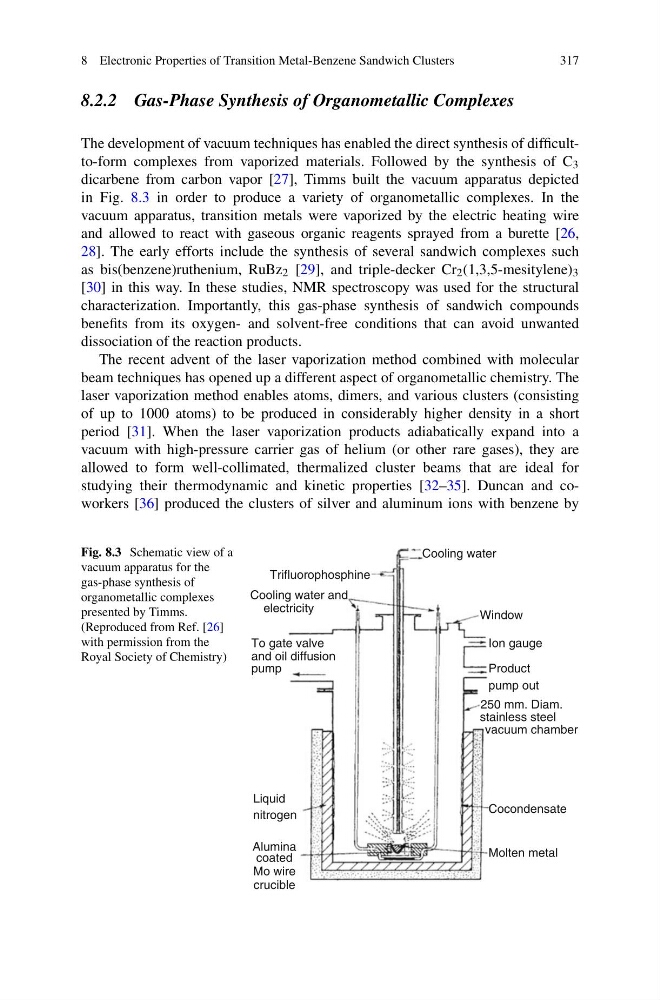
dicarbene from carbon vapor [27], Timms built the vacuum apparatus depicted
in Fig. 8.3 in order to produce a variety of organometallic complexes. In the
vacuum apparatus, transition metals were vaporized by the electric heating wire
and allowed to react with gaseous organic reagents sprayed from a burette [26,
28]. The early efforts include the synthesis of several sandwich complexes such
as bis(benzene)ruthenium, RuBz 2 [29], and triple-decker Cr 2 (1,3,5-mesitylene) 3
[30] in this way. In these studies, NMR spectroscopy was used for the structural
characterization. Importantly, this gas-phase synthesis of sandwich compounds
benefits from its oxygen- and solvent-free conditions that can avoid unwanted
dissociation of the reaction products.
The recent advent of the laser vaporization method combined with molecular
beam techniques has opened up a different aspect of organometallic chemistry. The
laser vaporization method enables atoms, dimers, and various clusters (consisting
of up to 1000 atoms) to be produced in considerably higher density in a short
period [31]. When the laser vaporization products adiabatically expand into a
vacuum with high-pressure carrier gas of helium (or other rare gases), they are
allowed to form well-collimated, thermalized cluster beams that are ideal for
studying their thermodynamic and kinetic properties [32–35]. Duncan and coworkers [36] produced the clusters of silver and aluminum ions with benzene by
Fig. 8.3 Schematic view of a
vacuum apparatus for the
gas-phase synthesis of
organometallic complexes
presented by Timms.
(Reproduced from Ref. [26]
with permission from the
Royal Society of Chemistry)
Cooling water
Window
Ion gauge
Product
pump out
250 mm. Diam.
stainless steel
vacuum chamber
Cocondensate
Molten metal
Alumina
coated
Mo wire
crucible
Liquid
nitrogen
To gate valve
and oil diffusion
pump
Cooling water and
electricity
Trifluorophosphine
317
8.2.2 Gas-Phase Synthesis of Organometallic Complexes
The development of vacuum techniques has enabled the direct synthesis of difficultto-form complexes from vaporized materials. Followed by the synthesis of C 3
dicarbene from carbon vapor [27], Timms built the vacuum apparatus depicted
in Fig. 8.3 in order to produce a variety of organometallic complexes. In the
vacuum apparatus, transition metals were vaporized by the electric heating wire
and allowed to react with gaseous organic reagents sprayed from a burette [26,
28]. The early efforts include the synthesis of several sandwich complexes such
as bis(benzene)ruthenium, RuBz 2 [29], and triple-decker Cr 2 (1,3,5-mesitylene) 3
[30] in this way. In these studies, NMR spectroscopy was used for the structural
characterization. Importantly, this gas-phase synthesis of sandwich compounds
benefits from its oxygen- and solvent-free conditions that can avoid unwanted
dissociation of the reaction products.
The recent advent of the laser vaporization method combined with molecular
beam techniques has opened up a different aspect of organometallic chemistry. The
laser vaporization method enables atoms, dimers, and various clusters (consisting
of up to 1000 atoms) to be produced in considerably higher density in a short
period [31]. When the laser vaporization products adiabatically expand into a
vacuum with high-pressure carrier gas of helium (or other rare gases), they are
allowed to form well-collimated, thermalized cluster beams that are ideal for
studying their thermodynamic and kinetic properties [32–35]. Duncan and coworkers [36] produced the clusters of silver and aluminum ions with benzene by
Fig. 8.3 Schematic view of a
vacuum apparatus for the
gas-phase synthesis of
organometallic complexes
presented by Timms.
(Reproduced from Ref. [26]
with permission from the
Royal Society of Chemistry)
Cooling water
Window
Ion gauge
Product
pump out
250 mm. Diam.
stainless steel
vacuum chamber
Cocondensate
Molten metal
Alumina
coated
Mo wire
crucible
Liquid
nitrogen
To gate valve
and oil diffusion
pump
Cooling water and
electricity
Trifluorophosphine