

288
P. Veerakumar et al.
Recently, PCs have long been used as catalysts in organic transformations such as
oxidation phenol [110], ODH of ethylbenzene [111], and anaerobic biotransformation of nitroanilines [112]. But the considerable modification in the porous structure
of bare carbon materials, as well as the possibility of chemical and structural
changes, offers new opportunities to use the PC materials in many different chemical
reactions [113].
Carbon gels (CGs) are obtained by carbonization of organic gels produced
by the sol-gel polycondensation of organic monomers such as resorcinol and
formaldehyde, as first described by Pekala [114]. It exhibits high porosity and
surface area, narrow pore size distributions, and randomly oriented pores, which
have been reported as catalysts for quite a large variety of reactions. For instance,
CGs functionalized with sulfonic acid groups are active acid catalysts for the
esterification of acetic acid with ethanol [115]; N-doped carbon xerogels were used
for oxidation of NO [116] and in the degradation of organic pollutants by advanced
oxidation processes [117].
Black carbons (BCs) are carbonaceous materials composed of single and stacked
polyaromatic sheets in a highly disordered arrangement. These sheets can be
functionalized along the edges with hydroxyl (-OH), carboxyl (-COOH), keto
(>C=O), or other functional groups. The textural properties such as surface area,
pore volume, and pore size were dependent on the source material and conditions of
synthesis [118]. It consists of spherical graphite particles (less than 50 nm diameter)
with 0.35 nm interplanar spacing. The N 2 gas adsorption measurements reveal high
surface area (typically, more than 50 m 2 g −1 ), high porosity (0.1–0.2 cm 3 g −1 ), and
small pore size, i.e., below approximately 20 Å, with small porosity in the range
4–10 Å. They are most commonly used catalyst support in various environmental
applications due to its high surface area (250 m 2 g −1 ) and low cost [119].
Recent studies have demonstrated that black carbons (BCs) could significantly
accelerate the abiotic reduction of NACs in the presence of reductants, after
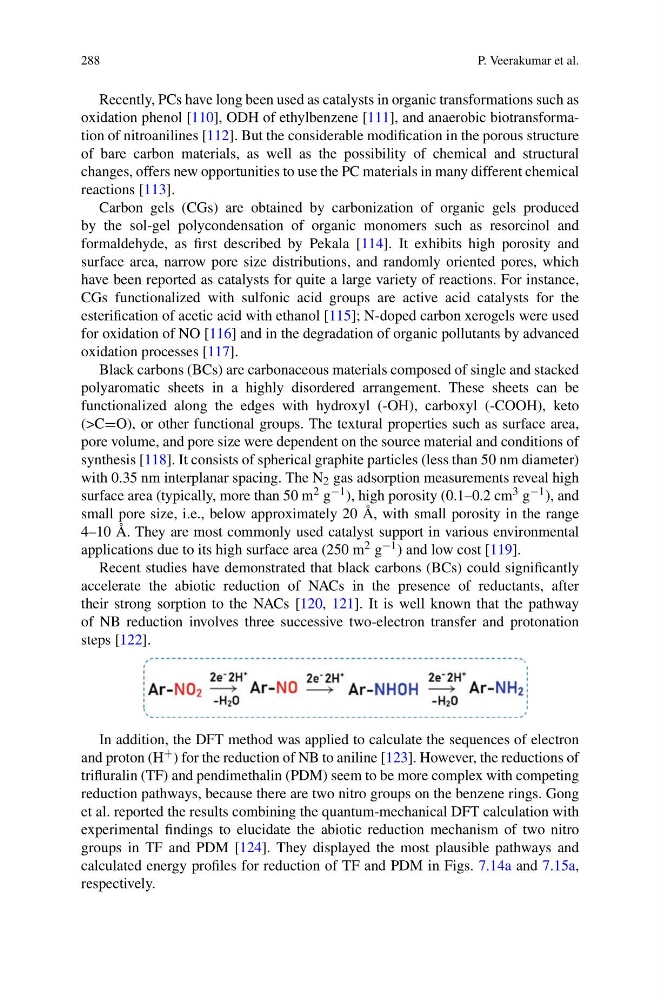
their strong sorption to the NACs [120, 121]. It is well known that the pathway
of NB reduction involves three successive two-electron transfer and protonation
steps [122].
In addition, the DFT method was applied to calculate the sequences of electron
and proton (H + ) for the reduction of NB to aniline [123]. However, the reductions of
trifluralin (TF) and pendimethalin (PDM) seem to be more complex with competing
reduction pathways, because there are two nitro groups on the benzene rings. Gong
et al. reported the results combining the quantum-mechanical DFT calculation with
experimental findings to elucidate the abiotic reduction mechanism of two nitro
groups in TF and PDM [124]. They displayed the most plausible pathways and
calculated energy profiles for reduction of TF and PDM in Figs. 7.14a and 7.15a,
respectively.
P. Veerakumar et al.
Recently, PCs have long been used as catalysts in organic transformations such as
oxidation phenol [110], ODH of ethylbenzene [111], and anaerobic biotransformation of nitroanilines [112]. But the considerable modification in the porous structure
of bare carbon materials, as well as the possibility of chemical and structural
changes, offers new opportunities to use the PC materials in many different chemical
reactions [113].
Carbon gels (CGs) are obtained by carbonization of organic gels produced
by the sol-gel polycondensation of organic monomers such as resorcinol and
formaldehyde, as first described by Pekala [114]. It exhibits high porosity and
surface area, narrow pore size distributions, and randomly oriented pores, which
have been reported as catalysts for quite a large variety of reactions. For instance,
CGs functionalized with sulfonic acid groups are active acid catalysts for the
esterification of acetic acid with ethanol [115]; N-doped carbon xerogels were used
for oxidation of NO [116] and in the degradation of organic pollutants by advanced
oxidation processes [117].
Black carbons (BCs) are carbonaceous materials composed of single and stacked
polyaromatic sheets in a highly disordered arrangement. These sheets can be
functionalized along the edges with hydroxyl (-OH), carboxyl (-COOH), keto
(>C=O), or other functional groups. The textural properties such as surface area,
pore volume, and pore size were dependent on the source material and conditions of
synthesis [118]. It consists of spherical graphite particles (less than 50 nm diameter)
with 0.35 nm interplanar spacing. The N 2 gas adsorption measurements reveal high
surface area (typically, more than 50 m 2 g −1 ), high porosity (0.1–0.2 cm 3 g −1 ), and
small pore size, i.e., below approximately 20 Å, with small porosity in the range
4–10 Å. They are most commonly used catalyst support in various environmental
applications due to its high surface area (250 m 2 g −1 ) and low cost [119].
Recent studies have demonstrated that black carbons (BCs) could significantly
accelerate the abiotic reduction of NACs in the presence of reductants, after
their strong sorption to the NACs [120, 121]. It is well known that the pathway
of NB reduction involves three successive two-electron transfer and protonation
steps [122].
In addition, the DFT method was applied to calculate the sequences of electron
and proton (H + ) for the reduction of NB to aniline [123]. However, the reductions of
trifluralin (TF) and pendimethalin (PDM) seem to be more complex with competing
reduction pathways, because there are two nitro groups on the benzene rings. Gong
et al. reported the results combining the quantum-mechanical DFT calculation with
experimental findings to elucidate the abiotic reduction mechanism of two nitro
groups in TF and PDM [124]. They displayed the most plausible pathways and
calculated energy profiles for reduction of TF and PDM in Figs. 7.14a and 7.15a,
respectively.