

7 Computational and Experimental Analysis of Carbon Functional Nanomaterials
287
organic frame work (MOF)-derived ACs, as the other major form of porous carbon,
are primarily made of graphitic sheets with regular order and possess extremely
high surface areas and large pore volumes which make them extremely promising
candidates for applications such as catalyst supports and adsorbents. Due to the
presence of favorable pore geometries and volumes, ACs have been used in the areas
of gas separation and storage, water purification, electrochemistry, and catalysis
[106].
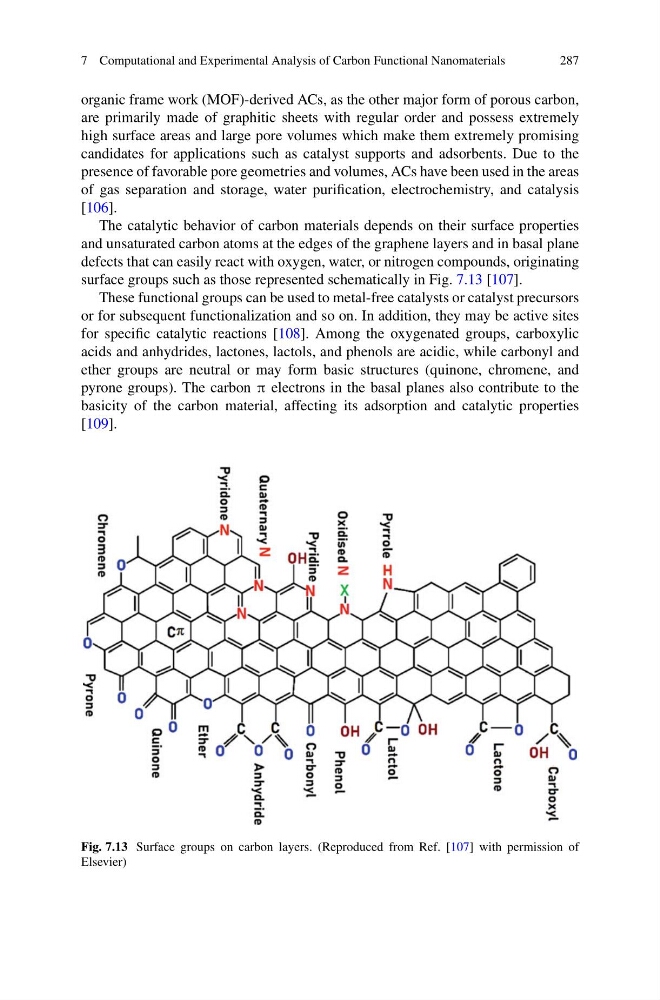
The catalytic behavior of carbon materials depends on their surface properties
and unsaturated carbon atoms at the edges of the graphene layers and in basal plane
defects that can easily react with oxygen, water, or nitrogen compounds, originating
surface groups such as those represented schematically in Fig. 7.13 [107].
These functional groups can be used to metal-free catalysts or catalyst precursors
or for subsequent functionalization and so on. In addition, they may be active sites
for specific catalytic reactions [108]. Among the oxygenated groups, carboxylic
acids and anhydrides, lactones, lactols, and phenols are acidic, while carbonyl and
ether groups are neutral or may form basic structures (quinone, chromene, and
pyrone groups). The carbon π electrons in the basal planes also contribute to the
basicity of the carbon material, affecting its adsorption and catalytic properties
[109].
Fig. 7.13 Surface groups on carbon layers. (Reproduced from Ref. [107] with permission of
Elsevier)
287
organic frame work (MOF)-derived ACs, as the other major form of porous carbon,
are primarily made of graphitic sheets with regular order and possess extremely
high surface areas and large pore volumes which make them extremely promising
candidates for applications such as catalyst supports and adsorbents. Due to the
presence of favorable pore geometries and volumes, ACs have been used in the areas
of gas separation and storage, water purification, electrochemistry, and catalysis
[106].
The catalytic behavior of carbon materials depends on their surface properties
and unsaturated carbon atoms at the edges of the graphene layers and in basal plane
defects that can easily react with oxygen, water, or nitrogen compounds, originating
surface groups such as those represented schematically in Fig. 7.13 [107].
These functional groups can be used to metal-free catalysts or catalyst precursors
or for subsequent functionalization and so on. In addition, they may be active sites
for specific catalytic reactions [108]. Among the oxygenated groups, carboxylic
acids and anhydrides, lactones, lactols, and phenols are acidic, while carbonyl and
ether groups are neutral or may form basic structures (quinone, chromene, and
pyrone groups). The carbon π electrons in the basal planes also contribute to the
basicity of the carbon material, affecting its adsorption and catalytic properties
[109].
Fig. 7.13 Surface groups on carbon layers. (Reproduced from Ref. [107] with permission of
Elsevier)