

7 Computational and Experimental Analysis of Carbon Functional Nanomaterials
279
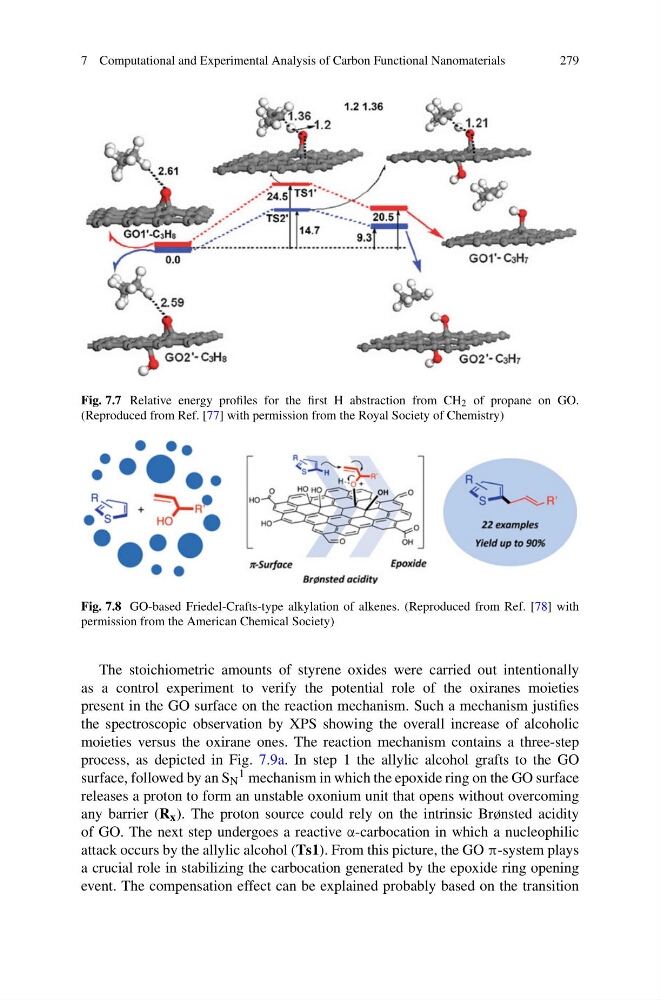
Fig. 7.7 Relative energy profiles for the first H abstraction from CH 2 of propane on GO.
(Reproduced from Ref. [77] with permission from the Royal Society of Chemistry)
Fig. 7.8 GO-based Friedel-Crafts-type alkylation of alkenes. (Reproduced from Ref. [78] with
permission from the American Chemical Society)
The stoichiometric amounts of styrene oxides were carried out intentionally
as a control experiment to verify the potential role of the oxiranes moieties
present in the GO surface on the reaction mechanism. Such a mechanism justifies
the spectroscopic observation by XPS showing the overall increase of alcoholic
moieties versus the oxirane ones. The reaction mechanism contains a three-step
process, as depicted in Fig. 7.9a. In step 1 the allylic alcohol grafts to the GO
surface, followed by an S N
1 mechanism in which the epoxide ring on the GO surface
releases a proton to form an unstable oxonium unit that opens without overcoming
any barrier (R x ). The proton source could rely on the intrinsic Brønsted acidity
of GO. The next step undergoes a reactive α-carbocation in which a nucleophilic
attack occurs by the allylic alcohol (Ts1). From this picture, the GO π-system plays
a crucial role in stabilizing the carbocation generated by the epoxide ring opening
event. The compensation effect can be explained probably based on the transition
279
Fig. 7.7 Relative energy profiles for the first H abstraction from CH 2 of propane on GO.
(Reproduced from Ref. [77] with permission from the Royal Society of Chemistry)
Fig. 7.8 GO-based Friedel-Crafts-type alkylation of alkenes. (Reproduced from Ref. [78] with
permission from the American Chemical Society)
The stoichiometric amounts of styrene oxides were carried out intentionally
as a control experiment to verify the potential role of the oxiranes moieties
present in the GO surface on the reaction mechanism. Such a mechanism justifies
the spectroscopic observation by XPS showing the overall increase of alcoholic
moieties versus the oxirane ones. The reaction mechanism contains a three-step
process, as depicted in Fig. 7.9a. In step 1 the allylic alcohol grafts to the GO
surface, followed by an S N
1 mechanism in which the epoxide ring on the GO surface
releases a proton to form an unstable oxonium unit that opens without overcoming
any barrier (R x ). The proton source could rely on the intrinsic Brønsted acidity
of GO. The next step undergoes a reactive α-carbocation in which a nucleophilic
attack occurs by the allylic alcohol (Ts1). From this picture, the GO π-system plays
a crucial role in stabilizing the carbocation generated by the epoxide ring opening
event. The compensation effect can be explained probably based on the transition