

278
P. Veerakumar et al.
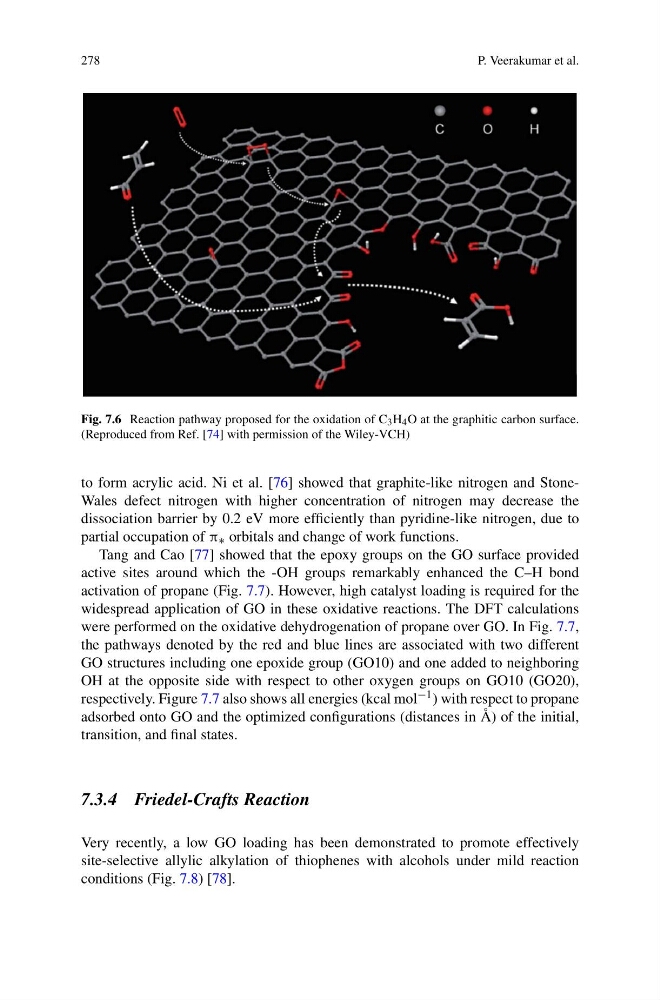
Fig. 7.6 Reaction pathway proposed for the oxidation of C 3 H 4 O at the graphitic carbon surface.
(Reproduced from Ref. [74] with permission of the Wiley-VCH)
to form acrylic acid. Ni et al. [76] showed that graphite-like nitrogen and StoneWales defect nitrogen with higher concentration of nitrogen may decrease the
dissociation barrier by 0.2 eV more efficiently than pyridine-like nitrogen, due to
partial occupation of π ∗ orbitals and change of work functions.
Tang and Cao [77] showed that the epoxy groups on the GO surface provided
active sites around which the -OH groups remarkably enhanced the C–H bond
activation of propane (Fig. 7.7). However, high catalyst loading is required for the
widespread application of GO in these oxidative reactions. The DFT calculations
were performed on the oxidative dehydrogenation of propane over GO. In Fig. 7.7,
the pathways denoted by the red and blue lines are associated with two different
GO structures including one epoxide group (GO10) and one added to neighboring
OH at the opposite side with respect to other oxygen groups on GO10 (GO20),
respectively. Figure 7.7 also shows all energies (kcal mol −1 ) with respect to propane
adsorbed onto GO and the optimized configurations (distances in Å) of the initial,
transition, and final states.
7.3.4 Friedel-Crafts Reaction
Very recently, a low GO loading has been demonstrated to promote effectively
site-selective allylic alkylation of thiophenes with alcohols under mild reaction
conditions (Fig. 7.8) [78].
P. Veerakumar et al.
Fig. 7.6 Reaction pathway proposed for the oxidation of C 3 H 4 O at the graphitic carbon surface.
(Reproduced from Ref. [74] with permission of the Wiley-VCH)
to form acrylic acid. Ni et al. [76] showed that graphite-like nitrogen and StoneWales defect nitrogen with higher concentration of nitrogen may decrease the
dissociation barrier by 0.2 eV more efficiently than pyridine-like nitrogen, due to
partial occupation of π ∗ orbitals and change of work functions.
Tang and Cao [77] showed that the epoxy groups on the GO surface provided
active sites around which the -OH groups remarkably enhanced the C–H bond
activation of propane (Fig. 7.7). However, high catalyst loading is required for the
widespread application of GO in these oxidative reactions. The DFT calculations
were performed on the oxidative dehydrogenation of propane over GO. In Fig. 7.7,
the pathways denoted by the red and blue lines are associated with two different
GO structures including one epoxide group (GO10) and one added to neighboring
OH at the opposite side with respect to other oxygen groups on GO10 (GO20),
respectively. Figure 7.7 also shows all energies (kcal mol −1 ) with respect to propane
adsorbed onto GO and the optimized configurations (distances in Å) of the initial,
transition, and final states.
7.3.4 Friedel-Crafts Reaction
Very recently, a low GO loading has been demonstrated to promote effectively
site-selective allylic alkylation of thiophenes with alcohols under mild reaction
conditions (Fig. 7.8) [78].