

6 Group 13–15 Needle-Shaped Oligomers and Nanorods: Structures. . .
255
HOMO
HOMO-2
HOMO
HOMO
FGa[HGaNH] 30 NCH 3
LUMO
LUMO
LUMO
CH 3 Ga[HGaNH] 30 NF
(CH 3 ) 3 [HGaNH] 30 F 3
(a)
(b)
(c)
(d)
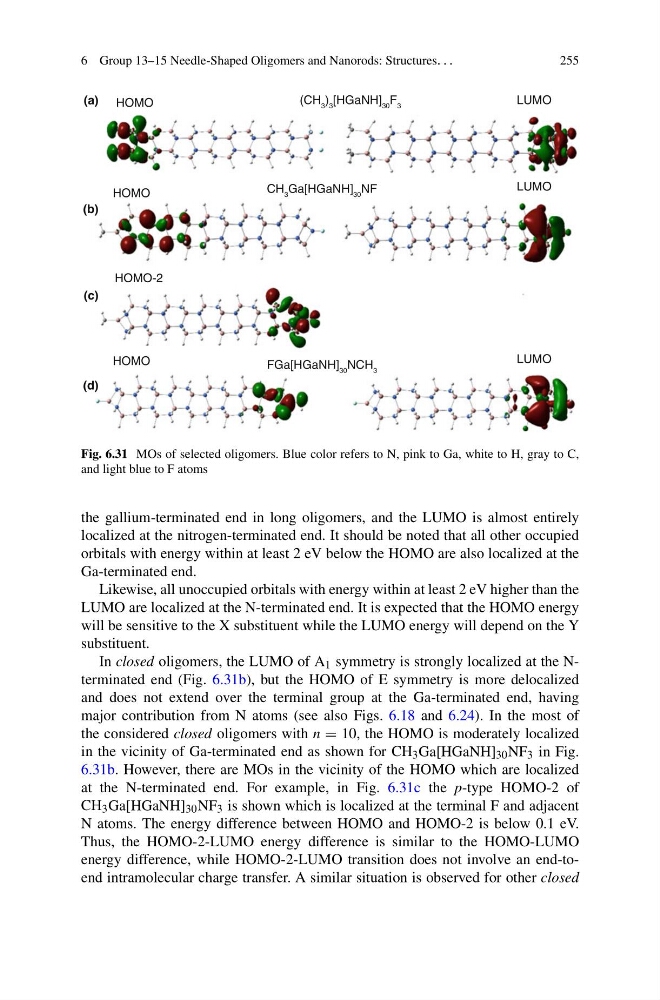
Fig. 6.31 MOs of selected oligomers. Blue color refers to N, pink to Ga, white to H, gray to C,
and light blue to F atoms
the gallium-terminated end in long oligomers, and the LUMO is almost entirely
localized at the nitrogen-terminated end. It should be noted that all other occupied
orbitals with energy within at least 2 eV below the HOMO are also localized at the
Ga-terminated end.
Likewise, all unoccupied orbitals with energy within at least 2 eV higher than the
LUMO are localized at the N-terminated end. It is expected that the HOMO energy
will be sensitive to the X substituent while the LUMO energy will depend on the Y
substituent.
In closed oligomers, the LUMO of A 1 symmetry is strongly localized at the Nterminated end (Fig. 6.31b), but the HOMO of E symmetry is more delocalized
and does not extend over the terminal group at the Ga-terminated end, having
major contribution from N atoms (see also Figs. 6.18 and 6.24). In the most of
the considered closed oligomers with n = 10, the HOMO is moderately localized
in the vicinity of Ga-terminated end as shown for CH 3 Ga[HGaNH] 30 NF 3 in Fig.
6.31b. However, there are MOs in the vicinity of the HOMO which are localized
at the N-terminated end. For example, in Fig. 6.31c the p-type HOMO-2 of
CH 3 Ga[HGaNH] 30 NF 3 is shown which is localized at the terminal F and adjacent
N atoms. The energy difference between HOMO and HOMO-2 is below 0.1 eV.
Thus, the HOMO-2-LUMO energy difference is similar to the HOMO-LUMO
energy difference, while HOMO-2-LUMO transition does not involve an end-toend intramolecular charge transfer. A similar situation is observed for other closed
255
HOMO
HOMO-2
HOMO
HOMO
FGa[HGaNH] 30 NCH 3
LUMO
LUMO
LUMO
CH 3 Ga[HGaNH] 30 NF
(CH 3 ) 3 [HGaNH] 30 F 3
(a)
(b)
(c)
(d)
Fig. 6.31 MOs of selected oligomers. Blue color refers to N, pink to Ga, white to H, gray to C,
and light blue to F atoms
the gallium-terminated end in long oligomers, and the LUMO is almost entirely
localized at the nitrogen-terminated end. It should be noted that all other occupied
orbitals with energy within at least 2 eV below the HOMO are also localized at the
Ga-terminated end.
Likewise, all unoccupied orbitals with energy within at least 2 eV higher than the
LUMO are localized at the N-terminated end. It is expected that the HOMO energy
will be sensitive to the X substituent while the LUMO energy will depend on the Y
substituent.
In closed oligomers, the LUMO of A 1 symmetry is strongly localized at the Nterminated end (Fig. 6.31b), but the HOMO of E symmetry is more delocalized
and does not extend over the terminal group at the Ga-terminated end, having
major contribution from N atoms (see also Figs. 6.18 and 6.24). In the most of
the considered closed oligomers with n = 10, the HOMO is moderately localized
in the vicinity of Ga-terminated end as shown for CH 3 Ga[HGaNH] 30 NF 3 in Fig.
6.31b. However, there are MOs in the vicinity of the HOMO which are localized
at the N-terminated end. For example, in Fig. 6.31c the p-type HOMO-2 of
CH 3 Ga[HGaNH] 30 NF 3 is shown which is localized at the terminal F and adjacent
N atoms. The energy difference between HOMO and HOMO-2 is below 0.1 eV.
Thus, the HOMO-2-LUMO energy difference is similar to the HOMO-LUMO
energy difference, while HOMO-2-LUMO transition does not involve an end-toend intramolecular charge transfer. A similar situation is observed for other closed