

254
A. V. Pomogaeva and A. Y. Timoshkin
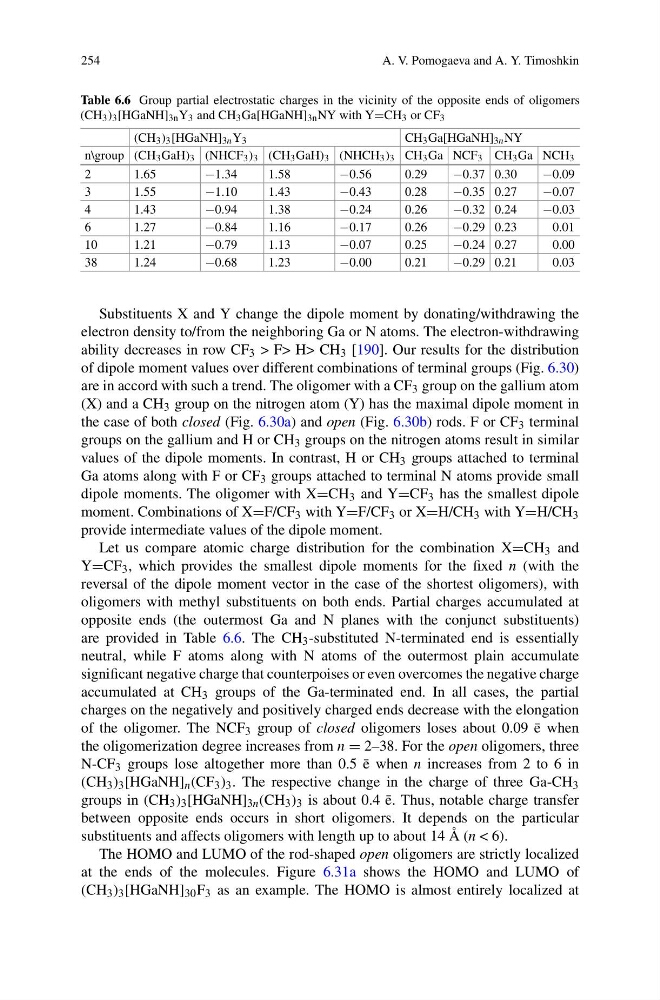
Table 6.6 Group partial electrostatic charges in the vicinity of the opposite ends of oligomers
(CH 3 ) 3 [HGaNH] 3n Y 3 and CH 3 Ga[HGaNH] 3n NY with Y=CH 3 or CF 3
(CH 3 ) 3 [HGaNH] 3n Y 3
CH 3 Ga[HGaNH] 3n NY
n\group (CH 3 GaH) 3 (NHCF 3 ) 3 (CH 3 GaH) 3 (NHCH 3 ) 3 CH 3 Ga NCF 3 CH 3 Ga NCH 3
2
1.65
−1.34
1.58
−0.56
0.29
−0.37 0.30
−0.09
3
1.55
−1.10
1.43
−0.43
0.28
−0.35 0.27
−0.07
4
1.43
−0.94
1.38
−0.24
0.26
−0.32 0.24
−0.03
6
1.27
−0.84
1.16
−0.17
0.26
−0.29 0.23
0.01
10
1.21
−0.79
1.13
−0.07
0.25
−0.24 0.27
0.00
38
1.24
−0.68
1.23
−0.00
0.21
−0.29 0.21
0.03
Substituents X and Y change the dipole moment by donating/withdrawing the
electron density to/from the neighboring Ga or N atoms. The electron-withdrawing
ability decreases in row CF 3 > F> H> CH 3 [190]. Our results for the distribution
of dipole moment values over different combinations of terminal groups (Fig. 6.30)
are in accord with such a trend. The oligomer with a CF 3 group on the gallium atom
(X) and a CH 3 group on the nitrogen atom (Y) has the maximal dipole moment in
the case of both closed (Fig. 6.30a) and open (Fig. 6.30b) rods. F or CF 3 terminal
groups on the gallium and H or CH 3 groups on the nitrogen atoms result in similar
values of the dipole moments. In contrast, H or CH 3 groups attached to terminal
Ga atoms along with F or CF 3 groups attached to terminal N atoms provide small
dipole moments. The oligomer with X=CH 3 and Y=CF 3 has the smallest dipole
moment. Combinations of X=F/CF 3 with Y=F/CF 3 or X=H/CH 3 with Y=H/CH 3
provide intermediate values of the dipole moment.
Let us compare atomic charge distribution for the combination X=CH 3 and
Y=CF 3 , which provides the smallest dipole moments for the fixed n (with the
reversal of the dipole moment vector in the case of the shortest oligomers), with
oligomers with methyl substituents on both ends. Partial charges accumulated at
opposite ends (the outermost Ga and N planes with the conjunct substituents)
are provided in Table 6.6. The CH 3 -substituted N-terminated end is essentially
neutral, while F atoms along with N atoms of the outermost plain accumulate
significant negative charge that counterpoises or even overcomes the negative charge
accumulated at CH 3 groups of the Ga-terminated end. In all cases, the partial
charges on the negatively and positively charged ends decrease with the elongation
of the oligomer. The NCF 3 group of closed oligomers loses about 0.09 ¯
e when
the oligomerization degree increases from n = 2–38. For the open oligomers, three
N-CF 3 groups lose altogether more than 0.5 ¯
e when n increases from 2 to 6 in
(CH 3 ) 3 [HGaNH] n (CF 3 ) 3 . The respective change in the charge of three Ga-CH 3
groups in (CH 3 ) 3 [HGaNH] 3n (CH 3 ) 3 is about 0.4 ¯
e. Thus, notable charge transfer
between opposite ends occurs in short oligomers. It depends on the particular
substituents and affects oligomers with length up to about 14 Å (n < 6).
The HOMO and LUMO of the rod-shaped open oligomers are strictly localized
at the ends of the molecules. Figure 6.31a shows the HOMO and LUMO of
(CH 3 ) 3 [HGaNH] 30 F 3 as an example. The HOMO is almost entirely localized at
A. V. Pomogaeva and A. Y. Timoshkin
Table 6.6 Group partial electrostatic charges in the vicinity of the opposite ends of oligomers
(CH 3 ) 3 [HGaNH] 3n Y 3 and CH 3 Ga[HGaNH] 3n NY with Y=CH 3 or CF 3
(CH 3 ) 3 [HGaNH] 3n Y 3
CH 3 Ga[HGaNH] 3n NY
n\group (CH 3 GaH) 3 (NHCF 3 ) 3 (CH 3 GaH) 3 (NHCH 3 ) 3 CH 3 Ga NCF 3 CH 3 Ga NCH 3
2
1.65
−1.34
1.58
−0.56
0.29
−0.37 0.30
−0.09
3
1.55
−1.10
1.43
−0.43
0.28
−0.35 0.27
−0.07
4
1.43
−0.94
1.38
−0.24
0.26
−0.32 0.24
−0.03
6
1.27
−0.84
1.16
−0.17
0.26
−0.29 0.23
0.01
10
1.21
−0.79
1.13
−0.07
0.25
−0.24 0.27
0.00
38
1.24
−0.68
1.23
−0.00
0.21
−0.29 0.21
0.03
Substituents X and Y change the dipole moment by donating/withdrawing the
electron density to/from the neighboring Ga or N atoms. The electron-withdrawing
ability decreases in row CF 3 > F> H> CH 3 [190]. Our results for the distribution
of dipole moment values over different combinations of terminal groups (Fig. 6.30)
are in accord with such a trend. The oligomer with a CF 3 group on the gallium atom
(X) and a CH 3 group on the nitrogen atom (Y) has the maximal dipole moment in
the case of both closed (Fig. 6.30a) and open (Fig. 6.30b) rods. F or CF 3 terminal
groups on the gallium and H or CH 3 groups on the nitrogen atoms result in similar
values of the dipole moments. In contrast, H or CH 3 groups attached to terminal
Ga atoms along with F or CF 3 groups attached to terminal N atoms provide small
dipole moments. The oligomer with X=CH 3 and Y=CF 3 has the smallest dipole
moment. Combinations of X=F/CF 3 with Y=F/CF 3 or X=H/CH 3 with Y=H/CH 3
provide intermediate values of the dipole moment.
Let us compare atomic charge distribution for the combination X=CH 3 and
Y=CF 3 , which provides the smallest dipole moments for the fixed n (with the
reversal of the dipole moment vector in the case of the shortest oligomers), with
oligomers with methyl substituents on both ends. Partial charges accumulated at
opposite ends (the outermost Ga and N planes with the conjunct substituents)
are provided in Table 6.6. The CH 3 -substituted N-terminated end is essentially
neutral, while F atoms along with N atoms of the outermost plain accumulate
significant negative charge that counterpoises or even overcomes the negative charge
accumulated at CH 3 groups of the Ga-terminated end. In all cases, the partial
charges on the negatively and positively charged ends decrease with the elongation
of the oligomer. The NCF 3 group of closed oligomers loses about 0.09 ¯
e when
the oligomerization degree increases from n = 2–38. For the open oligomers, three
N-CF 3 groups lose altogether more than 0.5 ¯
e when n increases from 2 to 6 in
(CH 3 ) 3 [HGaNH] n (CF 3 ) 3 . The respective change in the charge of three Ga-CH 3
groups in (CH 3 ) 3 [HGaNH] 3n (CH 3 ) 3 is about 0.4 ¯
e. Thus, notable charge transfer
between opposite ends occurs in short oligomers. It depends on the particular
substituents and affects oligomers with length up to about 14 Å (n < 6).
The HOMO and LUMO of the rod-shaped open oligomers are strictly localized
at the ends of the molecules. Figure 6.31a shows the HOMO and LUMO of
(CH 3 ) 3 [HGaNH] 30 F 3 as an example. The HOMO is almost entirely localized at