

256
A. V. Pomogaeva and A. Y. Timoshkin
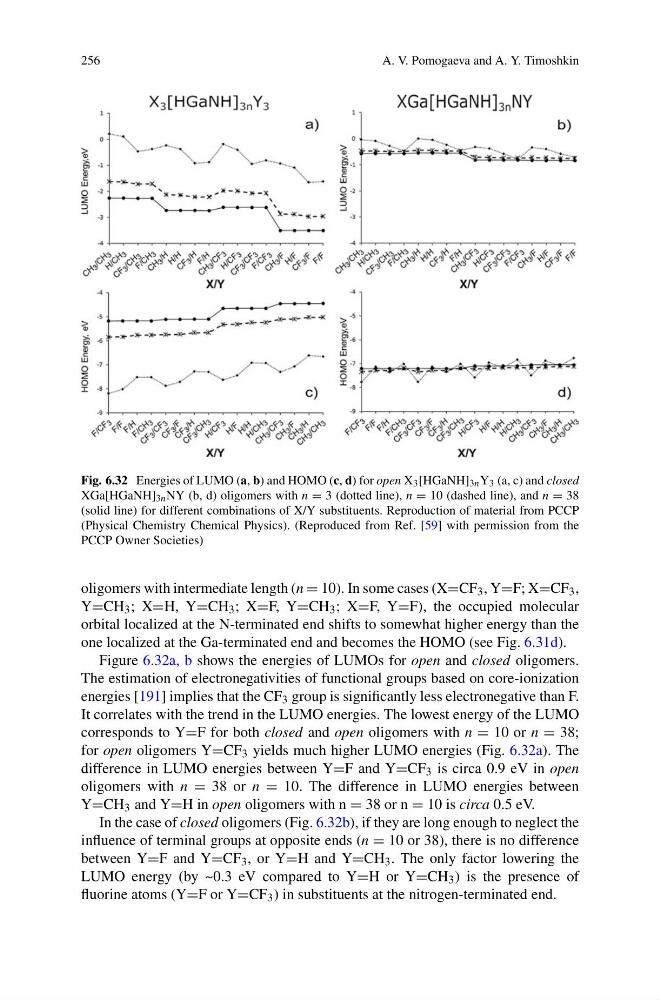
Fig. 6.32 Energies of LUMO (a, b) and HOMO (c, d) for open X 3 [HGaNH] 3n Y 3 (a, c) and closed
XGa[HGaNH] 3n NY (b, d) oligomers with n = 3 (dotted line), n = 10 (dashed line), and n = 38
(solid line) for different combinations of X/Y substituents. Reproduction of material from PCCP
(Physical Chemistry Chemical Physics). (Reproduced from Ref. [59] with permission from the
PCCP Owner Societies)
oligomers with intermediate length (n = 10). In some cases (X=CF 3 , Y=F; X=CF 3 ,
Y=CH 3 ; X=H, Y=CH 3 ; X=F, Y=CH 3 ; X=F, Y=F), the occupied molecular
orbital localized at the N-terminated end shifts to somewhat higher energy than the
one localized at the Ga-terminated end and becomes the HOMO (see Fig. 6.31d).
Figure 6.32a, b shows the energies of LUMOs for open and closed oligomers.
The estimation of electronegativities of functional groups based on core-ionization
energies [191] implies that the CF 3 group is significantly less electronegative than F.
It correlates with the trend in the LUMO energies. The lowest energy of the LUMO
corresponds to Y=F for both closed and open oligomers with n = 10 or n = 38;
for open oligomers Y=CF 3 yields much higher LUMO energies (Fig. 6.32a). The
difference in LUMO energies between Y=F and Y=CF 3 is circa 0.9 eV in open
oligomers with n = 38 or n = 10. The difference in LUMO energies between
Y=CH 3 and Y=H in open oligomers with n = 38 or n = 10 is circa 0.5 eV.
In the case of closed oligomers (Fig. 6.32b), if they are long enough to neglect the
influence of terminal groups at opposite ends (n = 10 or 38), there is no difference
between Y=F and Y=CF 3 , or Y=H and Y=CH 3 . The only factor lowering the
LUMO energy (by ~0.3 eV compared to Y=H or Y=CH 3 ) is the presence of
fluorine atoms (Y=F or Y=CF 3 ) in substituents at the nitrogen-terminated end.
A. V. Pomogaeva and A. Y. Timoshkin
Fig. 6.32 Energies of LUMO (a, b) and HOMO (c, d) for open X 3 [HGaNH] 3n Y 3 (a, c) and closed
XGa[HGaNH] 3n NY (b, d) oligomers with n = 3 (dotted line), n = 10 (dashed line), and n = 38
(solid line) for different combinations of X/Y substituents. Reproduction of material from PCCP
(Physical Chemistry Chemical Physics). (Reproduced from Ref. [59] with permission from the
PCCP Owner Societies)
oligomers with intermediate length (n = 10). In some cases (X=CF 3 , Y=F; X=CF 3 ,
Y=CH 3 ; X=H, Y=CH 3 ; X=F, Y=CH 3 ; X=F, Y=F), the occupied molecular
orbital localized at the N-terminated end shifts to somewhat higher energy than the
one localized at the Ga-terminated end and becomes the HOMO (see Fig. 6.31d).
Figure 6.32a, b shows the energies of LUMOs for open and closed oligomers.
The estimation of electronegativities of functional groups based on core-ionization
energies [191] implies that the CF 3 group is significantly less electronegative than F.
It correlates with the trend in the LUMO energies. The lowest energy of the LUMO
corresponds to Y=F for both closed and open oligomers with n = 10 or n = 38;
for open oligomers Y=CF 3 yields much higher LUMO energies (Fig. 6.32a). The
difference in LUMO energies between Y=F and Y=CF 3 is circa 0.9 eV in open
oligomers with n = 38 or n = 10. The difference in LUMO energies between
Y=CH 3 and Y=H in open oligomers with n = 38 or n = 10 is circa 0.5 eV.
In the case of closed oligomers (Fig. 6.32b), if they are long enough to neglect the
influence of terminal groups at opposite ends (n = 10 or 38), there is no difference
between Y=F and Y=CF 3 , or Y=H and Y=CH 3 . The only factor lowering the
LUMO energy (by ~0.3 eV compared to Y=H or Y=CH 3 ) is the presence of
fluorine atoms (Y=F or Y=CF 3 ) in substituents at the nitrogen-terminated end.