

6 Group 13–15 Needle-Shaped Oligomers and Nanorods: Structures. . .
249
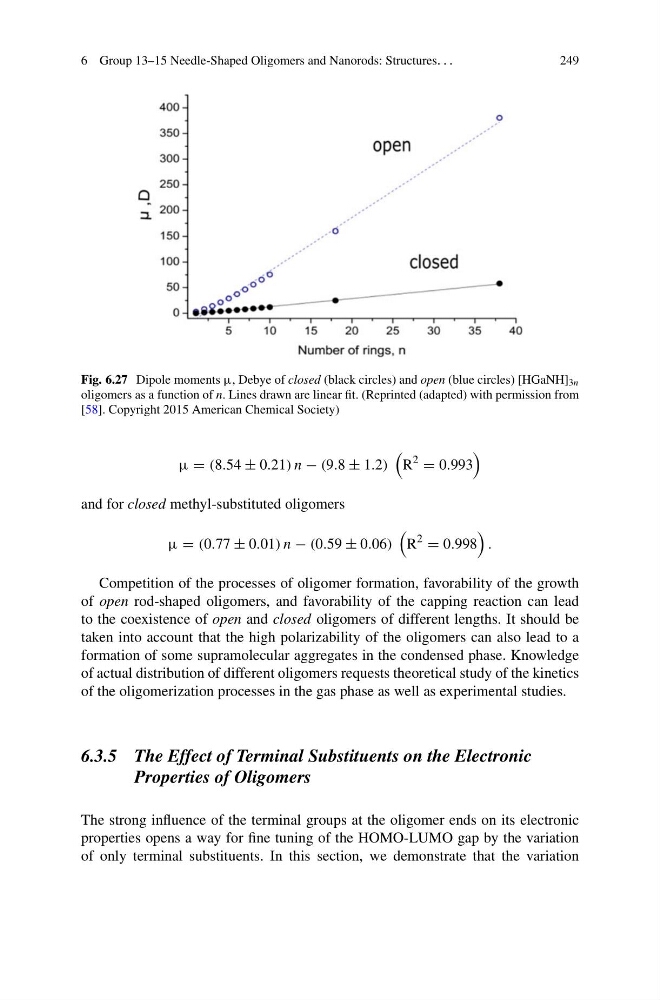
Fig. 6.27 Dipole moments μ, Debye of closed (black circles) and open (blue circles) [HGaNH] 3n
oligomers as a function of n. Lines drawn are linear fit. (Reprinted (adapted) with permission from
[58]. Copyright 2015 American Chemical Society)
μ = (8.54 ± 0.21) n − (9.8 ± 1.2)
R
2
= 0.993
and for closed methyl-substituted oligomers
μ = (0.77 ± 0.01) n − (0.59 ± 0.06)
R
2
= 0.998
.
Competition of the processes of oligomer formation, favorability of the growth
of open rod-shaped oligomers, and favorability of the capping reaction can lead
to the coexistence of open and closed oligomers of different lengths. It should be
taken into account that the high polarizability of the oligomers can also lead to a
formation of some supramolecular aggregates in the condensed phase. Knowledge
of actual distribution of different oligomers requests theoretical study of the kinetics
of the oligomerization processes in the gas phase as well as experimental studies.
6.3.5 The Effect of Terminal Substituents on the Electronic
Properties of Oligomers
The strong influence of the terminal groups at the oligomer ends on its electronic
properties opens a way for fine tuning of the HOMO-LUMO gap by the variation
of only terminal substituents. In this section, we demonstrate that the variation
249
Fig. 6.27 Dipole moments μ, Debye of closed (black circles) and open (blue circles) [HGaNH] 3n
oligomers as a function of n. Lines drawn are linear fit. (Reprinted (adapted) with permission from
[58]. Copyright 2015 American Chemical Society)
μ = (8.54 ± 0.21) n − (9.8 ± 1.2)
R
2
= 0.993
and for closed methyl-substituted oligomers
μ = (0.77 ± 0.01) n − (0.59 ± 0.06)
R
2
= 0.998
.
Competition of the processes of oligomer formation, favorability of the growth
of open rod-shaped oligomers, and favorability of the capping reaction can lead
to the coexistence of open and closed oligomers of different lengths. It should be
taken into account that the high polarizability of the oligomers can also lead to a
formation of some supramolecular aggregates in the condensed phase. Knowledge
of actual distribution of different oligomers requests theoretical study of the kinetics
of the oligomerization processes in the gas phase as well as experimental studies.
6.3.5 The Effect of Terminal Substituents on the Electronic
Properties of Oligomers
The strong influence of the terminal groups at the oligomer ends on its electronic
properties opens a way for fine tuning of the HOMO-LUMO gap by the variation
of only terminal substituents. In this section, we demonstrate that the variation