

248
A. V. Pomogaeva and A. Y. Timoshkin
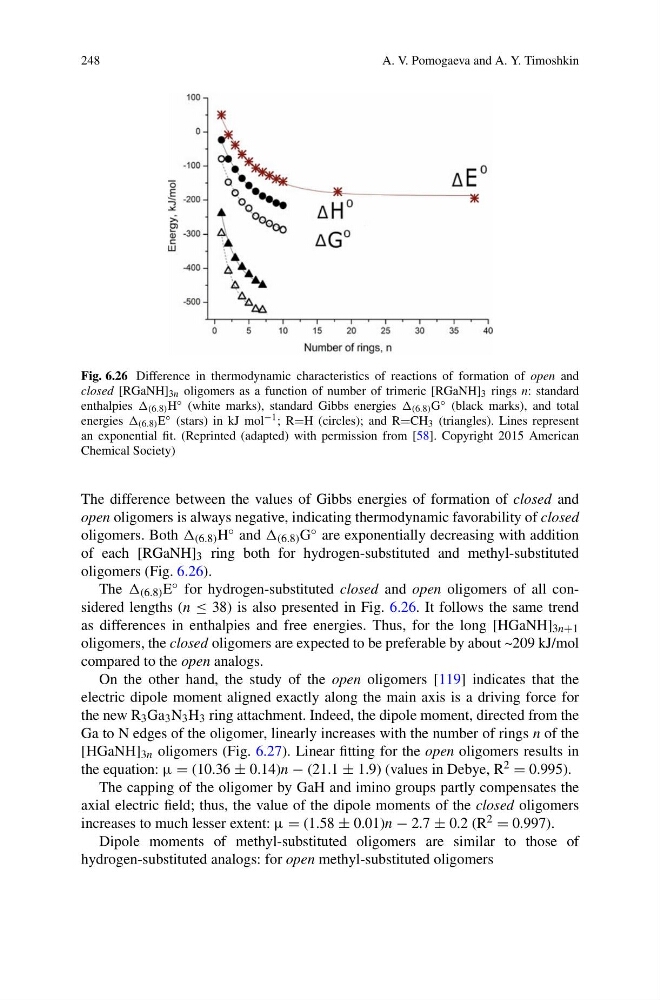
Fig. 6.26 Difference in thermodynamic characteristics of reactions of formation of open and
closed [RGaNH] 3n oligomers as a function of number of trimeric [RGaNH] 3 rings n: standard
enthalpies (6.8) H ◦ (white marks), standard Gibbs energies (6.8) G ◦ (black marks), and total
energies (6.8) E ◦ (stars) in kJ mol −1 ; R=H (circles); and R=CH 3 (triangles). Lines represent
an exponential fit. (Reprinted (adapted) with permission from [58]. Copyright 2015 American
Chemical Society)
The difference between the values of Gibbs energies of formation of closed and
open oligomers is always negative, indicating thermodynamic favorability of closed
oligomers. Both (6.8) H ◦ and (6.8) G ◦ are exponentially decreasing with addition
of each [RGaNH] 3 ring both for hydrogen-substituted and methyl-substituted
oligomers (Fig. 6.26).
The (6.8) E ◦ for hydrogen-substituted closed and open oligomers of all considered lengths (n ≤ 38) is also presented in Fig. 6.26. It follows the same trend
as differences in enthalpies and free energies. Thus, for the long [HGaNH] 3n+1
oligomers, the closed oligomers are expected to be preferable by about ~209 kJ/mol
compared to the open analogs.
On the other hand, the study of the open oligomers [119] indicates that the
electric dipole moment aligned exactly along the main axis is a driving force for
the new R 3 Ga 3 N 3 H 3 ring attachment. Indeed, the dipole moment, directed from the
Ga to N edges of the oligomer, linearly increases with the number of rings n of the
[HGaNH] 3n oligomers (Fig. 6.27). Linear fitting for the open oligomers results in
the equation: μ = (10.36 ± 0.14)n − (21.1 ± 1.9) (values in Debye, R 2 = 0.995).
The capping of the oligomer by GaH and imino groups partly compensates the
axial electric field; thus, the value of the dipole moments of the closed oligomers
increases to much lesser extent: μ = (1.58 ± 0.01)n − 2.7 ± 0.2 (R 2 = 0.997).
Dipole moments of methyl-substituted oligomers are similar to those of
hydrogen-substituted analogs: for open methyl-substituted oligomers
A. V. Pomogaeva and A. Y. Timoshkin
Fig. 6.26 Difference in thermodynamic characteristics of reactions of formation of open and
closed [RGaNH] 3n oligomers as a function of number of trimeric [RGaNH] 3 rings n: standard
enthalpies (6.8) H ◦ (white marks), standard Gibbs energies (6.8) G ◦ (black marks), and total
energies (6.8) E ◦ (stars) in kJ mol −1 ; R=H (circles); and R=CH 3 (triangles). Lines represent
an exponential fit. (Reprinted (adapted) with permission from [58]. Copyright 2015 American
Chemical Society)
The difference between the values of Gibbs energies of formation of closed and
open oligomers is always negative, indicating thermodynamic favorability of closed
oligomers. Both (6.8) H ◦ and (6.8) G ◦ are exponentially decreasing with addition
of each [RGaNH] 3 ring both for hydrogen-substituted and methyl-substituted
oligomers (Fig. 6.26).
The (6.8) E ◦ for hydrogen-substituted closed and open oligomers of all considered lengths (n ≤ 38) is also presented in Fig. 6.26. It follows the same trend
as differences in enthalpies and free energies. Thus, for the long [HGaNH] 3n+1
oligomers, the closed oligomers are expected to be preferable by about ~209 kJ/mol
compared to the open analogs.
On the other hand, the study of the open oligomers [119] indicates that the
electric dipole moment aligned exactly along the main axis is a driving force for
the new R 3 Ga 3 N 3 H 3 ring attachment. Indeed, the dipole moment, directed from the
Ga to N edges of the oligomer, linearly increases with the number of rings n of the
[HGaNH] 3n oligomers (Fig. 6.27). Linear fitting for the open oligomers results in
the equation: μ = (10.36 ± 0.14)n − (21.1 ± 1.9) (values in Debye, R 2 = 0.995).
The capping of the oligomer by GaH and imino groups partly compensates the
axial electric field; thus, the value of the dipole moments of the closed oligomers
increases to much lesser extent: μ = (1.58 ± 0.01)n − 2.7 ± 0.2 (R 2 = 0.997).
Dipole moments of methyl-substituted oligomers are similar to those of
hydrogen-substituted analogs: for open methyl-substituted oligomers