

250
A. V. Pomogaeva and A. Y. Timoshkin
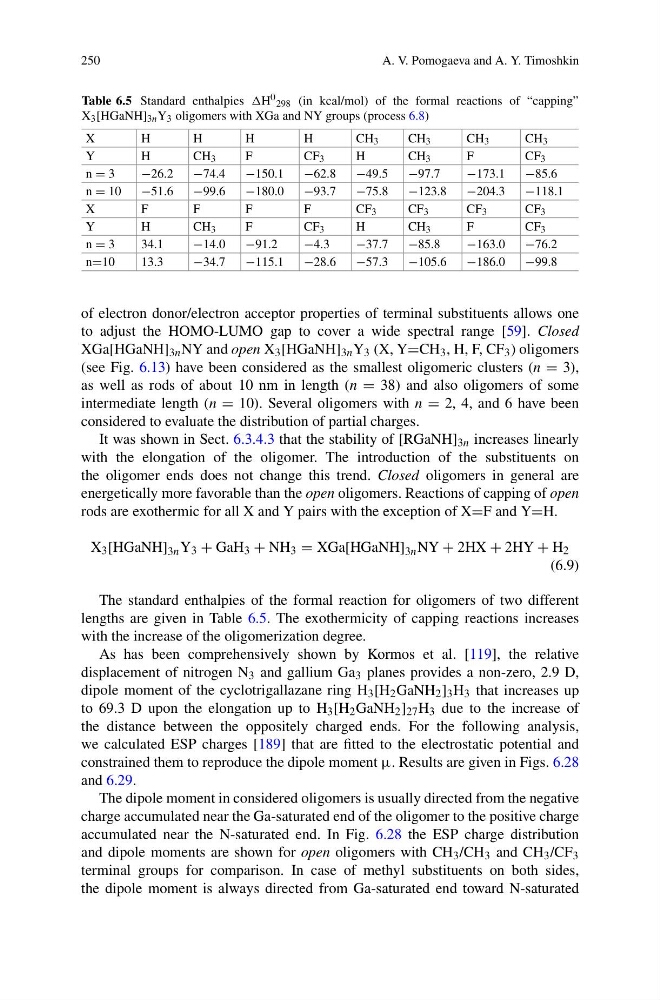
Table 6.5 Standard enthalpies H 0 298 (in kcal/mol) of the formal reactions of “capping”
X 3 [HGaNH] 3n Y 3 oligomers with XGa and NY groups (process 6.8)
X
H
H
H
H
CH 3
CH 3
CH 3
CH 3
Y
H
CH 3
F
CF 3
H
CH 3
F
CF 3
n = 3
−26.2
−74.4
−150.1
−62.8
−49.5
−97.7
−173.1
−85.6
n = 10
−51.6
−99.6
−180.0
−93.7
−75.8
−123.8
−204.3
−118.1
X
F
F
F
F
CF 3
CF 3
CF 3
CF 3
Y
H
CH 3
F
CF 3
H
CH 3
F
CF 3
n = 3
34.1
−14.0
−91.2
−4.3
−37.7
−85.8
−163.0
−76.2
n=10
13.3
−34.7
−115.1
−28.6
−57.3
−105.6
−186.0
−99.8
of electron donor/electron acceptor properties of terminal substituents allows one
to adjust the HOMO-LUMO gap to cover a wide spectral range [59]. Closed
XGa[HGaNH] 3n NY and open X 3 [HGaNH] 3n Y 3 (X, Y=CH 3 , H, F, CF 3 ) oligomers
(see Fig. 6.13) have been considered as the smallest oligomeric clusters (n = 3),
as well as rods of about 10 nm in length (n = 38) and also oligomers of some
intermediate length (n = 10). Several oligomers with n = 2, 4, and 6 have been
considered to evaluate the distribution of partial charges.
It was shown in Sect. 6.3.4.3 that the stability of [RGaNH] 3n increases linearly
with the elongation of the oligomer. The introduction of the substituents on
the oligomer ends does not change this trend. Closed oligomers in general are
energetically more favorable than the open oligomers. Reactions of capping of open
rods are exothermic for all X and Y pairs with the exception of X=F and Y=H.
X 3 [HGaNH] 3n Y 3 + GaH 3 + NH 3 = XGa[HGaNH] 3n NY + 2HX + 2HY + H 2
(6.9)
The standard enthalpies of the formal reaction for oligomers of two different
lengths are given in Table 6.5. The exothermicity of capping reactions increases
with the increase of the oligomerization degree.
As has been comprehensively shown by Kormos et al. [119], the relative
displacement of nitrogen N 3 and gallium Ga 3 planes provides a non-zero, 2.9 D,
dipole moment of the cyclotrigallazane ring H 3 [H 2 GaNH 2 ] 3 H 3 that increases up
to 69.3 D upon the elongation up to H 3 [H 2 GaNH 2 ] 27 H 3 due to the increase of
the distance between the oppositely charged ends. For the following analysis,
we calculated ESP charges [189] that are fitted to the electrostatic potential and
constrained them to reproduce the dipole moment μ. Results are given in Figs. 6.28
and 6.29.
The dipole moment in considered oligomers is usually directed from the negative
charge accumulated near the Ga-saturated end of the oligomer to the positive charge
accumulated near the N-saturated end. In Fig. 6.28 the ESP charge distribution
and dipole moments are shown for open oligomers with CH 3 /CH 3 and CH 3 /CF 3
terminal groups for comparison. In case of methyl substituents on both sides,
the dipole moment is always directed from Ga-saturated end toward N-saturated
A. V. Pomogaeva and A. Y. Timoshkin
Table 6.5 Standard enthalpies H 0 298 (in kcal/mol) of the formal reactions of “capping”
X 3 [HGaNH] 3n Y 3 oligomers with XGa and NY groups (process 6.8)
X
H
H
H
H
CH 3
CH 3
CH 3
CH 3
Y
H
CH 3
F
CF 3
H
CH 3
F
CF 3
n = 3
−26.2
−74.4
−150.1
−62.8
−49.5
−97.7
−173.1
−85.6
n = 10
−51.6
−99.6
−180.0
−93.7
−75.8
−123.8
−204.3
−118.1
X
F
F
F
F
CF 3
CF 3
CF 3
CF 3
Y
H
CH 3
F
CF 3
H
CH 3
F
CF 3
n = 3
34.1
−14.0
−91.2
−4.3
−37.7
−85.8
−163.0
−76.2
n=10
13.3
−34.7
−115.1
−28.6
−57.3
−105.6
−186.0
−99.8
of electron donor/electron acceptor properties of terminal substituents allows one
to adjust the HOMO-LUMO gap to cover a wide spectral range [59]. Closed
XGa[HGaNH] 3n NY and open X 3 [HGaNH] 3n Y 3 (X, Y=CH 3 , H, F, CF 3 ) oligomers
(see Fig. 6.13) have been considered as the smallest oligomeric clusters (n = 3),
as well as rods of about 10 nm in length (n = 38) and also oligomers of some
intermediate length (n = 10). Several oligomers with n = 2, 4, and 6 have been
considered to evaluate the distribution of partial charges.
It was shown in Sect. 6.3.4.3 that the stability of [RGaNH] 3n increases linearly
with the elongation of the oligomer. The introduction of the substituents on
the oligomer ends does not change this trend. Closed oligomers in general are
energetically more favorable than the open oligomers. Reactions of capping of open
rods are exothermic for all X and Y pairs with the exception of X=F and Y=H.
X 3 [HGaNH] 3n Y 3 + GaH 3 + NH 3 = XGa[HGaNH] 3n NY + 2HX + 2HY + H 2
(6.9)
The standard enthalpies of the formal reaction for oligomers of two different
lengths are given in Table 6.5. The exothermicity of capping reactions increases
with the increase of the oligomerization degree.
As has been comprehensively shown by Kormos et al. [119], the relative
displacement of nitrogen N 3 and gallium Ga 3 planes provides a non-zero, 2.9 D,
dipole moment of the cyclotrigallazane ring H 3 [H 2 GaNH 2 ] 3 H 3 that increases up
to 69.3 D upon the elongation up to H 3 [H 2 GaNH 2 ] 27 H 3 due to the increase of
the distance between the oppositely charged ends. For the following analysis,
we calculated ESP charges [189] that are fitted to the electrostatic potential and
constrained them to reproduce the dipole moment μ. Results are given in Figs. 6.28
and 6.29.
The dipole moment in considered oligomers is usually directed from the negative
charge accumulated near the Ga-saturated end of the oligomer to the positive charge
accumulated near the N-saturated end. In Fig. 6.28 the ESP charge distribution
and dipole moments are shown for open oligomers with CH 3 /CH 3 and CH 3 /CF 3
terminal groups for comparison. In case of methyl substituents on both sides,
the dipole moment is always directed from Ga-saturated end toward N-saturated