

10
T. Onishi
Perovskite
Light Response
IonConductivity
Ferroelectricity
Magnetism
Superconductivity
Hydrogen
Storage
Next Generation
Energy
Next Generation
Electronic Device
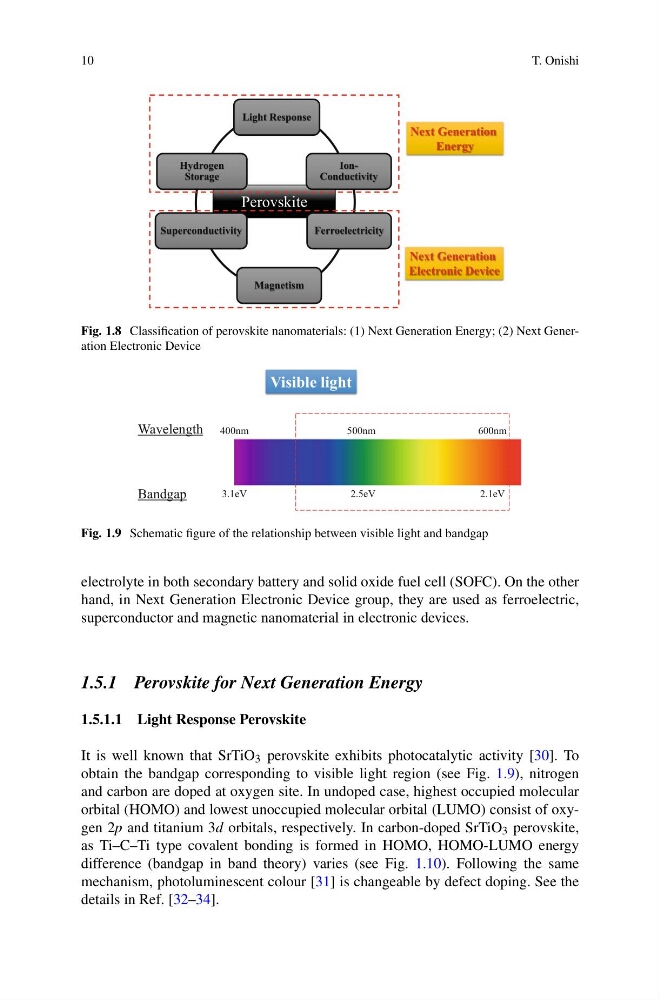
Fig. 1.8 Classification of perovskite nanomaterials: (1) Next Generation Energy; (2) Next Generation Electronic Device
Visible light
400nm
500nm
600nm
3.1eV
2.5eV
2.1eV
Wavelength
Bandgap
Fig. 1.9 Schematic figure of the relationship between visible light and bandgap
electrolyte in both secondary battery and solid oxide fuel cell (SOFC). On the other
hand, in Next Generation Electronic Device group, they are used as ferroelectric,
superconductor and magnetic nanomaterial in electronic devices.
1.5.1 Perovskite for Next Generation Energy
1.5.1.1 Light Response Perovskite
It is well known that SrTiO 3 perovskite exhibits photocatalytic activity [30]. To
obtain the bandgap corresponding to visible light region (see Fig. 1.9), nitrogen
and carbon are doped at oxygen site. In undoped case, highest occupied molecular
orbital (HOMO) and lowest unoccupied molecular orbital (LUMO) consist of oxygen 2p and titanium 3d orbitals, respectively. In carbon-doped SrTiO 3 perovskite,
as Ti–C–Ti type covalent bonding is formed in HOMO, HOMO-LUMO energy
difference (bandgap in band theory) varies (see Fig. 1.10). Following the same
mechanism, photoluminescent colour [31] is changeable by defect doping. See the
details in Ref. [32–34].
T. Onishi
Perovskite
Light Response
IonConductivity
Ferroelectricity
Magnetism
Superconductivity
Hydrogen
Storage
Next Generation
Energy
Next Generation
Electronic Device
Fig. 1.8 Classification of perovskite nanomaterials: (1) Next Generation Energy; (2) Next Generation Electronic Device
Visible light
400nm
500nm
600nm
3.1eV
2.5eV
2.1eV
Wavelength
Bandgap
Fig. 1.9 Schematic figure of the relationship between visible light and bandgap
electrolyte in both secondary battery and solid oxide fuel cell (SOFC). On the other
hand, in Next Generation Electronic Device group, they are used as ferroelectric,
superconductor and magnetic nanomaterial in electronic devices.
1.5.1 Perovskite for Next Generation Energy
1.5.1.1 Light Response Perovskite
It is well known that SrTiO 3 perovskite exhibits photocatalytic activity [30]. To
obtain the bandgap corresponding to visible light region (see Fig. 1.9), nitrogen
and carbon are doped at oxygen site. In undoped case, highest occupied molecular
orbital (HOMO) and lowest unoccupied molecular orbital (LUMO) consist of oxygen 2p and titanium 3d orbitals, respectively. In carbon-doped SrTiO 3 perovskite,
as Ti–C–Ti type covalent bonding is formed in HOMO, HOMO-LUMO energy
difference (bandgap in band theory) varies (see Fig. 1.10). Following the same
mechanism, photoluminescent colour [31] is changeable by defect doping. See the
details in Ref. [32–34].