

1 Theoretical Chemistry for Advanced Nanomaterials: Computational. . .
11
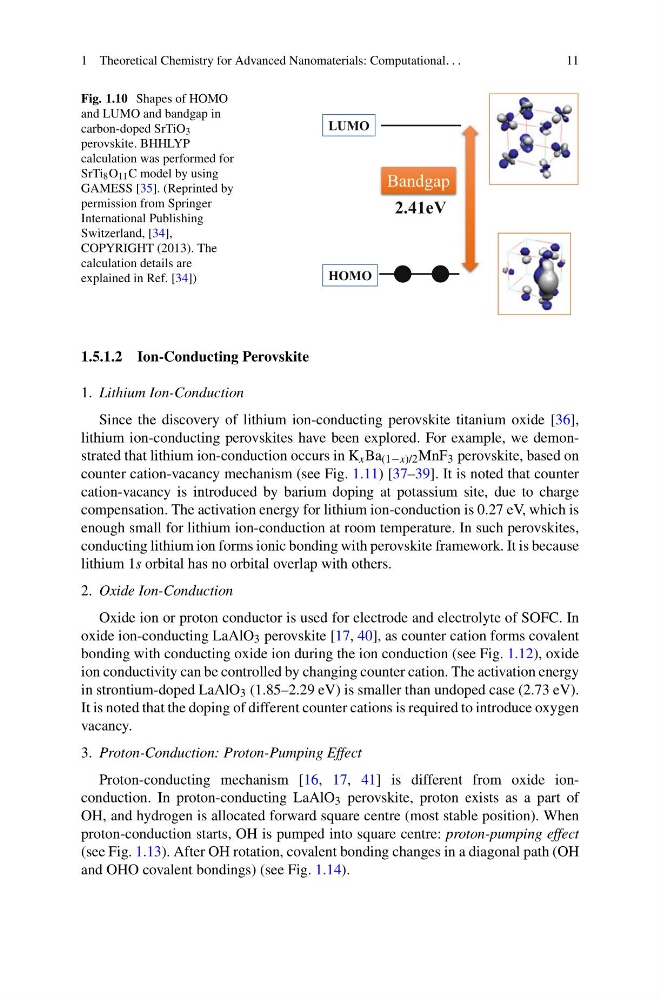
Fig. 1.10 Shapes of HOMO
and LUMO and bandgap in
carbon-doped SrTiO 3
perovskite. BHHLYP
calculation was performed for
SrTi 8 O 11 C model by using
GAMESS [35]. (Reprinted by
permission from Springer
International Publishing
Switzerland, [34],
COPYRIGHT (2013). The
calculation details are
explained in Ref. [34])
Bandgap
HOMO
LUMO
2.41eV
1.5.1.2 Ion-Conducting Perovskite
1. Lithium Ion-Conduction
Since the discovery of lithium ion-conducting perovskite titanium oxide [36],
lithium ion-conducting perovskites have been explored. For example, we demonstrated that lithium ion-conduction occurs in K x Ba (1−x)/2 MnF 3 perovskite, based on
counter cation-vacancy mechanism (see Fig. 1.11) [37–39]. It is noted that counter
cation-vacancy is introduced by barium doping at potassium site, due to charge
compensation. The activation energy for lithium ion-conduction is 0.27 eV, which is
enough small for lithium ion-conduction at room temperature. In such perovskites,
conducting lithium ion forms ionic bonding with perovskite framework. It is because
lithium 1s orbital has no orbital overlap with others.
2. Oxide Ion-Conduction
Oxide ion or proton conductor is used for electrode and electrolyte of SOFC. In
oxide ion-conducting LaAlO 3 perovskite [17, 40], as counter cation forms covalent
bonding with conducting oxide ion during the ion conduction (see Fig. 1.12), oxide
ion conductivity can be controlled by changing counter cation. The activation energy
in strontium-doped LaAlO 3 (1.85–2.29 eV) is smaller than undoped case (2.73 eV).
It is noted that the doping of different counter cations is required to introduce oxygen
vacancy.
3. Proton-Conduction: Proton-Pumping Effect
Proton-conducting mechanism [16, 17, 41] is different from oxide ionconduction. In proton-conducting LaAlO 3 perovskite, proton exists as a part of
OH, and hydrogen is allocated forward square centre (most stable position). When
proton-conduction starts, OH is pumped into square centre: proton-pumping effect
(see Fig. 1.13). After OH rotation, covalent bonding changes in a diagonal path (OH
and OHO covalent bondings) (see Fig. 1.14).
11
Fig. 1.10 Shapes of HOMO
and LUMO and bandgap in
carbon-doped SrTiO 3
perovskite. BHHLYP
calculation was performed for
SrTi 8 O 11 C model by using
GAMESS [35]. (Reprinted by
permission from Springer
International Publishing
Switzerland, [34],
COPYRIGHT (2013). The
calculation details are
explained in Ref. [34])
Bandgap
HOMO
LUMO
2.41eV
1.5.1.2 Ion-Conducting Perovskite
1. Lithium Ion-Conduction
Since the discovery of lithium ion-conducting perovskite titanium oxide [36],
lithium ion-conducting perovskites have been explored. For example, we demonstrated that lithium ion-conduction occurs in K x Ba (1−x)/2 MnF 3 perovskite, based on
counter cation-vacancy mechanism (see Fig. 1.11) [37–39]. It is noted that counter
cation-vacancy is introduced by barium doping at potassium site, due to charge
compensation. The activation energy for lithium ion-conduction is 0.27 eV, which is
enough small for lithium ion-conduction at room temperature. In such perovskites,
conducting lithium ion forms ionic bonding with perovskite framework. It is because
lithium 1s orbital has no orbital overlap with others.
2. Oxide Ion-Conduction
Oxide ion or proton conductor is used for electrode and electrolyte of SOFC. In
oxide ion-conducting LaAlO 3 perovskite [17, 40], as counter cation forms covalent
bonding with conducting oxide ion during the ion conduction (see Fig. 1.12), oxide
ion conductivity can be controlled by changing counter cation. The activation energy
in strontium-doped LaAlO 3 (1.85–2.29 eV) is smaller than undoped case (2.73 eV).
It is noted that the doping of different counter cations is required to introduce oxygen
vacancy.
3. Proton-Conduction: Proton-Pumping Effect
Proton-conducting mechanism [16, 17, 41] is different from oxide ionconduction. In proton-conducting LaAlO 3 perovskite, proton exists as a part of
OH, and hydrogen is allocated forward square centre (most stable position). When
proton-conduction starts, OH is pumped into square centre: proton-pumping effect
(see Fig. 1.13). After OH rotation, covalent bonding changes in a diagonal path (OH
and OHO covalent bondings) (see Fig. 1.14).