

1 Theoretical Chemistry for Advanced Nanomaterials: Computational. . .
9
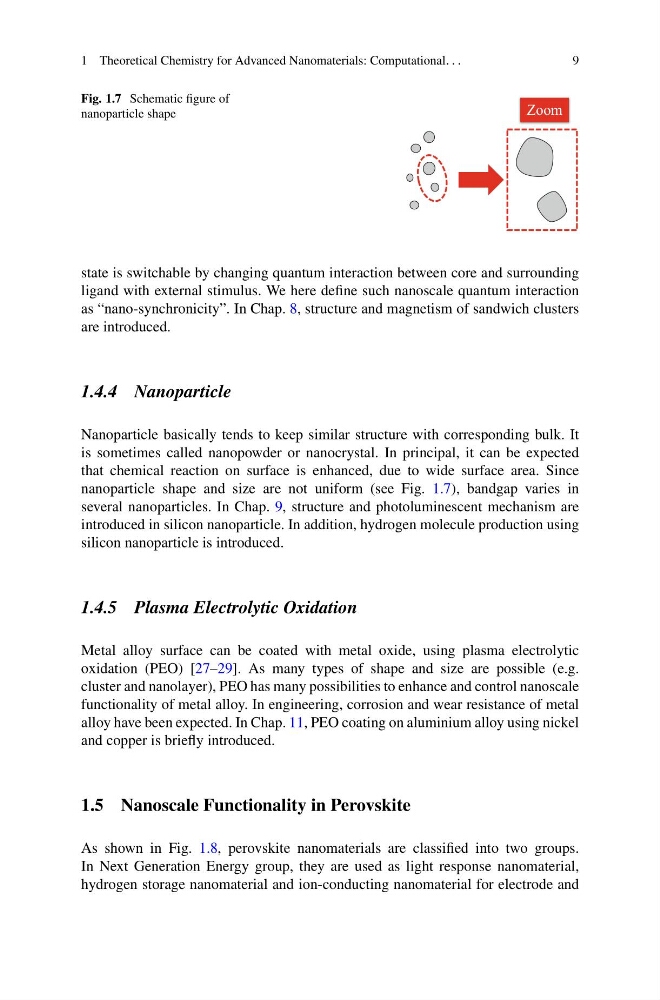
Fig. 1.7 Schematic figure of
nanoparticle shape
Zoom
state is switchable by changing quantum interaction between core and surrounding
ligand with external stimulus. We here define such nanoscale quantum interaction
as “nano-synchronicity”. In Chap. 8, structure and magnetism of sandwich clusters
are introduced.
1.4.4 Nanoparticle
Nanoparticle basically tends to keep similar structure with corresponding bulk. It
is sometimes called nanopowder or nanocrystal. In principal, it can be expected
that chemical reaction on surface is enhanced, due to wide surface area. Since
nanoparticle shape and size are not uniform (see Fig. 1.7), bandgap varies in
several nanoparticles. In Chap. 9, structure and photoluminescent mechanism are
introduced in silicon nanoparticle. In addition, hydrogen molecule production using
silicon nanoparticle is introduced.
1.4.5 Plasma Electrolytic Oxidation
Metal alloy surface can be coated with metal oxide, using plasma electrolytic
oxidation (PEO) [27–29]. As many types of shape and size are possible (e.g.
cluster and nanolayer), PEO has many possibilities to enhance and control nanoscale
functionality of metal alloy. In engineering, corrosion and wear resistance of metal
alloy have been expected. In Chap. 11, PEO coating on aluminium alloy using nickel
and copper is briefly introduced.
1.5 Nanoscale Functionality in Perovskite
As shown in Fig. 1.8, perovskite nanomaterials are classified into two groups.
In Next Generation Energy group, they are used as light response nanomaterial,
hydrogen storage nanomaterial and ion-conducting nanomaterial for electrode and
9
Fig. 1.7 Schematic figure of
nanoparticle shape
Zoom
state is switchable by changing quantum interaction between core and surrounding
ligand with external stimulus. We here define such nanoscale quantum interaction
as “nano-synchronicity”. In Chap. 8, structure and magnetism of sandwich clusters
are introduced.
1.4.4 Nanoparticle
Nanoparticle basically tends to keep similar structure with corresponding bulk. It
is sometimes called nanopowder or nanocrystal. In principal, it can be expected
that chemical reaction on surface is enhanced, due to wide surface area. Since
nanoparticle shape and size are not uniform (see Fig. 1.7), bandgap varies in
several nanoparticles. In Chap. 9, structure and photoluminescent mechanism are
introduced in silicon nanoparticle. In addition, hydrogen molecule production using
silicon nanoparticle is introduced.
1.4.5 Plasma Electrolytic Oxidation
Metal alloy surface can be coated with metal oxide, using plasma electrolytic
oxidation (PEO) [27–29]. As many types of shape and size are possible (e.g.
cluster and nanolayer), PEO has many possibilities to enhance and control nanoscale
functionality of metal alloy. In engineering, corrosion and wear resistance of metal
alloy have been expected. In Chap. 11, PEO coating on aluminium alloy using nickel
and copper is briefly introduced.
1.5 Nanoscale Functionality in Perovskite
As shown in Fig. 1.8, perovskite nanomaterials are classified into two groups.
In Next Generation Energy group, they are used as light response nanomaterial,
hydrogen storage nanomaterial and ion-conducting nanomaterial for electrode and