

1 Theoretical Chemistry for Advanced Nanomaterials: Computational. . .
7
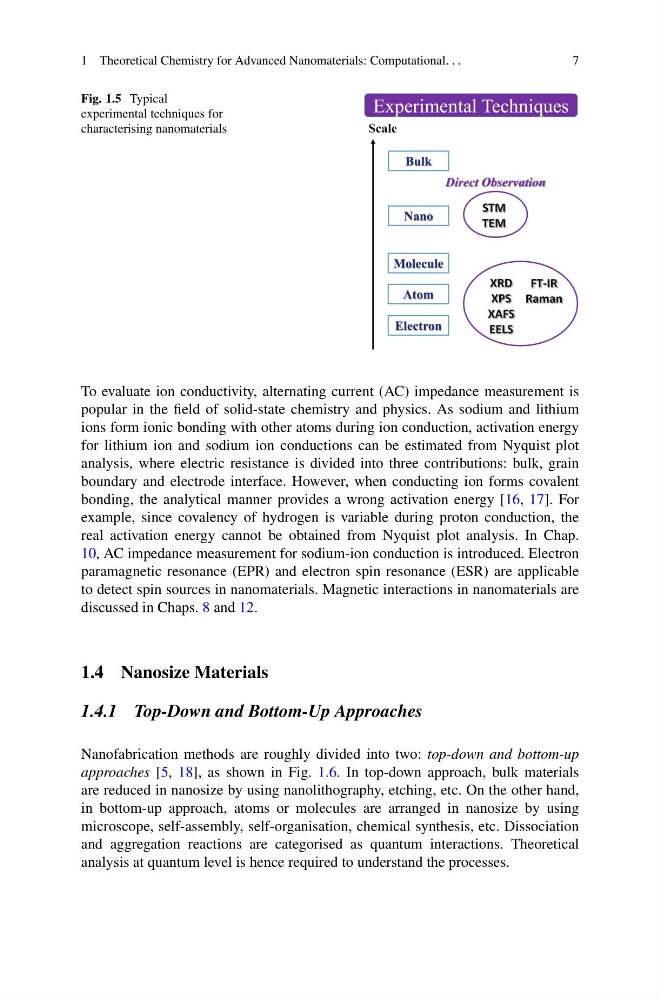
Fig. 1.5 Typical
experimental techniques for
characterising nanomaterials
Electron
Atom
Molecule
Nano
Bulk
Scale
Experimental Techniques
Direct Observation
To evaluate ion conductivity, alternating current (AC) impedance measurement is
popular in the field of solid-state chemistry and physics. As sodium and lithium
ions form ionic bonding with other atoms during ion conduction, activation energy
for lithium ion and sodium ion conductions can be estimated from Nyquist plot
analysis, where electric resistance is divided into three contributions: bulk, grain
boundary and electrode interface. However, when conducting ion forms covalent
bonding, the analytical manner provides a wrong activation energy [16, 17]. For
example, since covalency of hydrogen is variable during proton conduction, the
real activation energy cannot be obtained from Nyquist plot analysis. In Chap.
10, AC impedance measurement for sodium-ion conduction is introduced. Electron
paramagnetic resonance (EPR) and electron spin resonance (ESR) are applicable
to detect spin sources in nanomaterials. Magnetic interactions in nanomaterials are
discussed in Chaps. 8 and 12.
1.4 Nanosize Materials
1.4.1 Top-Down and Bottom-Up Approaches
Nanofabrication methods are roughly divided into two: top-down and bottom-up
approaches [5, 18], as shown in Fig. 1.6. In top-down approach, bulk materials
are reduced in nanosize by using nanolithography, etching, etc. On the other hand,
in bottom-up approach, atoms or molecules are arranged in nanosize by using
microscope, self-assembly, self-organisation, chemical synthesis, etc. Dissociation
and aggregation reactions are categorised as quantum interactions. Theoretical
analysis at quantum level is hence required to understand the processes.
7
Fig. 1.5 Typical
experimental techniques for
characterising nanomaterials
Electron
Atom
Molecule
Nano
Bulk
Scale
Experimental Techniques
Direct Observation
To evaluate ion conductivity, alternating current (AC) impedance measurement is
popular in the field of solid-state chemistry and physics. As sodium and lithium
ions form ionic bonding with other atoms during ion conduction, activation energy
for lithium ion and sodium ion conductions can be estimated from Nyquist plot
analysis, where electric resistance is divided into three contributions: bulk, grain
boundary and electrode interface. However, when conducting ion forms covalent
bonding, the analytical manner provides a wrong activation energy [16, 17]. For
example, since covalency of hydrogen is variable during proton conduction, the
real activation energy cannot be obtained from Nyquist plot analysis. In Chap.
10, AC impedance measurement for sodium-ion conduction is introduced. Electron
paramagnetic resonance (EPR) and electron spin resonance (ESR) are applicable
to detect spin sources in nanomaterials. Magnetic interactions in nanomaterials are
discussed in Chaps. 8 and 12.
1.4 Nanosize Materials
1.4.1 Top-Down and Bottom-Up Approaches
Nanofabrication methods are roughly divided into two: top-down and bottom-up
approaches [5, 18], as shown in Fig. 1.6. In top-down approach, bulk materials
are reduced in nanosize by using nanolithography, etching, etc. On the other hand,
in bottom-up approach, atoms or molecules are arranged in nanosize by using
microscope, self-assembly, self-organisation, chemical synthesis, etc. Dissociation
and aggregation reactions are categorised as quantum interactions. Theoretical
analysis at quantum level is hence required to understand the processes.