

204
A. V. Pomogaeva and A. Y. Timoshkin
The following abbreviations are used: Me, methyl; Et, ethyl; Pr, propyl; Bu,
butyl; Hx, hexyl; Ph, phenyl; Xyl, -C 6 H 3 -2,6-Me 2 ; Cp, cyclopentadienyl; py,
pyridine; Mes, mesityl (2,4,6-trimethylphenyl or –C 6 H 2 -2,4,6-Me 3 ); Mes*, 2,4,6tri-tert-butylphenyl (–C 6 H 2 -2,4,6- t Bu 3 ); Dipp, 2,6-diisopropylphenyl (-C 6 H 3 -2,6i Pr 2 ); Ad, adamantyl; THF, tetrahydrofuran; r.t., room temperature; ALD, atomic
layer deposition; CVD, chemical vapor deposition; MOCVD, metal organic CVD;
LED, light-emitting diode; UV, ultraviolet; MO, molecular orbital; CO, crystal
orbital; AO, atomic orbital; PBC, periodic boundary condition; BZ, Brillouin zone;
HOMO, highest occupied MO; LUMO, lowest unoccupied MO; (TD)DFT, (timedependent) density functional theory; GGA, generalized gradient approximation;
TS, transition state; and PDOS, partial density of states.
6.2 13–15 Needle-Shaped Oligomers: Experimental
and Computational Studies
6.2.1 Synthetic Methods of Production of Needle-Shaped
13–15 Compounds
Thermal activation is the first method employed for the synthesis of imino compounds [60–62], and it remains one of the major synthetic methods for their
generation. Wiberg [60] demonstrated that thermolysis of group 13 alkyls MR 3 with
ammonia results in the stepwise elimination of RH and formation of amido and
imino compounds and finally the bulk group 13 metal nitride (MN). These reactions
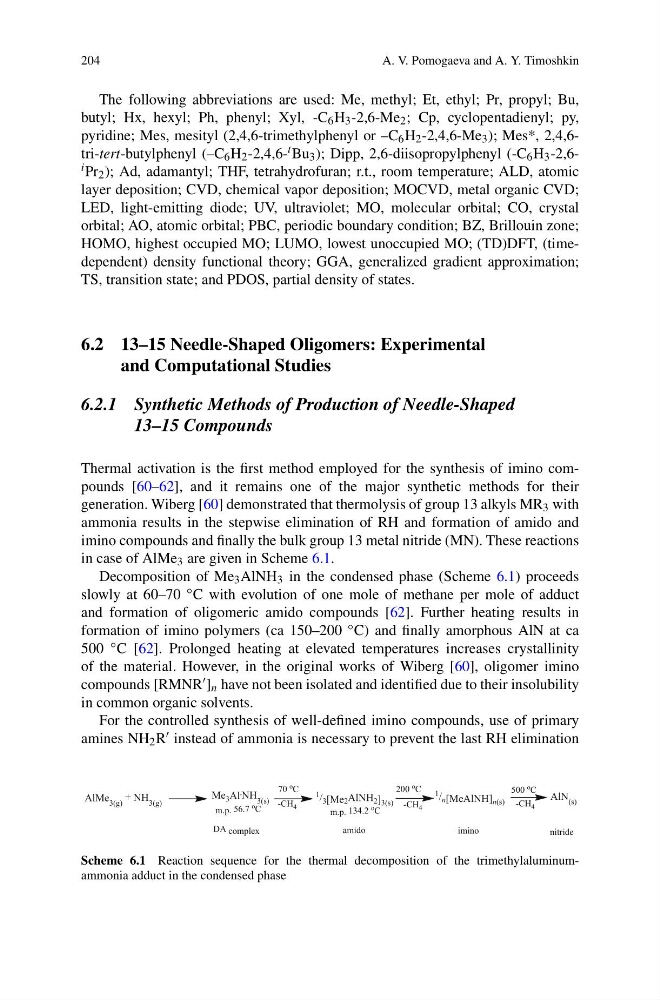
in case of AlMe 3 are given in Scheme 6.1.
Decomposition of Me 3 AlNH 3 in the condensed phase (Scheme 6.1) proceeds
slowly at 60–70 ◦ C with evolution of one mole of methane per mole of adduct
and formation of oligomeric amido compounds [62]. Further heating results in
formation of imino polymers (ca 150–200 ◦ C) and finally amorphous AlN at ca
500 ◦ C [62]. Prolonged heating at elevated temperatures increases crystallinity
of the material. However, in the original works of Wiberg [60], oligomer imino
compounds [RMNR ] n have not been isolated and identified due to their insolubility
in common organic solvents.
For the controlled synthesis of well-defined imino compounds, use of primary
amines NH 2 R instead of ammonia is necessary to prevent the last RH elimination
Me 3 Al
. NH 3(s)
1 / 3[Me2 AlNH 2] 3(s)
-CH 4
-CH 4
1 / n[MeAlNH] n(s)
AlN (s)
70 o C
200 o C
m.p. 56.7 o C
m.p. 134.2 o C
DA complex
amido
imino
nitride
-CH 4
500 o C
AlMe 3(g) + NH 3(g)
Scheme 6.1 Reaction sequence for the thermal decomposition of the trimethylaluminumammonia adduct in the condensed phase
A. V. Pomogaeva and A. Y. Timoshkin
The following abbreviations are used: Me, methyl; Et, ethyl; Pr, propyl; Bu,
butyl; Hx, hexyl; Ph, phenyl; Xyl, -C 6 H 3 -2,6-Me 2 ; Cp, cyclopentadienyl; py,
pyridine; Mes, mesityl (2,4,6-trimethylphenyl or –C 6 H 2 -2,4,6-Me 3 ); Mes*, 2,4,6tri-tert-butylphenyl (–C 6 H 2 -2,4,6- t Bu 3 ); Dipp, 2,6-diisopropylphenyl (-C 6 H 3 -2,6i Pr 2 ); Ad, adamantyl; THF, tetrahydrofuran; r.t., room temperature; ALD, atomic
layer deposition; CVD, chemical vapor deposition; MOCVD, metal organic CVD;
LED, light-emitting diode; UV, ultraviolet; MO, molecular orbital; CO, crystal
orbital; AO, atomic orbital; PBC, periodic boundary condition; BZ, Brillouin zone;
HOMO, highest occupied MO; LUMO, lowest unoccupied MO; (TD)DFT, (timedependent) density functional theory; GGA, generalized gradient approximation;
TS, transition state; and PDOS, partial density of states.
6.2 13–15 Needle-Shaped Oligomers: Experimental
and Computational Studies
6.2.1 Synthetic Methods of Production of Needle-Shaped
13–15 Compounds
Thermal activation is the first method employed for the synthesis of imino compounds [60–62], and it remains one of the major synthetic methods for their
generation. Wiberg [60] demonstrated that thermolysis of group 13 alkyls MR 3 with
ammonia results in the stepwise elimination of RH and formation of amido and
imino compounds and finally the bulk group 13 metal nitride (MN). These reactions
in case of AlMe 3 are given in Scheme 6.1.
Decomposition of Me 3 AlNH 3 in the condensed phase (Scheme 6.1) proceeds
slowly at 60–70 ◦ C with evolution of one mole of methane per mole of adduct
and formation of oligomeric amido compounds [62]. Further heating results in
formation of imino polymers (ca 150–200 ◦ C) and finally amorphous AlN at ca
500 ◦ C [62]. Prolonged heating at elevated temperatures increases crystallinity
of the material. However, in the original works of Wiberg [60], oligomer imino
compounds [RMNR ] n have not been isolated and identified due to their insolubility
in common organic solvents.
For the controlled synthesis of well-defined imino compounds, use of primary
amines NH 2 R instead of ammonia is necessary to prevent the last RH elimination
Me 3 Al
. NH 3(s)
1 / 3[Me2 AlNH 2] 3(s)
-CH 4
-CH 4
1 / n[MeAlNH] n(s)
AlN (s)
70 o C
200 o C
m.p. 56.7 o C
m.p. 134.2 o C
DA complex
amido
imino
nitride
-CH 4
500 o C
AlMe 3(g) + NH 3(g)
Scheme 6.1 Reaction sequence for the thermal decomposition of the trimethylaluminumammonia adduct in the condensed phase