

6 Group 13–15 Needle-Shaped Oligomers and Nanorods: Structures. . .
203
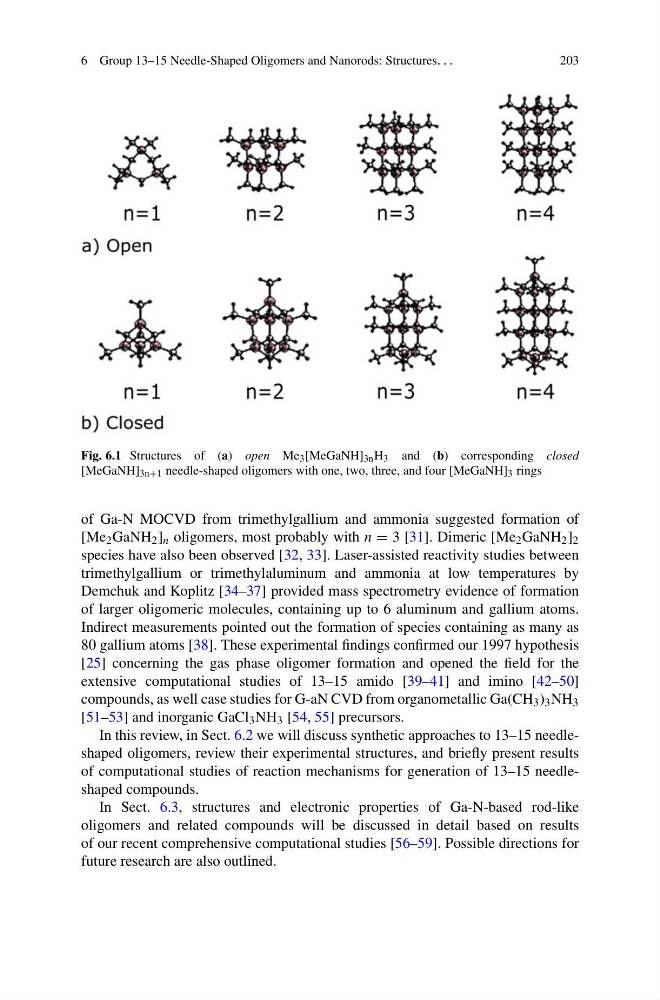
Fig. 6.1 Structures of (a) open Me 3 [MeGaNH] 3n H 3 and (b) corresponding closed
[MeGaNH] 3n+1 needle-shaped oligomers with one, two, three, and four [MeGaNH] 3 rings
of Ga-N MOCVD from trimethylgallium and ammonia suggested formation of
[Me 2 GaNH 2 ] n oligomers, most probably with n = 3 [31]. Dimeric [Me 2 GaNH 2 ] 2
species have also been observed [32, 33]. Laser-assisted reactivity studies between
trimethylgallium or trimethylaluminum and ammonia at low temperatures by
Demchuk and Koplitz [34–37] provided mass spectrometry evidence of formation
of larger oligomeric molecules, containing up to 6 aluminum and gallium atoms.
Indirect measurements pointed out the formation of species containing as many as
80 gallium atoms [38]. These experimental findings confirmed our 1997 hypothesis
[25] concerning the gas phase oligomer formation and opened the field for the
extensive computational studies of 13–15 amido [39–41] and imino [42–50]
compounds, as well case studies for G-aN CVD from organometallic Ga(CH 3 ) 3 NH 3
[51–53] and inorganic GaCl 3 NH 3 [54, 55] precursors.
In this review, in Sect. 6.2 we will discuss synthetic approaches to 13–15 needleshaped oligomers, review their experimental structures, and briefly present results
of computational studies of reaction mechanisms for generation of 13–15 needleshaped compounds.
In Sect. 6.3, structures and electronic properties of Ga-N-based rod-like
oligomers and related compounds will be discussed in detail based on results
of our recent comprehensive computational studies [56–59]. Possible directions for
future research are also outlined.
203
Fig. 6.1 Structures of (a) open Me 3 [MeGaNH] 3n H 3 and (b) corresponding closed
[MeGaNH] 3n+1 needle-shaped oligomers with one, two, three, and four [MeGaNH] 3 rings
of Ga-N MOCVD from trimethylgallium and ammonia suggested formation of
[Me 2 GaNH 2 ] n oligomers, most probably with n = 3 [31]. Dimeric [Me 2 GaNH 2 ] 2
species have also been observed [32, 33]. Laser-assisted reactivity studies between
trimethylgallium or trimethylaluminum and ammonia at low temperatures by
Demchuk and Koplitz [34–37] provided mass spectrometry evidence of formation
of larger oligomeric molecules, containing up to 6 aluminum and gallium atoms.
Indirect measurements pointed out the formation of species containing as many as
80 gallium atoms [38]. These experimental findings confirmed our 1997 hypothesis
[25] concerning the gas phase oligomer formation and opened the field for the
extensive computational studies of 13–15 amido [39–41] and imino [42–50]
compounds, as well case studies for G-aN CVD from organometallic Ga(CH 3 ) 3 NH 3
[51–53] and inorganic GaCl 3 NH 3 [54, 55] precursors.
In this review, in Sect. 6.2 we will discuss synthetic approaches to 13–15 needleshaped oligomers, review their experimental structures, and briefly present results
of computational studies of reaction mechanisms for generation of 13–15 needleshaped compounds.
In Sect. 6.3, structures and electronic properties of Ga-N-based rod-like
oligomers and related compounds will be discussed in detail based on results
of our recent comprehensive computational studies [56–59]. Possible directions for
future research are also outlined.