

1 Theoretical Chemistry for Advanced Nanomaterials: Computational. . .
5
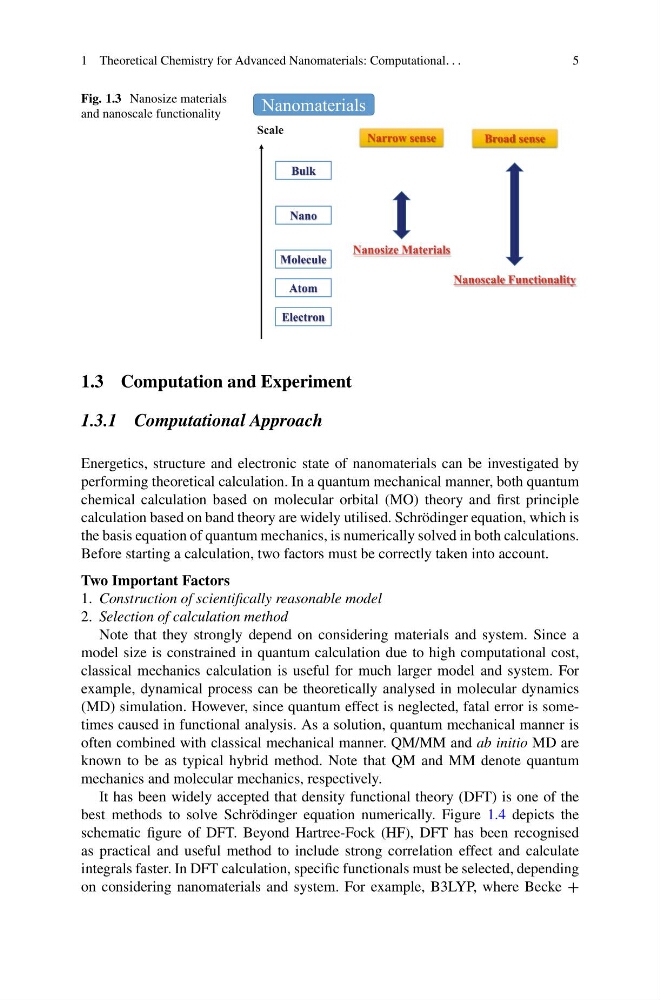
Fig. 1.3 Nanosize materials
and nanoscale functionality
Electron
Atom
Molecule
Nano
Bulk
Narrow sense
Broad sense
Nanosize Materials
Nanoscale Functionality
Scale
Nanomaterials
1.3 Computation and Experiment
1.3.1 Computational Approach
Energetics, structure and electronic state of nanomaterials can be investigated by
performing theoretical calculation. In a quantum mechanical manner, both quantum
chemical calculation based on molecular orbital (MO) theory and first principle
calculation based on band theory are widely utilised. Schrödinger equation, which is
the basis equation of quantum mechanics, is numerically solved in both calculations.
Before starting a calculation, two factors must be correctly taken into account.
Two Important Factors
1. Construction of scientifically reasonable model
2. Selection of calculation method
Note that they strongly depend on considering materials and system. Since a
model size is constrained in quantum calculation due to high computational cost,
classical mechanics calculation is useful for much larger model and system. For
example, dynamical process can be theoretically analysed in molecular dynamics
(MD) simulation. However, since quantum effect is neglected, fatal error is sometimes caused in functional analysis. As a solution, quantum mechanical manner is
often combined with classical mechanical manner. QM/MM and ab initio MD are
known to be as typical hybrid method. Note that QM and MM denote quantum
mechanics and molecular mechanics, respectively.
It has been widely accepted that density functional theory (DFT) is one of the
best methods to solve Schrödinger equation numerically. Figure 1.4 depicts the
schematic figure of DFT. Beyond Hartree-Fock (HF), DFT has been recognised
as practical and useful method to include strong correlation effect and calculate
integrals faster. In DFT calculation, specific functionals must be selected, depending
on considering nanomaterials and system. For example, B3LYP, where Becke +
5
Fig. 1.3 Nanosize materials
and nanoscale functionality
Electron
Atom
Molecule
Nano
Bulk
Narrow sense
Broad sense
Nanosize Materials
Nanoscale Functionality
Scale
Nanomaterials
1.3 Computation and Experiment
1.3.1 Computational Approach
Energetics, structure and electronic state of nanomaterials can be investigated by
performing theoretical calculation. In a quantum mechanical manner, both quantum
chemical calculation based on molecular orbital (MO) theory and first principle
calculation based on band theory are widely utilised. Schrödinger equation, which is
the basis equation of quantum mechanics, is numerically solved in both calculations.
Before starting a calculation, two factors must be correctly taken into account.
Two Important Factors
1. Construction of scientifically reasonable model
2. Selection of calculation method
Note that they strongly depend on considering materials and system. Since a
model size is constrained in quantum calculation due to high computational cost,
classical mechanics calculation is useful for much larger model and system. For
example, dynamical process can be theoretically analysed in molecular dynamics
(MD) simulation. However, since quantum effect is neglected, fatal error is sometimes caused in functional analysis. As a solution, quantum mechanical manner is
often combined with classical mechanical manner. QM/MM and ab initio MD are
known to be as typical hybrid method. Note that QM and MM denote quantum
mechanics and molecular mechanics, respectively.
It has been widely accepted that density functional theory (DFT) is one of the
best methods to solve Schrödinger equation numerically. Figure 1.4 depicts the
schematic figure of DFT. Beyond Hartree-Fock (HF), DFT has been recognised
as practical and useful method to include strong correlation effect and calculate
integrals faster. In DFT calculation, specific functionals must be selected, depending
on considering nanomaterials and system. For example, B3LYP, where Becke +