

4
T. Onishi
Fig. 1.1 Major calculation
targets in computational
chemistry and physics
Nanomaterials
Biology
Chemical Reaction
Collision, Spectroscopy,
Light-matter interaction
Battery, Catalyst, Semiconductor,
Ferroelectric, Magnetic material etc
Protein, DNA, Enzyme etc
THIS BOOK
Fig. 1.2 Schematic figure of
research of advanced
nanomaterials
Research of Advanced Nanomaterials
Nanomaterials
Design
Synthesis
Functional
Analysis
Application
THIS BOOK
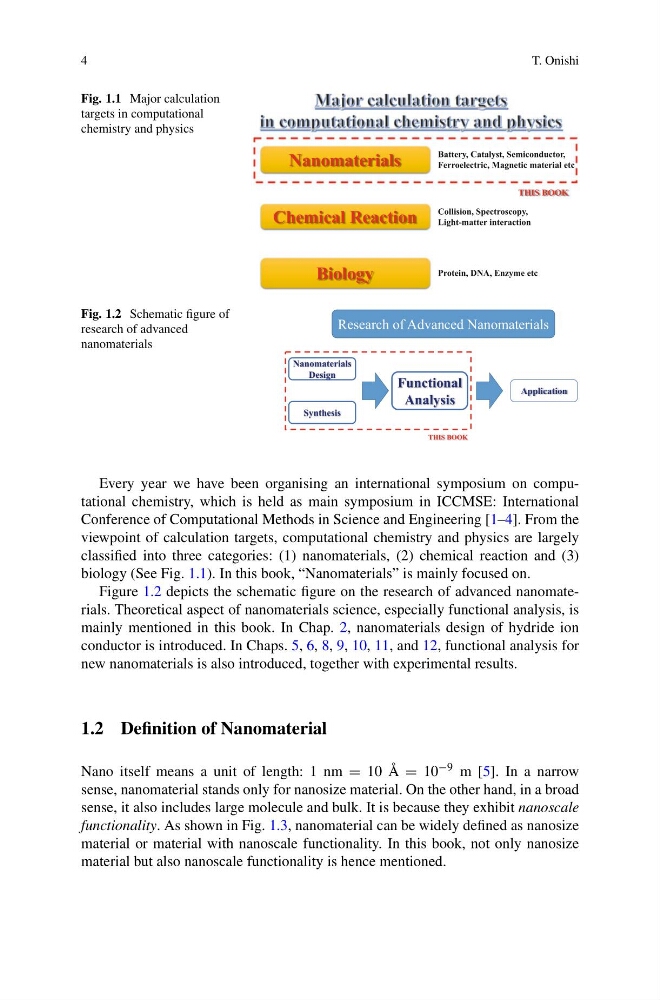
Every year we have been organising an international symposium on computational chemistry, which is held as main symposium in ICCMSE: International
Conference of Computational Methods in Science and Engineering [1–4]. From the
viewpoint of calculation targets, computational chemistry and physics are largely
classified into three categories: (1) nanomaterials, (2) chemical reaction and (3)
biology (See Fig. 1.1). In this book, “Nanomaterials” is mainly focused on.
Figure 1.2 depicts the schematic figure on the research of advanced nanomaterials. Theoretical aspect of nanomaterials science, especially functional analysis, is
mainly mentioned in this book. In Chap. 2, nanomaterials design of hydride ion
conductor is introduced. In Chaps. 5, 6, 8, 9, 10, 11, and 12, functional analysis for
new nanomaterials is also introduced, together with experimental results.
1.2 Definition of Nanomaterial
Nano itself means a unit of length: 1 nm = 10 Å = 10 −9 m [5]. In a narrow
sense, nanomaterial stands only for nanosize material. On the other hand, in a broad
sense, it also includes large molecule and bulk. It is because they exhibit nanoscale
functionality. As shown in Fig. 1.3, nanomaterial can be widely defined as nanosize
material or material with nanoscale functionality. In this book, not only nanosize
material but also nanoscale functionality is hence mentioned.
T. Onishi
Fig. 1.1 Major calculation
targets in computational
chemistry and physics
Nanomaterials
Biology
Chemical Reaction
Collision, Spectroscopy,
Light-matter interaction
Battery, Catalyst, Semiconductor,
Ferroelectric, Magnetic material etc
Protein, DNA, Enzyme etc
THIS BOOK
Fig. 1.2 Schematic figure of
research of advanced
nanomaterials
Research of Advanced Nanomaterials
Nanomaterials
Design
Synthesis
Functional
Analysis
Application
THIS BOOK
Every year we have been organising an international symposium on computational chemistry, which is held as main symposium in ICCMSE: International
Conference of Computational Methods in Science and Engineering [1–4]. From the
viewpoint of calculation targets, computational chemistry and physics are largely
classified into three categories: (1) nanomaterials, (2) chemical reaction and (3)
biology (See Fig. 1.1). In this book, “Nanomaterials” is mainly focused on.
Figure 1.2 depicts the schematic figure on the research of advanced nanomaterials. Theoretical aspect of nanomaterials science, especially functional analysis, is
mainly mentioned in this book. In Chap. 2, nanomaterials design of hydride ion
conductor is introduced. In Chaps. 5, 6, 8, 9, 10, 11, and 12, functional analysis for
new nanomaterials is also introduced, together with experimental results.
1.2 Definition of Nanomaterial
Nano itself means a unit of length: 1 nm = 10 Å = 10 −9 m [5]. In a narrow
sense, nanomaterial stands only for nanosize material. On the other hand, in a broad
sense, it also includes large molecule and bulk. It is because they exhibit nanoscale
functionality. As shown in Fig. 1.3, nanomaterial can be widely defined as nanosize
material or material with nanoscale functionality. In this book, not only nanosize
material but also nanoscale functionality is hence mentioned.