

5 Enabling Materials By Dimensionality: From 0D to 3D Carbon-Based. . .
189
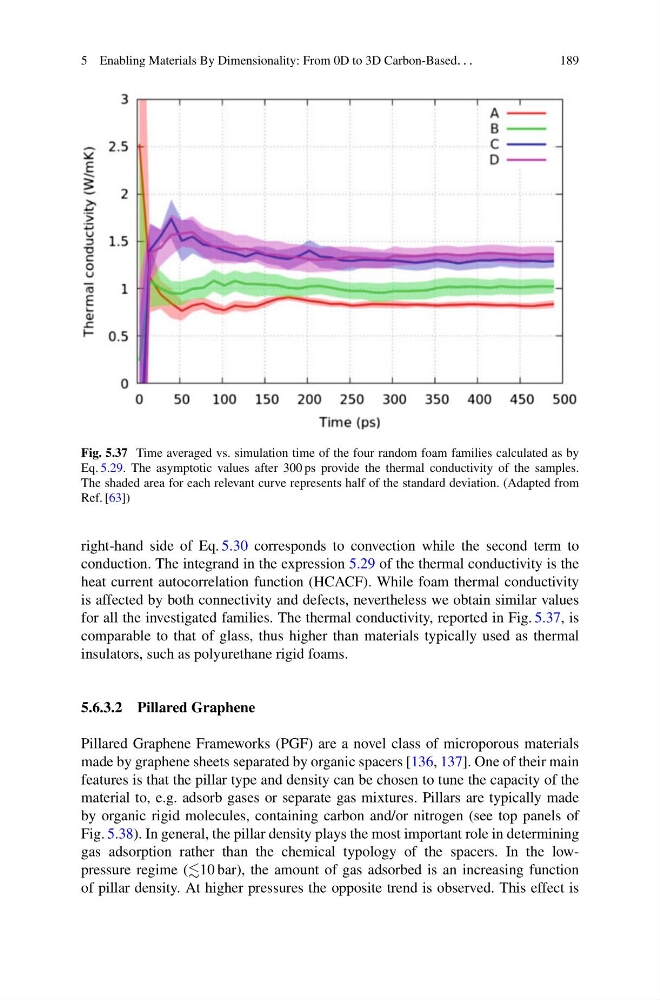
Fig. 5.37 Time averaged vs. simulation time of the four random foam families calculated as by
Eq. 5.29. The asymptotic values after 300 ps provide the thermal conductivity of the samples.
The shaded area for each relevant curve represents half of the standard deviation. (Adapted from
Ref. [63])
right-hand side of Eq. 5.30 corresponds to convection while the second term to
conduction. The integrand in the expression 5.29 of the thermal conductivity is the
heat current autocorrelation function (HCACF). While foam thermal conductivity
is affected by both connectivity and defects, nevertheless we obtain similar values
for all the investigated families. The thermal conductivity, reported in Fig. 5.37, is
comparable to that of glass, thus higher than materials typically used as thermal
insulators, such as polyurethane rigid foams.
5.6.3.2 Pillared Graphene
Pillared Graphene Frameworks (PGF) are a novel class of microporous materials
made by graphene sheets separated by organic spacers [136, 137]. One of their main
features is that the pillar type and density can be chosen to tune the capacity of the
material to, e.g. adsorb gases or separate gas mixtures. Pillars are typically made
by organic rigid molecules, containing carbon and/or nitrogen (see top panels of
Fig. 5.38). In general, the pillar density plays the most important role in determining
gas adsorption rather than the chemical typology of the spacers. In the lowpressure regime (10 bar), the amount of gas adsorbed is an increasing function
of pillar density. At higher pressures the opposite trend is observed. This effect is
189
Fig. 5.37 Time averaged vs. simulation time of the four random foam families calculated as by
Eq. 5.29. The asymptotic values after 300 ps provide the thermal conductivity of the samples.
The shaded area for each relevant curve represents half of the standard deviation. (Adapted from
Ref. [63])
right-hand side of Eq. 5.30 corresponds to convection while the second term to
conduction. The integrand in the expression 5.29 of the thermal conductivity is the
heat current autocorrelation function (HCACF). While foam thermal conductivity
is affected by both connectivity and defects, nevertheless we obtain similar values
for all the investigated families. The thermal conductivity, reported in Fig. 5.37, is
comparable to that of glass, thus higher than materials typically used as thermal
insulators, such as polyurethane rigid foams.
5.6.3.2 Pillared Graphene
Pillared Graphene Frameworks (PGF) are a novel class of microporous materials
made by graphene sheets separated by organic spacers [136, 137]. One of their main
features is that the pillar type and density can be chosen to tune the capacity of the
material to, e.g. adsorb gases or separate gas mixtures. Pillars are typically made
by organic rigid molecules, containing carbon and/or nitrogen (see top panels of
Fig. 5.38). In general, the pillar density plays the most important role in determining
gas adsorption rather than the chemical typology of the spacers. In the lowpressure regime (10 bar), the amount of gas adsorbed is an increasing function
of pillar density. At higher pressures the opposite trend is observed. This effect is