

190
S. Taioli
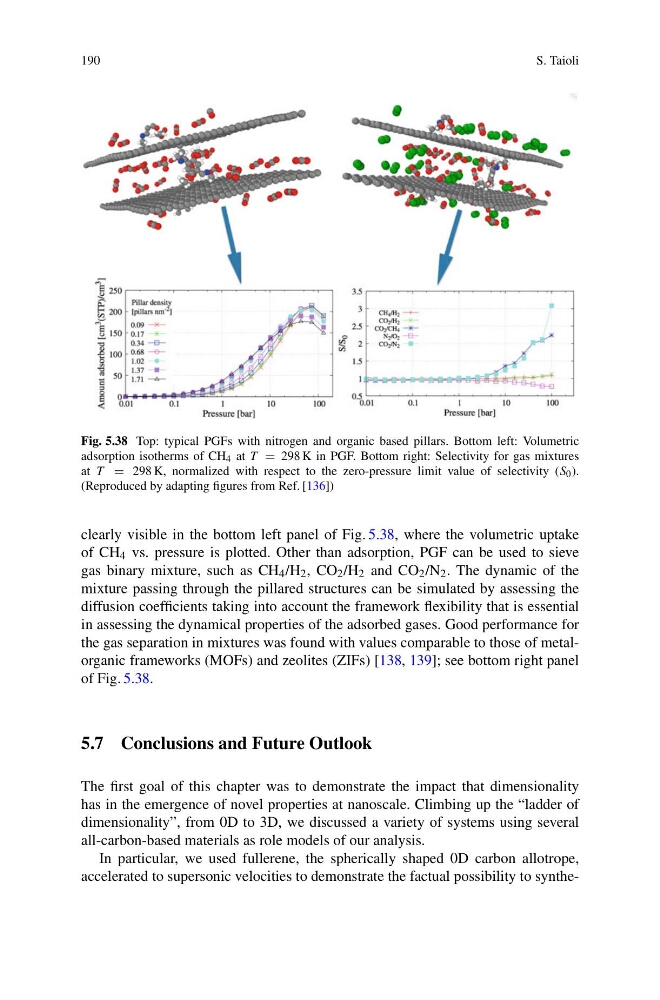
Fig. 5.38 Top: typical PGFs with nitrogen and organic based pillars. Bottom left: Volumetric
adsorption isotherms of CH 4 at T = 298 K in PGF. Bottom right: Selectivity for gas mixtures
at T = 298 K, normalized with respect to the zero-pressure limit value of selectivity (S 0 ).
(Reproduced by adapting figures from Ref. [136])
clearly visible in the bottom left panel of Fig. 5.38, where the volumetric uptake
of CH 4 vs. pressure is plotted. Other than adsorption, PGF can be used to sieve
gas binary mixture, such as CH 4 /H 2 , CO 2 /H 2 and CO 2 /N 2 . The dynamic of the
mixture passing through the pillared structures can be simulated by assessing the
diffusion coefficients taking into account the framework flexibility that is essential
in assessing the dynamical properties of the adsorbed gases. Good performance for
the gas separation in mixtures was found with values comparable to those of metalorganic frameworks (MOFs) and zeolites (ZIFs) [138, 139]; see bottom right panel
of Fig. 5.38.
5.7 Conclusions and Future Outlook
The first goal of this chapter was to demonstrate the impact that dimensionality
has in the emergence of novel properties at nanoscale. Climbing up the “ladder of
dimensionality”, from 0D to 3D, we discussed a variety of systems using several
all-carbon-based materials as role models of our analysis.
In particular, we used fullerene, the spherically shaped 0D carbon allotrope,
accelerated to supersonic velocities to demonstrate the factual possibility to synthe-
S. Taioli
Fig. 5.38 Top: typical PGFs with nitrogen and organic based pillars. Bottom left: Volumetric
adsorption isotherms of CH 4 at T = 298 K in PGF. Bottom right: Selectivity for gas mixtures
at T = 298 K, normalized with respect to the zero-pressure limit value of selectivity (S 0 ).
(Reproduced by adapting figures from Ref. [136])
clearly visible in the bottom left panel of Fig. 5.38, where the volumetric uptake
of CH 4 vs. pressure is plotted. Other than adsorption, PGF can be used to sieve
gas binary mixture, such as CH 4 /H 2 , CO 2 /H 2 and CO 2 /N 2 . The dynamic of the
mixture passing through the pillared structures can be simulated by assessing the
diffusion coefficients taking into account the framework flexibility that is essential
in assessing the dynamical properties of the adsorbed gases. Good performance for
the gas separation in mixtures was found with values comparable to those of metalorganic frameworks (MOFs) and zeolites (ZIFs) [138, 139]; see bottom right panel
of Fig. 5.38.
5.7 Conclusions and Future Outlook
The first goal of this chapter was to demonstrate the impact that dimensionality
has in the emergence of novel properties at nanoscale. Climbing up the “ladder of
dimensionality”, from 0D to 3D, we discussed a variety of systems using several
all-carbon-based materials as role models of our analysis.
In particular, we used fullerene, the spherically shaped 0D carbon allotrope,
accelerated to supersonic velocities to demonstrate the factual possibility to synthe-