

186
S. Taioli
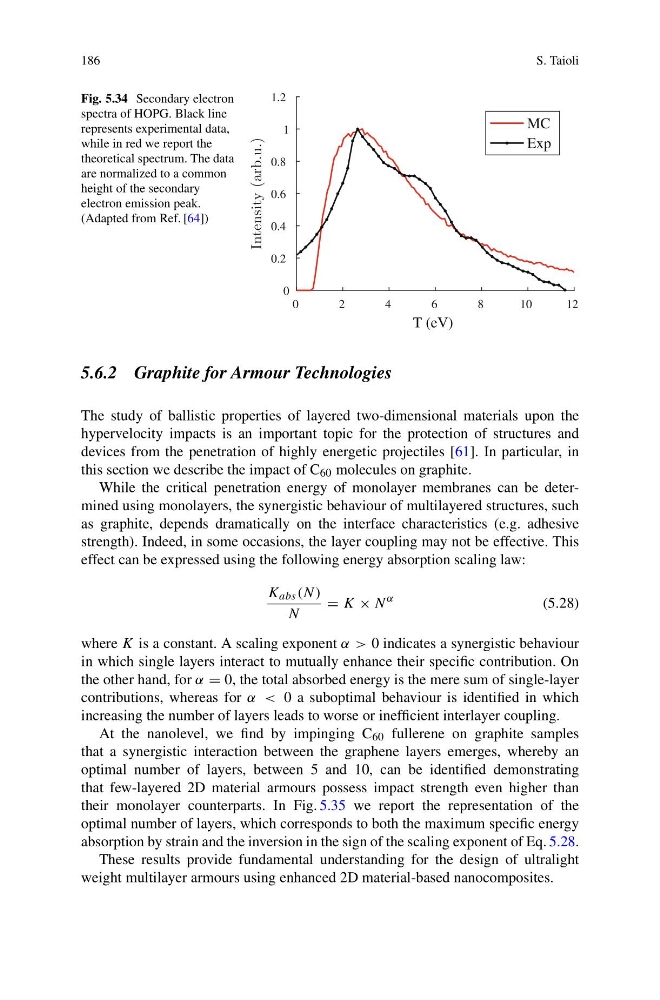
Fig. 5.34 Secondary electron
spectra of HOPG. Black line
represents experimental data,
while in red we report the
theoretical spectrum. The data
are normalized to a common
height of the secondary
electron emission peak.
(Adapted from Ref. [64])
5.6.2 Graphite for Armour Technologies
The study of ballistic properties of layered two-dimensional materials upon the
hypervelocity impacts is an important topic for the protection of structures and
devices from the penetration of highly energetic projectiles [61]. In particular, in
this section we describe the impact of C 60 molecules on graphite.
While the critical penetration energy of monolayer membranes can be determined using monolayers, the synergistic behaviour of multilayered structures, such
as graphite, depends dramatically on the interface characteristics (e.g. adhesive
strength). Indeed, in some occasions, the layer coupling may not be effective. This
effect can be expressed using the following energy absorption scaling law:
K abs (N)
N
= K × N
α
(5.28)
where K is a constant. A scaling exponent α > 0 indicates a synergistic behaviour
in which single layers interact to mutually enhance their specific contribution. On
the other hand, for α = 0, the total absorbed energy is the mere sum of single-layer
contributions, whereas for α < 0 a suboptimal behaviour is identified in which
increasing the number of layers leads to worse or inefficient interlayer coupling.
At the nanolevel, we find by impinging C 60 fullerene on graphite samples
that a synergistic interaction between the graphene layers emerges, whereby an
optimal number of layers, between 5 and 10, can be identified demonstrating
that few-layered 2D material armours possess impact strength even higher than
their monolayer counterparts. In Fig. 5.35 we report the representation of the
optimal number of layers, which corresponds to both the maximum specific energy
absorption by strain and the inversion in the sign of the scaling exponent of Eq. 5.28.
These results provide fundamental understanding for the design of ultralight
weight multilayer armours using enhanced 2D material-based nanocomposites.
S. Taioli
Fig. 5.34 Secondary electron
spectra of HOPG. Black line
represents experimental data,
while in red we report the
theoretical spectrum. The data
are normalized to a common
height of the secondary
electron emission peak.
(Adapted from Ref. [64])
5.6.2 Graphite for Armour Technologies
The study of ballistic properties of layered two-dimensional materials upon the
hypervelocity impacts is an important topic for the protection of structures and
devices from the penetration of highly energetic projectiles [61]. In particular, in
this section we describe the impact of C 60 molecules on graphite.
While the critical penetration energy of monolayer membranes can be determined using monolayers, the synergistic behaviour of multilayered structures, such
as graphite, depends dramatically on the interface characteristics (e.g. adhesive
strength). Indeed, in some occasions, the layer coupling may not be effective. This
effect can be expressed using the following energy absorption scaling law:
K abs (N)
N
= K × N
α
(5.28)
where K is a constant. A scaling exponent α > 0 indicates a synergistic behaviour
in which single layers interact to mutually enhance their specific contribution. On
the other hand, for α = 0, the total absorbed energy is the mere sum of single-layer
contributions, whereas for α < 0 a suboptimal behaviour is identified in which
increasing the number of layers leads to worse or inefficient interlayer coupling.
At the nanolevel, we find by impinging C 60 fullerene on graphite samples
that a synergistic interaction between the graphene layers emerges, whereby an
optimal number of layers, between 5 and 10, can be identified demonstrating
that few-layered 2D material armours possess impact strength even higher than
their monolayer counterparts. In Fig. 5.35 we report the representation of the
optimal number of layers, which corresponds to both the maximum specific energy
absorption by strain and the inversion in the sign of the scaling exponent of Eq. 5.28.
These results provide fundamental understanding for the design of ultralight
weight multilayer armours using enhanced 2D material-based nanocomposites.