

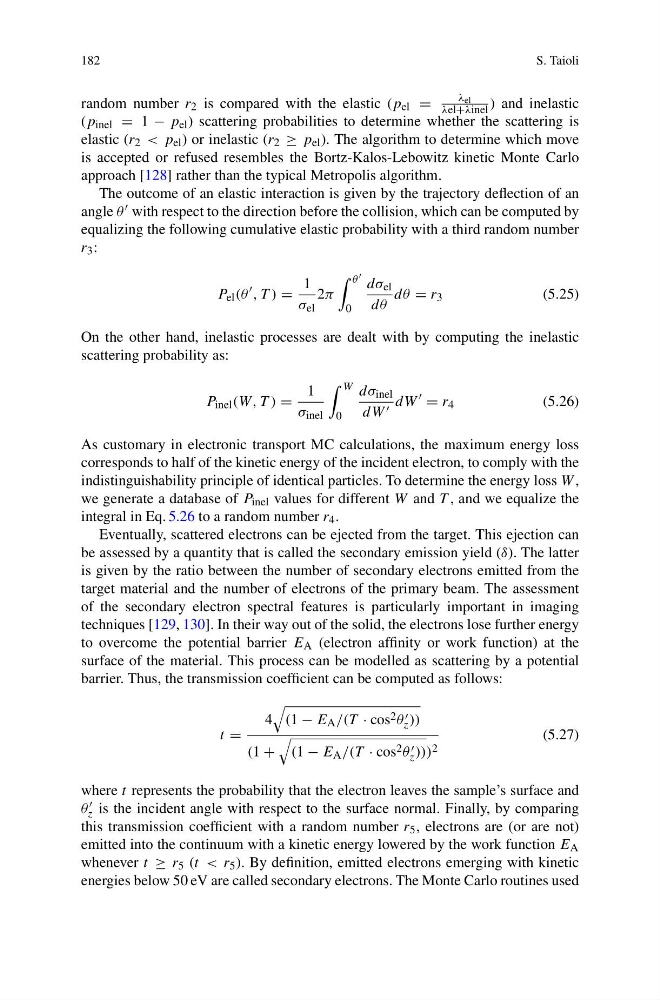
182
S. Taioli
random number r 2 is compared with the elastic (p el =
λ el
λel+λinel ) and inelastic
(p inel = 1 − p el ) scattering probabilities to determine whether the scattering is
elastic (r 2 < p el ) or inelastic (r 2 ≥ p el ). The algorithm to determine which move
is accepted or refused resembles the Bortz-Kalos-Lebowitz kinetic Monte Carlo
approach [128] rather than the typical Metropolis algorithm.
The outcome of an elastic interaction is given by the trajectory deflection of an
angle θ with respect to the direction before the collision, which can be computed by
equalizing the following cumulative elastic probability with a third random number
r 3 :
P el (θ
, T ) =
1
σ el
2π
θ
0
dσ el
dθ
dθ = r 3
(5.25)
On the other hand, inelastic processes are dealt with by computing the inelastic
scattering probability as:
P inel (W, T ) =
1
σ inel
W
0
dσ inel
dW dW
= r 4
(5.26)
As customary in electronic transport MC calculations, the maximum energy loss
corresponds to half of the kinetic energy of the incident electron, to comply with the
indistinguishability principle of identical particles. To determine the energy loss W ,
we generate a database of P inel values for different W and T , and we equalize the
integral in Eq. 5.26 to a random number r 4 .
Eventually, scattered electrons can be ejected from the target. This ejection can
be assessed by a quantity that is called the secondary emission yield (δ). The latter
is given by the ratio between the number of secondary electrons emitted from the
target material and the number of electrons of the primary beam. The assessment
of the secondary electron spectral features is particularly important in imaging
techniques [129, 130]. In their way out of the solid, the electrons lose further energy
to overcome the potential barrier E A (electron affinity or work function) at the
surface of the material. This process can be modelled as scattering by a potential
barrier. Thus, the transmission coefficient can be computed as follows:
t =
4
(1 − E A /(T · cos 2 θ
z ))
(1 +
(1 − E A /(T · cos 2 θ
z ))) 2
(5.27)
where t represents the probability that the electron leaves the sample’s surface and
θ
z is the incident angle with respect to the surface normal. Finally, by comparing
this transmission coefficient with a random number r 5 , electrons are (or are not)
emitted into the continuum with a kinetic energy lowered by the work function E A
whenever t ≥ r 5 (t < r 5 ). By definition, emitted electrons emerging with kinetic
energies below 50 eV are called secondary electrons. The Monte Carlo routines used
S. Taioli
random number r 2 is compared with the elastic (p el =
λ el
λel+λinel ) and inelastic
(p inel = 1 − p el ) scattering probabilities to determine whether the scattering is
elastic (r 2 < p el ) or inelastic (r 2 ≥ p el ). The algorithm to determine which move
is accepted or refused resembles the Bortz-Kalos-Lebowitz kinetic Monte Carlo
approach [128] rather than the typical Metropolis algorithm.
The outcome of an elastic interaction is given by the trajectory deflection of an
angle θ with respect to the direction before the collision, which can be computed by
equalizing the following cumulative elastic probability with a third random number
r 3 :
P el (θ
, T ) =
1
σ el
2π
θ
0
dσ el
dθ
dθ = r 3
(5.25)
On the other hand, inelastic processes are dealt with by computing the inelastic
scattering probability as:
P inel (W, T ) =
1
σ inel
W
0
dσ inel
dW dW
= r 4
(5.26)
As customary in electronic transport MC calculations, the maximum energy loss
corresponds to half of the kinetic energy of the incident electron, to comply with the
indistinguishability principle of identical particles. To determine the energy loss W ,
we generate a database of P inel values for different W and T , and we equalize the
integral in Eq. 5.26 to a random number r 4 .
Eventually, scattered electrons can be ejected from the target. This ejection can
be assessed by a quantity that is called the secondary emission yield (δ). The latter
is given by the ratio between the number of secondary electrons emitted from the
target material and the number of electrons of the primary beam. The assessment
of the secondary electron spectral features is particularly important in imaging
techniques [129, 130]. In their way out of the solid, the electrons lose further energy
to overcome the potential barrier E A (electron affinity or work function) at the
surface of the material. This process can be modelled as scattering by a potential
barrier. Thus, the transmission coefficient can be computed as follows:
t =
4
(1 − E A /(T · cos 2 θ
z ))
(1 +
(1 − E A /(T · cos 2 θ
z ))) 2
(5.27)
where t represents the probability that the electron leaves the sample’s surface and
θ
z is the incident angle with respect to the surface normal. Finally, by comparing
this transmission coefficient with a random number r 5 , electrons are (or are not)
emitted into the continuum with a kinetic energy lowered by the work function E A
whenever t ≥ r 5 (t < r 5 ). By definition, emitted electrons emerging with kinetic
energies below 50 eV are called secondary electrons. The Monte Carlo routines used