

5 Enabling Materials By Dimensionality: From 0D to 3D Carbon-Based. . .
181
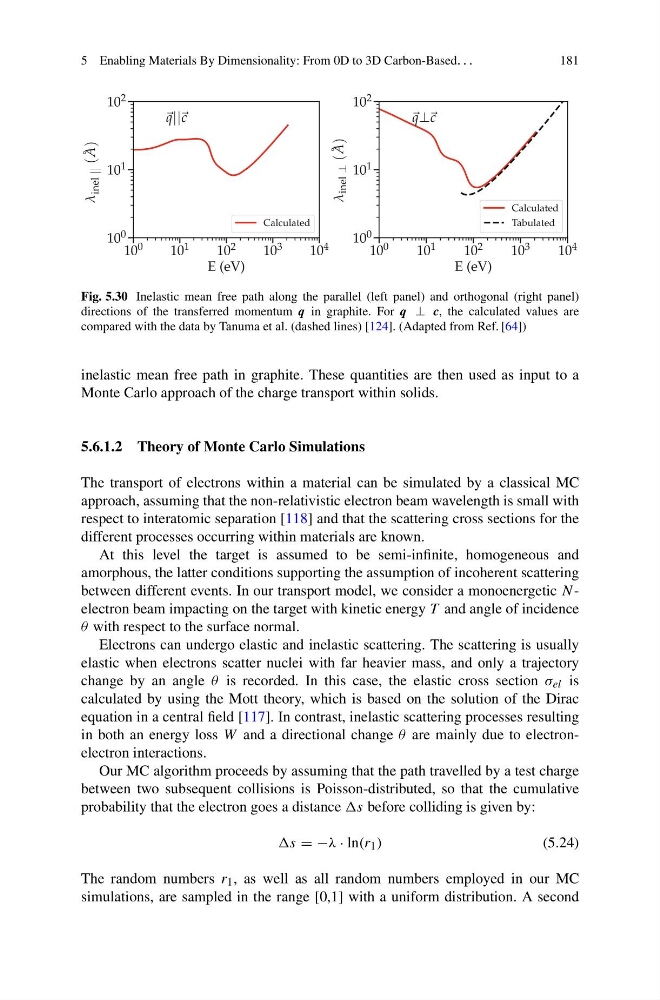
Fig. 5.30 Inelastic mean free path along the parallel (left panel) and orthogonal (right panel)
directions of the transferred momentum q in graphite. For q ⊥ c, the calculated values are
compared with the data by Tanuma et al. (dashed lines) [124]. (Adapted from Ref. [64])
inelastic mean free path in graphite. These quantities are then used as input to a
Monte Carlo approach of the charge transport within solids.
5.6.1.2 Theory of Monte Carlo Simulations
The transport of electrons within a material can be simulated by a classical MC
approach, assuming that the non-relativistic electron beam wavelength is small with
respect to interatomic separation [118] and that the scattering cross sections for the
different processes occurring within materials are known.
At this level the target is assumed to be semi-infinite, homogeneous and
amorphous, the latter conditions supporting the assumption of incoherent scattering
between different events. In our transport model, we consider a monoenergetic N -
electron beam impacting on the target with kinetic energy T and angle of incidence
θ with respect to the surface normal.
Electrons can undergo elastic and inelastic scattering. The scattering is usually
elastic when electrons scatter nuclei with far heavier mass, and only a trajectory
change by an angle θ is recorded. In this case, the elastic cross section σ el is
calculated by using the Mott theory, which is based on the solution of the Dirac
equation in a central field [117]. In contrast, inelastic scattering processes resulting
in both an energy loss W and a directional change θ are mainly due to electronelectron interactions.
Our MC algorithm proceeds by assuming that the path travelled by a test charge
between two subsequent collisions is Poisson-distributed, so that the cumulative
probability that the electron goes a distance s before colliding is given by:
s = −λ · ln(r 1 )
(5.24)
The random numbers r 1 , as well as all random numbers employed in our MC
simulations, are sampled in the range [0,1] with a uniform distribution. A second
181
Fig. 5.30 Inelastic mean free path along the parallel (left panel) and orthogonal (right panel)
directions of the transferred momentum q in graphite. For q ⊥ c, the calculated values are
compared with the data by Tanuma et al. (dashed lines) [124]. (Adapted from Ref. [64])
inelastic mean free path in graphite. These quantities are then used as input to a
Monte Carlo approach of the charge transport within solids.
5.6.1.2 Theory of Monte Carlo Simulations
The transport of electrons within a material can be simulated by a classical MC
approach, assuming that the non-relativistic electron beam wavelength is small with
respect to interatomic separation [118] and that the scattering cross sections for the
different processes occurring within materials are known.
At this level the target is assumed to be semi-infinite, homogeneous and
amorphous, the latter conditions supporting the assumption of incoherent scattering
between different events. In our transport model, we consider a monoenergetic N -
electron beam impacting on the target with kinetic energy T and angle of incidence
θ with respect to the surface normal.
Electrons can undergo elastic and inelastic scattering. The scattering is usually
elastic when electrons scatter nuclei with far heavier mass, and only a trajectory
change by an angle θ is recorded. In this case, the elastic cross section σ el is
calculated by using the Mott theory, which is based on the solution of the Dirac
equation in a central field [117]. In contrast, inelastic scattering processes resulting
in both an energy loss W and a directional change θ are mainly due to electronelectron interactions.
Our MC algorithm proceeds by assuming that the path travelled by a test charge
between two subsequent collisions is Poisson-distributed, so that the cumulative
probability that the electron goes a distance s before colliding is given by:
s = −λ · ln(r 1 )
(5.24)
The random numbers r 1 , as well as all random numbers employed in our MC
simulations, are sampled in the range [0,1] with a uniform distribution. A second