

5 Enabling Materials By Dimensionality: From 0D to 3D Carbon-Based. . .
165
case, we call it E A . Of course one can define also the usual Young’s modulus E
by introducing a fictitious thickness t which for graphene is conventionally chosen
equal to the intra-planar distance in solid graphite (0.335 nm). We also remind that
at variance with a stable, isotropic, linear elastic 3D material where the bounds on
Poisson’s ratio are −1 < ν < 1/2, for 2D materials, one can have −1 < ν < 1
[81]. Furthermore, we notice that the Poisson’s ratio of tilene, flakene and liskene
shows that these materials are almost incompressible.
The most significant quantity to be compared with graphene is of course the
specific modulus, that is, the Young’s modulus divided by the mass density. In
particular, dealing with a bi-dimensional material one can assess the Young’s
modulus E per area density ρ A , E/ρ A . We report this quantity in the last column
of Table 5.2. We notice that graphene presents the biggest specific modulus among
the materials studied here. Flakene, in particular, displays the lowest density among
the investigated structures and shows a major drop in both the absolute and specific
elastic moduli, which are from eight to five times lower than graphene. Nevertheless,
while we do not find a material outperforming the specific properties of graphene
in this respect and, thus, we do observe that the augmentation is only partially an
advantageous route to follow in order to increase the specific modulus of graphenelike materials, the difference in the specific Young’s modulus is less remarkable than
for the absolute values, with the exception of flakene.
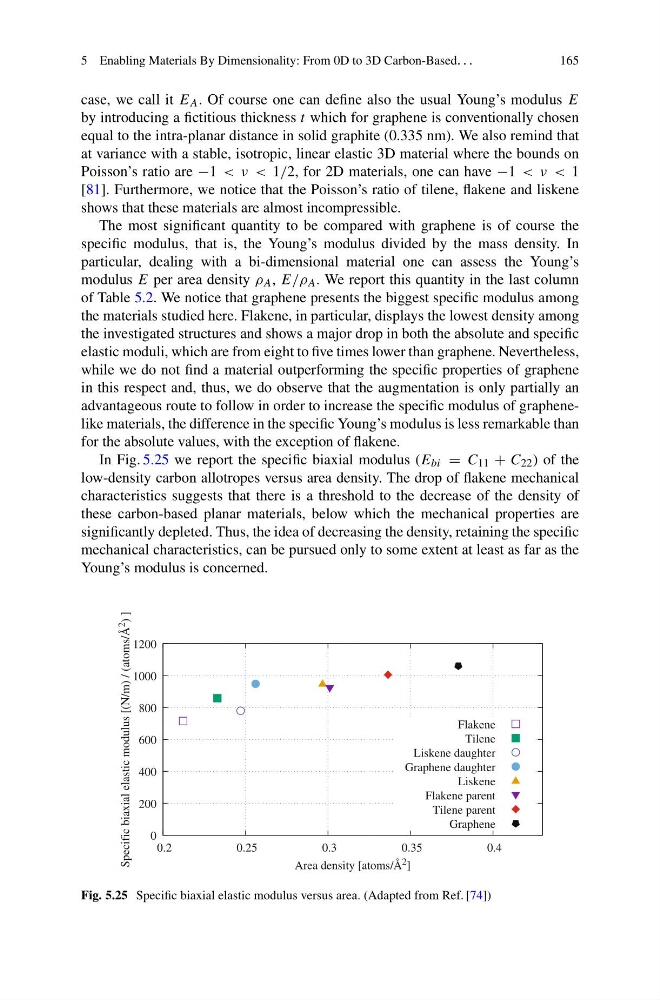
In Fig. 5.25 we report the specific biaxial modulus (E bi = C 11 + C 22 ) of the
low-density carbon allotropes versus area density. The drop of flakene mechanical
characteristics suggests that there is a threshold to the decrease of the density of
these carbon-based planar materials, below which the mechanical properties are
significantly depleted. Thus, the idea of decreasing the density, retaining the specific
mechanical characteristics, can be pursued only to some extent at least as far as the
Young’s modulus is concerned.
0
200
400
600
800
1000
1200
0.2
0.25
0.3
0.35
0.4
Specific biaxial elastic modulus [(N/m) / (atoms/Å 2
) ]
Area density [atoms/Å 2 ]
Flakene
Tilene
Liskene daughter
Graphene daughter
Liskene
Flakene parent
Tilene parent
Graphene
Fig. 5.25 Specific biaxial elastic modulus versus area. (Adapted from Ref. [74])
165
case, we call it E A . Of course one can define also the usual Young’s modulus E
by introducing a fictitious thickness t which for graphene is conventionally chosen
equal to the intra-planar distance in solid graphite (0.335 nm). We also remind that
at variance with a stable, isotropic, linear elastic 3D material where the bounds on
Poisson’s ratio are −1 < ν < 1/2, for 2D materials, one can have −1 < ν < 1
[81]. Furthermore, we notice that the Poisson’s ratio of tilene, flakene and liskene
shows that these materials are almost incompressible.
The most significant quantity to be compared with graphene is of course the
specific modulus, that is, the Young’s modulus divided by the mass density. In
particular, dealing with a bi-dimensional material one can assess the Young’s
modulus E per area density ρ A , E/ρ A . We report this quantity in the last column
of Table 5.2. We notice that graphene presents the biggest specific modulus among
the materials studied here. Flakene, in particular, displays the lowest density among
the investigated structures and shows a major drop in both the absolute and specific
elastic moduli, which are from eight to five times lower than graphene. Nevertheless,
while we do not find a material outperforming the specific properties of graphene
in this respect and, thus, we do observe that the augmentation is only partially an
advantageous route to follow in order to increase the specific modulus of graphenelike materials, the difference in the specific Young’s modulus is less remarkable than
for the absolute values, with the exception of flakene.
In Fig. 5.25 we report the specific biaxial modulus (E bi = C 11 + C 22 ) of the
low-density carbon allotropes versus area density. The drop of flakene mechanical
characteristics suggests that there is a threshold to the decrease of the density of
these carbon-based planar materials, below which the mechanical properties are
significantly depleted. Thus, the idea of decreasing the density, retaining the specific
mechanical characteristics, can be pursued only to some extent at least as far as the
Young’s modulus is concerned.
0
200
400
600
800
1000
1200
0.2
0.25
0.3
0.35
0.4
Specific biaxial elastic modulus [(N/m) / (atoms/Å 2
) ]
Area density [atoms/Å 2 ]
Flakene
Tilene
Liskene daughter
Graphene daughter
Liskene
Flakene parent
Tilene parent
Graphene
Fig. 5.25 Specific biaxial elastic modulus versus area. (Adapted from Ref. [74])