

164
S. Taioli
C ij =
∂ 2 F
∂ε i ∂ε j
(5.4)
where in harmonic approximation (neglecting the thermal electronic contribution)
the density function F can be expressed as:
F = F 0 +
1
2
F
(2) ε
2
+ o(ε
3 )
(5.5)
where F 0 and 1/2F (2) ε 2 are the static energy of the system and the lattice
vibrational contribution, respectively. From the knowledge of the elastic constants,
the Young’s modulus E, which measures the material stiffness, and the Poisson’s
ratio ν, which measures the material tendency to expand perpendicularly to the
direction of compression, can be computed as E = (C 2
11 − C 2
12 )/C 11 and ν =
C 12 /C 11 , respectively.
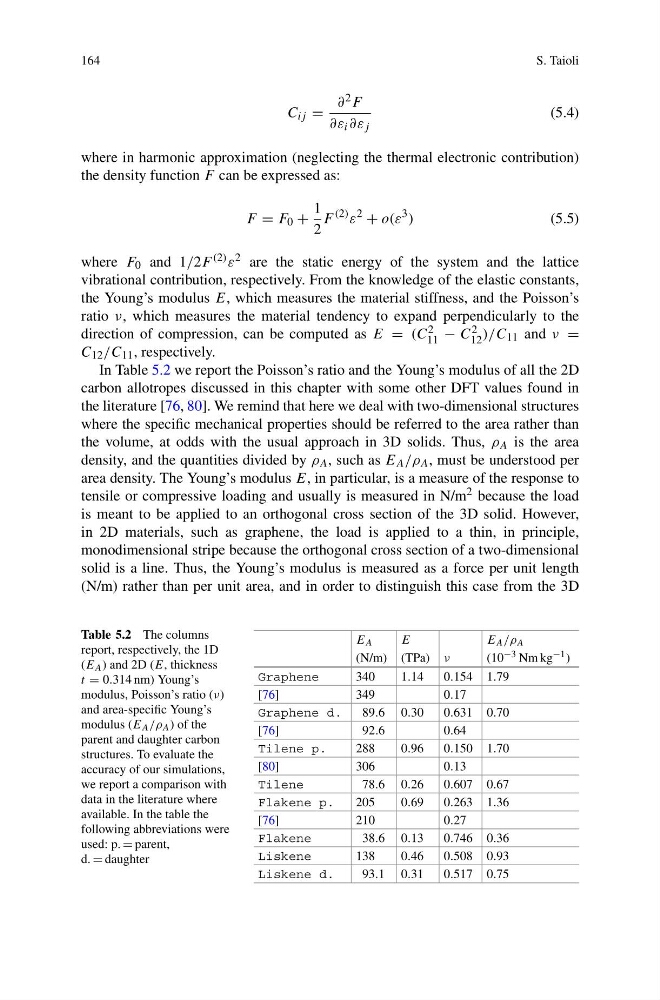
In Table 5.2 we report the Poisson’s ratio and the Young’s modulus of all the 2D
carbon allotropes discussed in this chapter with some other DFT values found in
the literature [76, 80]. We remind that here we deal with two-dimensional structures
where the specific mechanical properties should be referred to the area rather than
the volume, at odds with the usual approach in 3D solids. Thus, ρ A is the area
density, and the quantities divided by ρ A , such as E A /ρ A , must be understood per
area density. The Young’s modulus E, in particular, is a measure of the response to
tensile or compressive loading and usually is measured in N/m 2 because the load
is meant to be applied to an orthogonal cross section of the 3D solid. However,
in 2D materials, such as graphene, the load is applied to a thin, in principle,
monodimensional stripe because the orthogonal cross section of a two-dimensional
solid is a line. Thus, the Young’s modulus is measured as a force per unit length
(N/m) rather than per unit area, and in order to distinguish this case from the 3D
Table 5.2 The columns
report, respectively, the 1D
(E A ) and 2D (E, thickness
t = 0.314 nm) Young’s
modulus, Poisson’s ratio (ν)
and area-specific Young’s
modulus (E A /ρ A ) of the
parent and daughter carbon
structures. To evaluate the
accuracy of our simulations,
we report a comparison with
data in the literature where
available. In the table the
following abbreviations were
used: p. = parent,
d. = daughter
E A
E
E A /ρ A
(N/m) (TPa) ν
(10 −3 Nm kg −1 )
Graphene
340
1.14
0.154 1.79
[76]
349
0.17
Graphene d.
89.6 0.30
0.631 0.70
[76]
92.6
0.64
Tilene p.
288
0.96
0.150 1.70
[80]
306
0.13
Tilene
78.6 0.26
0.607 0.67
Flakene p.
205
0.69
0.263 1.36
[76]
210
0.27
Flakene
38.6 0.13
0.746 0.36
Liskene
138
0.46
0.508 0.93
Liskene d.
93.1 0.31
0.517 0.75
S. Taioli
C ij =
∂ 2 F
∂ε i ∂ε j
(5.4)
where in harmonic approximation (neglecting the thermal electronic contribution)
the density function F can be expressed as:
F = F 0 +
1
2
F
(2) ε
2
+ o(ε
3 )
(5.5)
where F 0 and 1/2F (2) ε 2 are the static energy of the system and the lattice
vibrational contribution, respectively. From the knowledge of the elastic constants,
the Young’s modulus E, which measures the material stiffness, and the Poisson’s
ratio ν, which measures the material tendency to expand perpendicularly to the
direction of compression, can be computed as E = (C 2
11 − C 2
12 )/C 11 and ν =
C 12 /C 11 , respectively.
In Table 5.2 we report the Poisson’s ratio and the Young’s modulus of all the 2D
carbon allotropes discussed in this chapter with some other DFT values found in
the literature [76, 80]. We remind that here we deal with two-dimensional structures
where the specific mechanical properties should be referred to the area rather than
the volume, at odds with the usual approach in 3D solids. Thus, ρ A is the area
density, and the quantities divided by ρ A , such as E A /ρ A , must be understood per
area density. The Young’s modulus E, in particular, is a measure of the response to
tensile or compressive loading and usually is measured in N/m 2 because the load
is meant to be applied to an orthogonal cross section of the 3D solid. However,
in 2D materials, such as graphene, the load is applied to a thin, in principle,
monodimensional stripe because the orthogonal cross section of a two-dimensional
solid is a line. Thus, the Young’s modulus is measured as a force per unit length
(N/m) rather than per unit area, and in order to distinguish this case from the 3D
Table 5.2 The columns
report, respectively, the 1D
(E A ) and 2D (E, thickness
t = 0.314 nm) Young’s
modulus, Poisson’s ratio (ν)
and area-specific Young’s
modulus (E A /ρ A ) of the
parent and daughter carbon
structures. To evaluate the
accuracy of our simulations,
we report a comparison with
data in the literature where
available. In the table the
following abbreviations were
used: p. = parent,
d. = daughter
E A
E
E A /ρ A
(N/m) (TPa) ν
(10 −3 Nm kg −1 )
Graphene
340
1.14
0.154 1.79
[76]
349
0.17
Graphene d.
89.6 0.30
0.631 0.70
[76]
92.6
0.64
Tilene p.
288
0.96
0.150 1.70
[80]
306
0.13
Tilene
78.6 0.26
0.607 0.67
Flakene p.
205
0.69
0.263 1.36
[76]
210
0.27
Flakene
38.6 0.13
0.746 0.36
Liskene
138
0.46
0.508 0.93
Liskene d.
93.1 0.31
0.517 0.75