

5 Enabling Materials By Dimensionality: From 0D to 3D Carbon-Based. . .
163
-5
-4
-3
-2
-1
0
1
2
3
4
X
M
Energy [eV]
0
1
2
3
4
5
6
7
8
-4
-2
0
2
4
DOS
Energy [eV]
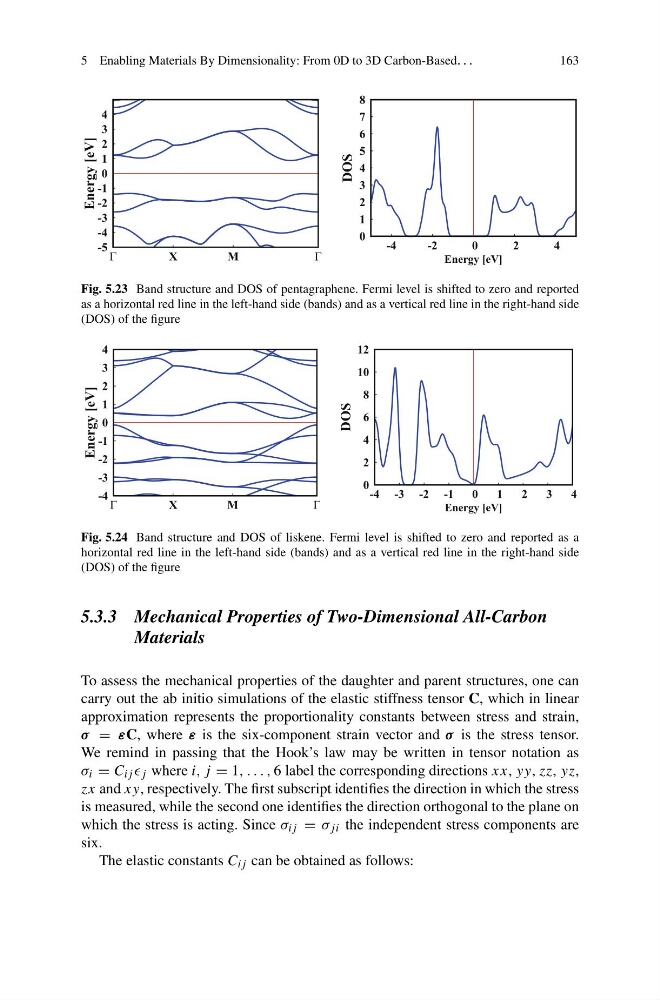
Fig. 5.23 Band structure and DOS of pentagraphene. Fermi level is shifted to zero and reported
as a horizontal red line in the left-hand side (bands) and as a vertical red line in the right-hand side
(DOS) of the figure
-4
-3
-2
-1
0
1
2
3
4
X
M
Energy [eV]
0
2
4
6
8
10
12
-4 -3 -2 -1
0
1
2
3
4
DOS
Energy [eV]
Fig. 5.24 Band structure and DOS of liskene. Fermi level is shifted to zero and reported as a
horizontal red line in the left-hand side (bands) and as a vertical red line in the right-hand side
(DOS) of the figure
5.3.3 Mechanical Properties of Two-Dimensional All-Carbon
Materials
To assess the mechanical properties of the daughter and parent structures, one can
carry out the ab initio simulations of the elastic stiffness tensor C, which in linear
approximation represents the proportionality constants between stress and strain,
σ = εC, where ε is the six-component strain vector and σ is the stress tensor.
We remind in passing that the Hook’s law may be written in tensor notation as
σ i = C ij j where i, j = 1, . . . , 6 label the corresponding directions xx, yy, zz, yz,
zx and xy, respectively. The first subscript identifies the direction in which the stress
is measured, while the second one identifies the direction orthogonal to the plane on
which the stress is acting. Since σ ij = σ ji the independent stress components are
six.
The elastic constants C ij can be obtained as follows:
163
-5
-4
-3
-2
-1
0
1
2
3
4
X
M
Energy [eV]
0
1
2
3
4
5
6
7
8
-4
-2
0
2
4
DOS
Energy [eV]
Fig. 5.23 Band structure and DOS of pentagraphene. Fermi level is shifted to zero and reported
as a horizontal red line in the left-hand side (bands) and as a vertical red line in the right-hand side
(DOS) of the figure
-4
-3
-2
-1
0
1
2
3
4
X
M
Energy [eV]
0
2
4
6
8
10
12
-4 -3 -2 -1
0
1
2
3
4
DOS
Energy [eV]
Fig. 5.24 Band structure and DOS of liskene. Fermi level is shifted to zero and reported as a
horizontal red line in the left-hand side (bands) and as a vertical red line in the right-hand side
(DOS) of the figure
5.3.3 Mechanical Properties of Two-Dimensional All-Carbon
Materials
To assess the mechanical properties of the daughter and parent structures, one can
carry out the ab initio simulations of the elastic stiffness tensor C, which in linear
approximation represents the proportionality constants between stress and strain,
σ = εC, where ε is the six-component strain vector and σ is the stress tensor.
We remind in passing that the Hook’s law may be written in tensor notation as
σ i = C ij j where i, j = 1, . . . , 6 label the corresponding directions xx, yy, zz, yz,
zx and xy, respectively. The first subscript identifies the direction in which the stress
is measured, while the second one identifies the direction orthogonal to the plane on
which the stress is acting. Since σ ij = σ ji the independent stress components are
six.
The elastic constants C ij can be obtained as follows: