

166
S. Taioli
Further information on the mechanical properties of the graphene-based lowdensity structures can be obtained by analysing the stress-strain curves from which
several quantities can be obtained, such as the absolute fracture strain, tensile
strength and toughness.
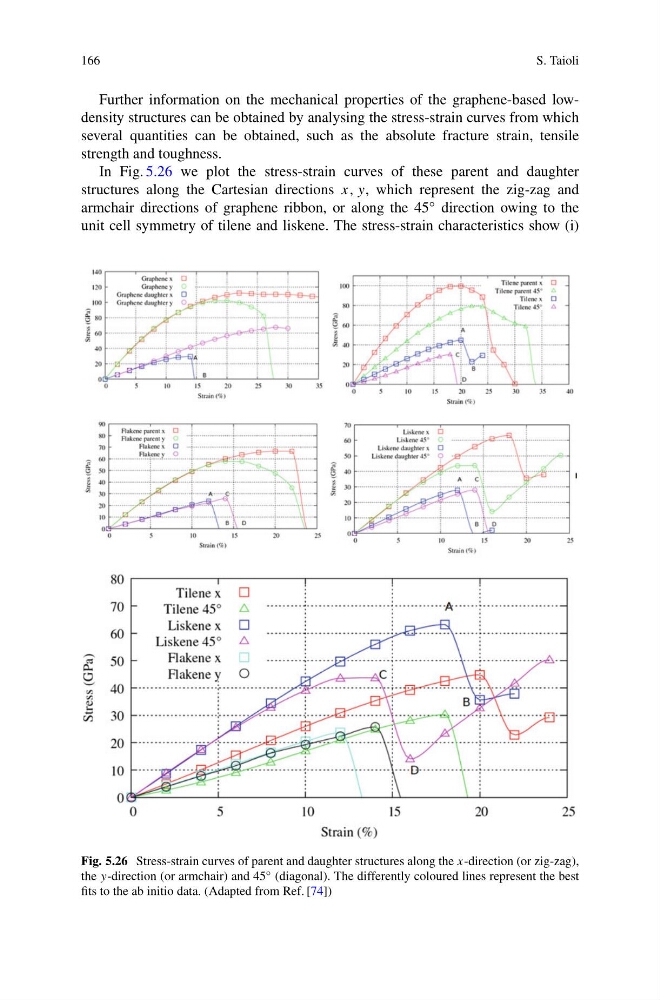
In Fig. 5.26 we plot the stress-strain curves of these parent and daughter
structures along the Cartesian directions x, y, which represent the zig-zag and
armchair directions of graphene ribbon, or along the 45 ◦ direction owing to the
unit cell symmetry of tilene and liskene. The stress-strain characteristics show (i)
Fig. 5.26 Stress-strain curves of parent and daughter structures along the x-direction (or zig-zag),
the y-direction (or armchair) and 45 ◦ (diagonal). The differently coloured lines represent the best
fits to the ab initio data. (Adapted from Ref. [74])
S. Taioli
Further information on the mechanical properties of the graphene-based lowdensity structures can be obtained by analysing the stress-strain curves from which
several quantities can be obtained, such as the absolute fracture strain, tensile
strength and toughness.
In Fig. 5.26 we plot the stress-strain curves of these parent and daughter
structures along the Cartesian directions x, y, which represent the zig-zag and
armchair directions of graphene ribbon, or along the 45 ◦ direction owing to the
unit cell symmetry of tilene and liskene. The stress-strain characteristics show (i)
Fig. 5.26 Stress-strain curves of parent and daughter structures along the x-direction (or zig-zag),
the y-direction (or armchair) and 45 ◦ (diagonal). The differently coloured lines represent the best
fits to the ab initio data. (Adapted from Ref. [74])