

5 Enabling Materials By Dimensionality: From 0D to 3D Carbon-Based. . .
159
5.3.1.4 Liskene
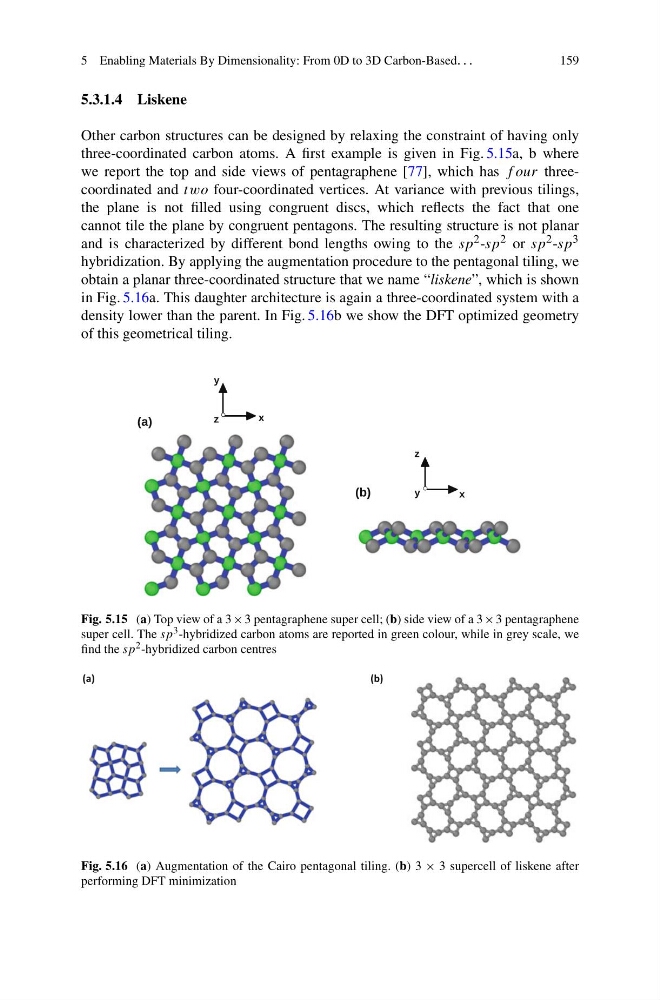
Other carbon structures can be designed by relaxing the constraint of having only
three-coordinated carbon atoms. A first example is given in Fig. 5.15a, b where
we report the top and side views of pentagraphene [77], which has f our threecoordinated and two four-coordinated vertices. At variance with previous tilings,
the plane is not filled using congruent discs, which reflects the fact that one
cannot tile the plane by congruent pentagons. The resulting structure is not planar
and is characterized by different bond lengths owing to the sp 2 -sp 2 or sp 2 -sp 3
hybridization. By applying the augmentation procedure to the pentagonal tiling, we
obtain a planar three-coordinated structure that we name “liskene”, which is shown
in Fig. 5.16a. This daughter architecture is again a three-coordinated system with a
density lower than the parent. In Fig. 5.16b we show the DFT optimized geometry
of this geometrical tiling.
Fig. 5.15 (a) Top view of a 3 × 3 pentagraphene super cell; (b) side view of a 3 × 3 pentagraphene
super cell. The sp 3 -hybridized carbon atoms are reported in green colour, while in grey scale, we
find the sp 2 -hybridized carbon centres
Fig. 5.16 (a) Augmentation of the Cairo pentagonal tiling. (b) 3 × 3 supercell of liskene after
performing DFT minimization
159
5.3.1.4 Liskene
Other carbon structures can be designed by relaxing the constraint of having only
three-coordinated carbon atoms. A first example is given in Fig. 5.15a, b where
we report the top and side views of pentagraphene [77], which has f our threecoordinated and two four-coordinated vertices. At variance with previous tilings,
the plane is not filled using congruent discs, which reflects the fact that one
cannot tile the plane by congruent pentagons. The resulting structure is not planar
and is characterized by different bond lengths owing to the sp 2 -sp 2 or sp 2 -sp 3
hybridization. By applying the augmentation procedure to the pentagonal tiling, we
obtain a planar three-coordinated structure that we name “liskene”, which is shown
in Fig. 5.16a. This daughter architecture is again a three-coordinated system with a
density lower than the parent. In Fig. 5.16b we show the DFT optimized geometry
of this geometrical tiling.
Fig. 5.15 (a) Top view of a 3 × 3 pentagraphene super cell; (b) side view of a 3 × 3 pentagraphene
super cell. The sp 3 -hybridized carbon atoms are reported in green colour, while in grey scale, we
find the sp 2 -hybridized carbon centres
Fig. 5.16 (a) Augmentation of the Cairo pentagonal tiling. (b) 3 × 3 supercell of liskene after
performing DFT minimization