

160
S. Taioli
5.3.2 Electronic Properties of 2D All-Carbon-Based Materials
Here we discuss the electronic band structure and the stress-strain characteristics of
the father and daughter structures obtained by the space tiling and augmentation
procedures previously introduced. Further details on computer simulations and
methods can be found in Ref. [74].
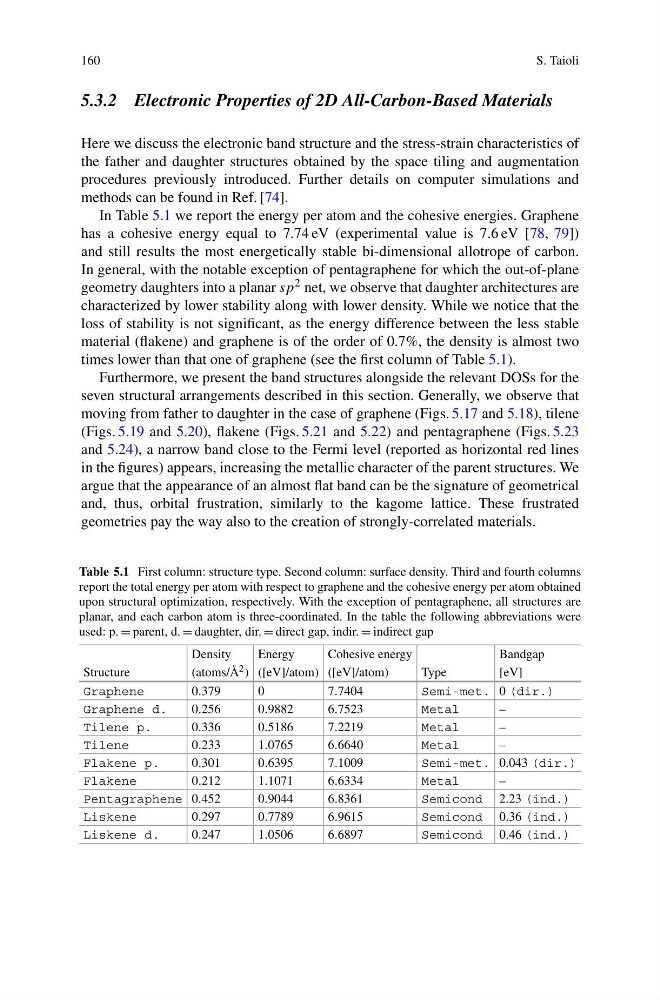
In Table 5.1 we report the energy per atom and the cohesive energies. Graphene
has a cohesive energy equal to 7.74 eV (experimental value is 7.6 eV [78, 79])
and still results the most energetically stable bi-dimensional allotrope of carbon.
In general, with the notable exception of pentagraphene for which the out-of-plane
geometry daughters into a planar sp 2 net, we observe that daughter architectures are
characterized by lower stability along with lower density. While we notice that the
loss of stability is not significant, as the energy difference between the less stable
material (flakene) and graphene is of the order of 0.7%, the density is almost two
times lower than that one of graphene (see the first column of Table 5.1).
Furthermore, we present the band structures alongside the relevant DOSs for the
seven structural arrangements described in this section. Generally, we observe that
moving from father to daughter in the case of graphene (Figs. 5.17 and 5.18), tilene
(Figs. 5.19 and 5.20), flakene (Figs. 5.21 and 5.22) and pentagraphene (Figs. 5.23
and 5.24), a narrow band close to the Fermi level (reported as horizontal red lines
in the figures) appears, increasing the metallic character of the parent structures. We
argue that the appearance of an almost flat band can be the signature of geometrical
and, thus, orbital frustration, similarly to the kagome lattice. These frustrated
geometries pay the way also to the creation of strongly-correlated materials.
Table 5.1 First column: structure type. Second column: surface density. Third and fourth columns
report the total energy per atom with respect to graphene and the cohesive energy per atom obtained
upon structural optimization, respectively. With the exception of pentagraphene, all structures are
planar, and each carbon atom is three-coordinated. In the table the following abbreviations were
used: p. = parent, d. = daughter, dir. = direct gap, indir. = indirect gap
Density
Energy
Cohesive energy
Bandgap
Structure
(atoms/Å 2 ) ([eV]/atom) ([eV]/atom)
Type
[eV]
Graphene
0.379
0
7.7404
Semi-met. 0 (dir.)
Graphene d.
0.256
0.9882
6.7523
Metal
–
Tilene p.
0.336
0.5186
7.2219
Metal
–
Tilene
0.233
1.0765
6.6640
Metal
–
Flakene p.
0.301
0.6395
7.1009
Semi-met. 0.043 (dir.)
Flakene
0.212
1.1071
6.6334
Metal
–
Pentagraphene 0.452
0.9044
6.8361
Semicond 2.23 (ind.)
Liskene
0.297
0.7789
6.9615
Semicond 0.36 (ind.)
Liskene d.
0.247
1.0506
6.6897
Semicond 0.46 (ind.)
S. Taioli
5.3.2 Electronic Properties of 2D All-Carbon-Based Materials
Here we discuss the electronic band structure and the stress-strain characteristics of
the father and daughter structures obtained by the space tiling and augmentation
procedures previously introduced. Further details on computer simulations and
methods can be found in Ref. [74].
In Table 5.1 we report the energy per atom and the cohesive energies. Graphene
has a cohesive energy equal to 7.74 eV (experimental value is 7.6 eV [78, 79])
and still results the most energetically stable bi-dimensional allotrope of carbon.
In general, with the notable exception of pentagraphene for which the out-of-plane
geometry daughters into a planar sp 2 net, we observe that daughter architectures are
characterized by lower stability along with lower density. While we notice that the
loss of stability is not significant, as the energy difference between the less stable
material (flakene) and graphene is of the order of 0.7%, the density is almost two
times lower than that one of graphene (see the first column of Table 5.1).
Furthermore, we present the band structures alongside the relevant DOSs for the
seven structural arrangements described in this section. Generally, we observe that
moving from father to daughter in the case of graphene (Figs. 5.17 and 5.18), tilene
(Figs. 5.19 and 5.20), flakene (Figs. 5.21 and 5.22) and pentagraphene (Figs. 5.23
and 5.24), a narrow band close to the Fermi level (reported as horizontal red lines
in the figures) appears, increasing the metallic character of the parent structures. We
argue that the appearance of an almost flat band can be the signature of geometrical
and, thus, orbital frustration, similarly to the kagome lattice. These frustrated
geometries pay the way also to the creation of strongly-correlated materials.
Table 5.1 First column: structure type. Second column: surface density. Third and fourth columns
report the total energy per atom with respect to graphene and the cohesive energy per atom obtained
upon structural optimization, respectively. With the exception of pentagraphene, all structures are
planar, and each carbon atom is three-coordinated. In the table the following abbreviations were
used: p. = parent, d. = daughter, dir. = direct gap, indir. = indirect gap
Density
Energy
Cohesive energy
Bandgap
Structure
(atoms/Å 2 ) ([eV]/atom) ([eV]/atom)
Type
[eV]
Graphene
0.379
0
7.7404
Semi-met. 0 (dir.)
Graphene d.
0.256
0.9882
6.7523
Metal
–
Tilene p.
0.336
0.5186
7.2219
Metal
–
Tilene
0.233
1.0765
6.6640
Metal
–
Flakene p.
0.301
0.6395
7.1009
Semi-met. 0.043 (dir.)
Flakene
0.212
1.1071
6.6334
Metal
–
Pentagraphene 0.452
0.9044
6.8361
Semicond 2.23 (ind.)
Liskene
0.297
0.7789
6.9615
Semicond 0.36 (ind.)
Liskene d.
0.247
1.0506
6.6897
Semicond 0.46 (ind.)