

158
S. Taioli
corresponding net of carbon atoms of “tilene parent” (octagraphene in [76]). Its
packing factor is lower than graphene and equal to π(3 − 2
√
2) ∼ 0.539012. Its
augmentation, carried out under the constraints discussed in Sect. 5.3.1, leads to the
lesser dense packing equal to 3π/(2 +
√
2 +
√
3) 2 ∼ 0.355866 shown in the right
panel of Fig. 5.13a. The resulting structure, called “tilene”, is reported in the right
panel of Fig. 5.13b.
5.3.1.3 Flakene Parent and Flakene
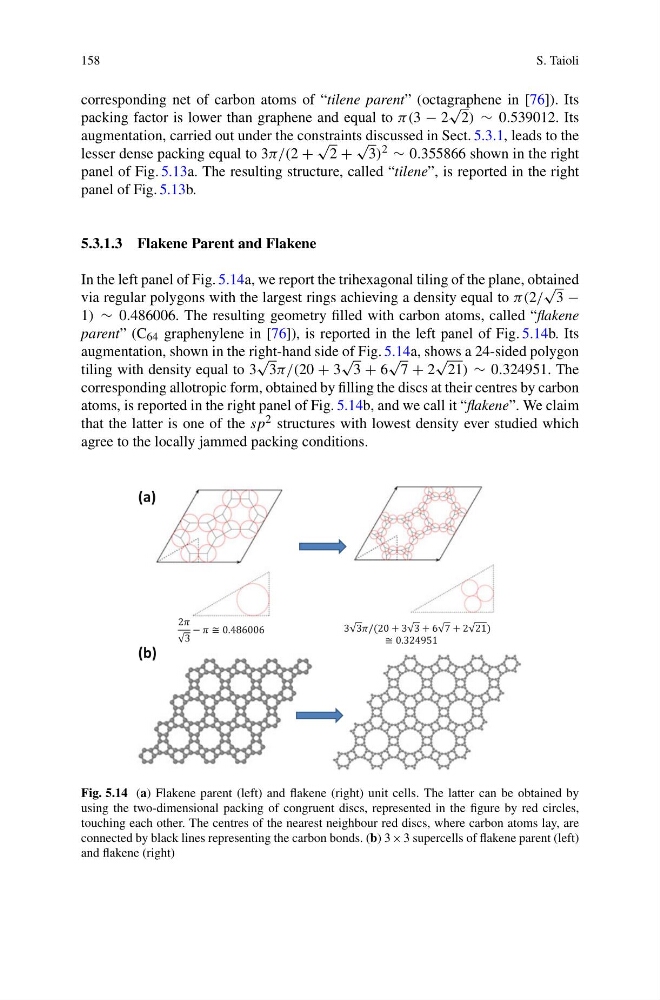
In the left panel of Fig. 5.14a, we report the trihexagonal tiling of the plane, obtained
via regular polygons with the largest rings achieving a density equal to π(2/
√
3 −
1) ∼ 0.486006. The resulting geometry filled with carbon atoms, called “flakene
parent” (C 64 graphenylene in [76]), is reported in the left panel of Fig. 5.14b. Its
augmentation, shown in the right-hand side of Fig. 5.14a, shows a 24-sided polygon
tiling with density equal to 3
√
3π/(20 + 3
√
3 + 6
√
7 + 2
√
21) ∼ 0.324951. The
corresponding allotropic form, obtained by filling the discs at their centres by carbon
atoms, is reported in the right panel of Fig. 5.14b, and we call it “flakene”. We claim
that the latter is one of the sp 2 structures with lowest density ever studied which
agree to the locally jammed packing conditions.
Fig. 5.14 (a) Flakene parent (left) and flakene (right) unit cells. The latter can be obtained by
using the two-dimensional packing of congruent discs, represented in the figure by red circles,
touching each other. The centres of the nearest neighbour red discs, where carbon atoms lay, are
connected by black lines representing the carbon bonds. (b) 3× 3 supercells of flakene parent (left)
and flakene (right)
S. Taioli
corresponding net of carbon atoms of “tilene parent” (octagraphene in [76]). Its
packing factor is lower than graphene and equal to π(3 − 2
√
2) ∼ 0.539012. Its
augmentation, carried out under the constraints discussed in Sect. 5.3.1, leads to the
lesser dense packing equal to 3π/(2 +
√
2 +
√
3) 2 ∼ 0.355866 shown in the right
panel of Fig. 5.13a. The resulting structure, called “tilene”, is reported in the right
panel of Fig. 5.13b.
5.3.1.3 Flakene Parent and Flakene
In the left panel of Fig. 5.14a, we report the trihexagonal tiling of the plane, obtained
via regular polygons with the largest rings achieving a density equal to π(2/
√
3 −
1) ∼ 0.486006. The resulting geometry filled with carbon atoms, called “flakene
parent” (C 64 graphenylene in [76]), is reported in the left panel of Fig. 5.14b. Its
augmentation, shown in the right-hand side of Fig. 5.14a, shows a 24-sided polygon
tiling with density equal to 3
√
3π/(20 + 3
√
3 + 6
√
7 + 2
√
21) ∼ 0.324951. The
corresponding allotropic form, obtained by filling the discs at their centres by carbon
atoms, is reported in the right panel of Fig. 5.14b, and we call it “flakene”. We claim
that the latter is one of the sp 2 structures with lowest density ever studied which
agree to the locally jammed packing conditions.
Fig. 5.14 (a) Flakene parent (left) and flakene (right) unit cells. The latter can be obtained by
using the two-dimensional packing of congruent discs, represented in the figure by red circles,
touching each other. The centres of the nearest neighbour red discs, where carbon atoms lay, are
connected by black lines representing the carbon bonds. (b) 3× 3 supercells of flakene parent (left)
and flakene (right)